Samrudha Krushak Yojana 2026: Odisha Paddy Price, Registration & Payment
Read in another language:
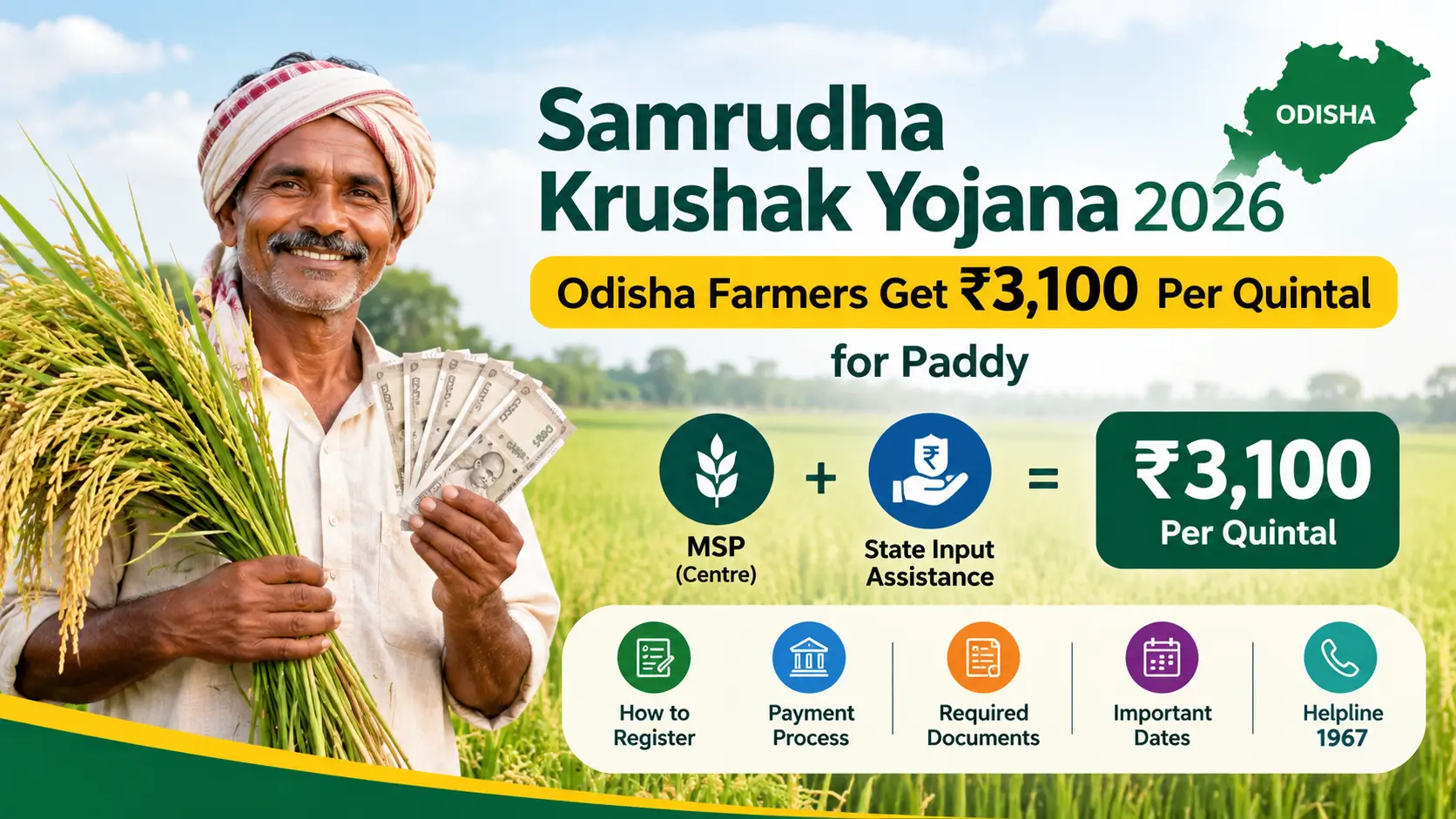
Odisha’s Samrudha Krushak Yojana aims to improve the price farmers receive for paddy sold through the state’s government procurement system. Under the scheme, the state has promised a total price of ₹3,100 per quintal, combining the Centre’s Minimum Support Price (MSP) with state input assistance.
For the 2026–27 Kharif marketing season, the Centre has fixed the MSP at ₹2,441 per quintal for common paddy and ₹2,461 for Grade A paddy. The state assistance component should be checked against the applicable Odisha procurement order before relying on a specific amount.
This guide explains how the scheme works, the farmer registration process, documents required, payment problems and the official sources farmers should check before visiting their local procurement society.
Important: The registration dates listed in the published 2026–27 schedule have already passed. Contact your PACS, LAMPCS or Pani Panchayat to confirm whether late registration, corrections or any revised arrangements are available in your area.
Samrudha Krushak Yojana 2026: Overview
| Detail | Information |
|---|---|
| Scheme name | Samrudha Krushak Yojana |
| State | Odisha |
| Main purpose | Improve the price received for paddy sold through government procurement |
| Announced price | ₹3,100 per quintal, subject to applicable procurement rules |
| Central MSP for common paddy, 2026–27 | ₹2,441 per quintal |
| Central MSP for Grade A paddy, 2026–27 | ₹2,461 per quintal |
| Registration channel | PACS, LAMPCS or Pani Panchayat, as applicable |
| Payment method | Bank transfer, subject to applicable verification and payment rules |
| Procurement information | Food Supplies and Consumer Welfare Department, Odisha |
| Helpline | 1967; confirm current availability and the appropriate service |
What Is Samrudha Krushak Yojana?
Samruddha Krushak Yojana is an Odisha government initiative intended to improve farmers’ returns from paddy procurement. Rather than relying only on the Minimum Support Price announced by the Central Government, Odisha has committed additional input assistance to achieve a stated total price of ₹3,100 per quintal.
The scheme is connected to the state’s paddy procurement system. Farmers must satisfy the applicable registration, cultivation, verification and procurement conditions to sell paddy through authorised channels.
The Odisha government’s Agriculture and Farmers’ Empowerment Department lists Samrudha Krushak Yojana among its agricultural schemes. Farmers can consult the department’s official scheme page for supporting documents and updates.
Is Samrudha Krushak Yojana a separate cash benefit?
No, it should not be confused with a flat annual cash transfer such as CM-KISAN or PM-KISAN. The benefit discussed here is linked to paddy procurement and the applicable price and input assistance.
Farmers should not assume that registering for CM-KISAN or PM-KISAN automatically completes their paddy procurement registration.
How Much Does Odisha Pay for Paddy in 2026–27?
The announced total price under Samrudha Krushak Yojana is ₹3,100 per quintal. However, the Central Government sets the MSP, while the state determines the applicable input assistance under its scheme and procurement arrangements.
According to the Government of India’s 2026–27 Kharif MSP announcement, the MSP rates are as follows.
| Paddy grade | Central MSP per quintal |
|---|---|
| Common paddy | ₹2,441 |
| Grade A paddy | ₹2,461 |
The difference between the announced total price and the MSP can be calculated as follows:
| Calculation | Amount |
|---|---|
| Announced total price | ₹3,100 |
| Less: common paddy MSP | ₹2,441 |
| Indicative difference | ₹659 |
Please note: ₹659 is an arithmetic difference for common paddy, not confirmation of a separately notified input assistance rate. Check the latest Odisha procurement order for the applicable grade, assistance amount and payment conditions.
Example: How much is 50 quintals worth?
If 50 quintals are accepted for procurement at an applicable total price of ₹3,100 per quintal, the gross amount would be:
50 × ₹3,100 = ₹1,55,000
This is an illustration, not a guarantee of payment. The actual amount depends on the accepted quantity, applicable grade and procurement rules.
Who Can Benefit From Samrudha Krushak Yojana?
The main beneficiaries are farmers registered to sell eligible paddy through Odisha’s authorised procurement system.
Eligibility and the quantity accepted for procurement depend on the applicable season’s rules and verification. Registration alone does not guarantee that every quantity claimed by a farmer will be purchased.
The scheme’s published framework also refers to eligible paddy seed growers registered with OSSOPCA who sell seed through the Odisha State Seeds Corporation. Such growers should confirm the specific conditions applicable to their category.
Before registering, check the following:
- Whether you are eligible to register as a cultivator or sharecropper.
- Whether your land and cultivated paddy area meet the applicable rules.
- Whether your bank and Aadhaar details are correct.
- Whether your registration has been verified and accepted.
- Whether your procurement token or sale authorisation has been issued, where required.
Odisha Paddy Registration 2026–27: How the Process Works
For Kharif Marketing Season 2026–27, the registration modalities published by the Food Supplies and Consumer Welfare Department describe a process involving farmer details, land records, bank information and verification.
The published schedule included registration from 6 August to 31 August 2026, followed by an extension to 7 September 2026. These dates are now in the past.
If you registered earlier, check your acknowledgement and registration status. If you missed the deadline, contact your local procurement society to ask whether any late-registration or correction facility is available. Do not assume that a new window has opened unless the department confirms it.
Step 1: Contact your procurement society
Visit your PACS, LAMPCS or Pani Panchayat, depending on the arrangements in your area. Ask for the current farmer registration procedure and whether your details are already recorded.
Step 2: Complete the required form
Provide accurate personal details, land information, cultivated paddy area and bank details. The department’s applicable modalities determine the information and supporting documents required.
Step 3: Submit your documents
Submit the required copies of your land records, Aadhaar and bank information, along with any additional documents relevant to your case.
Step 4: Complete identity verification
Follow the prescribed Aadhaar verification and e-KYC process. If an OTP or biometric check is required, make sure your registered mobile number and identity details are correct.
Step 5: Collect your acknowledgement
Keep the registration acknowledgement or receipt. It can help the society locate your application if a correction or status enquiry is needed.
Step 6: Wait for field verification
The relevant officials may verify land records, cultivated area and other details before approving the registration.
Step 7: Confirm procurement arrangements
Once your registration is accepted, ask the society about the procurement schedule, token, delivery instructions and any quality requirements that apply to your paddy.
Documents Required for Odisha Paddy Registration
The exact document list should be checked against the latest registration modalities and the requirements of your procurement society.
The documents commonly identified in the published 2026–27 procedure include:
- Aadhaar card.
- Record of Rights (RoR) or applicable land record.
- First page of the bank passbook for account verification.
- Aadhaar-linked mobile number, where required for authentication.
- Landowner’s consent letter for eligible sharecroppers.
- Electricity consumer number when claiming irrigation through a lift point or borewell, where required by the form.
Carry original documents when requested for verification. Do not submit false land details or pay an unauthorised agent for a form that the department provides free of charge.
Subhadra yojana
Odisha CM Kisan Yojana Beneficiary List 2026 (Kalia Yojana): How to Check Your Name and Payment Status
CM Kisan Odisha e KYC 2026: Online Process, Status Check, Common Problems and Latest Update
Odisha Approves ₹1,360 Crore Fund for Fertilizer and Seeds Supply
Odisha Farmer ID Card Download 2026: Agrisnet, Krushak and AgriStack Explained
Krushak Odisha Registration 2026: Online Apply, Status Check, Login & Beneficiary List @ krushak.odisha.gov.in
CM Kisan Yojana Status 2026: Check Online at cmkisan.odisha.gov.in Using Aadhaar or Token Number
Is AgriStack Farmer ID Mandatory?
The presence of an AgriStack Farmer ID field on a form does not, by itself, establish that the ID is compulsory.
The article’s earlier version refers to a clarification dated 10 August 2026 stating that AgriStack registration was not mandatory for Kharif 2026–27. Before relying on that claim, confirm the clarification against an official notice or the latest instructions issued by the Food Supplies Department.
If a registration centre refuses your application solely because you do not have a Farmer ID, ask for the applicable written rule or contact the department to clarify your position.
Can Sharecroppers Apply?
Sharecroppers, also known as bhag chasis, should check the specific registration provisions that apply to them.
The published procedure described in the earlier schedule refers to a landowner’s consent letter and identity verification for both parties. The society should confirm the current documentation and authentication requirements before the application is submitted.
If you cultivate someone else’s land, explain your arrangement clearly. Do not claim ownership of land that belongs to another person, and do not assume that every informal tenancy arrangement qualifies automatically.
Samrudha Krushak Yojana Payment Status: How to Check
There may not be a separate application or payment-status page exclusively for the state assistance component. Since the benefit is connected to paddy procurement, the procurement record and payment details are the appropriate starting points.
To investigate a delayed payment:
- Contact the society where you registered or delivered your paddy.
- Keep your registration acknowledgement and procurement receipt available.
- Ask whether the accepted quantity and payment entry have been recorded.
- Confirm that your bank account details are correct.
- Ask your bank to verify Aadhaar seeding and NPCI mapping if the applicable payment process requires them.
- If the issue remains unresolved, ask the procurement society or department for the appropriate grievance procedure.
For departmental information, visit Food Supplies and Consumer Welfare Department, Odisha (https://www.foododisha.in). The published helpline number is 1967; confirm the appropriate service and current availability before relying on it for a complaint.
Why can a paddy payment be delayed?
Common issues to investigate include:
- Incorrect bank account information.
- Incomplete identity verification.
- A mismatch between the registered farmer’s details and the procurement record.
- Pending land or cultivated-area verification.
- An error in the accepted quantity or payment entry.
- Bank-side processing or account-mapping problems.
These are troubleshooting possibilities, not confirmation of the reason for any individual farmer’s delay. Ask the society or bank to identify the specific issue.
Why Does Cultivated Area Matter?
A farmer’s registered area can affect the quantity of paddy accepted for procurement. The applicable system may use land records, reported cultivation, prescribed yield norms and verification to determine the eligible marketable surplus.
Register only land and crops that accurately reflect your cultivation. If the area recorded in the system is incorrect, ask the responsible office about the official correction process.
The original registration instructions also refer to land classification and irrigation details. Farmers should provide accurate information about their plots and irrigation arrangements rather than assume that every parcel of land is eligible for paddy procurement.
Samrudha Krushak Yojana vs CM-KISAN vs PM-KISAN
These schemes have different purposes and should not be treated as interchangeable.
| Scheme | Main benefit | How it differs |
|---|---|---|
| Samrudha Krushak Yojana | Announced ₹3,100 total price per quintal for eligible paddy procurement | Benefit is linked to paddy sold through the authorised procurement system |
| CM-KISAN | State agricultural income support under the applicable scheme rules | Separate from the price received for paddy |
| PM-KISAN | Central income support of ₹6,000 annually for eligible beneficiaries, subject to scheme rules | Separate from Odisha’s paddy procurement price |
KALIA is an earlier Odisha farmer-support scheme associated with the state’s agricultural assistance framework. For current beneficiary eligibility and payment questions, consult the official CM-KISAN portal (cmkisan.odisha.gov.in) rather than assuming that all historical KALIA provisions remain unchanged.
A farmer may qualify for more than one scheme if the relevant eligibility requirements are met. Receiving income support does not, by itself, establish eligibility for paddy procurement.
Common Mistakes Farmers Should Avoid
- Waiting for a separate Samrudha Krushak Yojana application without checking the paddy registration process.
- Assuming that a previous year’s registration automatically remains valid.
- Relying on an expired registration deadline without checking for a revised notice.
- Providing incorrect land, bank or Aadhaar details.
- Claiming a cultivated area that does not match the actual crop.
- Discarding the registration acknowledgement or procurement receipt.
- Assuming that ₹659 is a separately notified state assistance amount without checking the applicable order.
- Paying an unauthorised person to complete a free registration process.
Official Links for Samrudha Krushak Yojana
Use official sources wherever possible to verify registration conditions, MSP rates and payment rules.
- Food Supplies and Consumer Welfare Department, Odisha: https://www.foododisha.in
- Farmer Registration Modalities 2026–27: https://www.foododisha.in/Download/Farmer-Registration-Modalities-2026-27.pdf
- Agriculture and Farmers’ Empowerment Department, Odisha: agri.odisha.gov.in/en/schemes-agriculture/agriculture
- Government of India’s Kharif MSP announcement: https://www.pib.gov.in/PressReleasePage.aspx?PRID=2260618&lang=1®=3
- CM-KISAN portal: cmkisan.odisha.gov.in
- Krushak Odisha portal: krushak.odisha.gov.in
For a registration or payment complaint, contact your local procurement society first and ask for the appropriate departmental grievance channel. The published Food Supplies helpline is 1967; verify current availability.
Banishree Scholarship 2026-27: Eligibility, Amount, Last Date and How to Apply
Education scholarships
Frequently Asked Questions
1. What is Samrudha Krushak Yojana 2026?
It is an Odisha government initiative designed to improve the price received by eligible farmers selling paddy through the state’s procurement system. The announced total price is ₹3,100 per quintal, combining MSP and state input assistance.
2. What is the paddy MSP in Odisha for 2026–27?
The Central Government’s MSP is ₹2,441 per quintal for common paddy and ₹2,461 for Grade A paddy. Odisha’s announced total price under the scheme is ₹3,100 per quintal, subject to the applicable state procurement rules.
3. How much state assistance will farmers receive per quintal?
For common paddy, subtracting the ₹2,441 central MSP from the announced ₹3,100 total gives an indicative difference of ₹659. The exact state assistance should be confirmed from the applicable Odisha order.
4. Is a separate Samrudha Krushak Yojana form required?
The benefit is connected to paddy procurement registration rather than a separate general cash-benefit application. Contact your procurement society for the relevant registration procedure and eligibility conditions.
5. What was the Kharif 2026–27 registration deadline?
The published schedule listed 31 August 2026 as the original deadline and 7 September 2026 as the extended deadline. Both dates have passed. Ask your PACS or the department whether any later registration or correction window is available.
6. How can I check a delayed paddy payment?
Contact your procurement society with your acknowledgement and procurement receipt. Ask it to verify the accepted quantity, payment entry and bank details. Your bank can help investigate account-related issues.
7. Can sharecroppers register?
Sharecroppers should check the applicable registration conditions with their procurement society. The earlier published procedure refers to a landowner’s consent and identity verification requirements.
8. Is AgriStack Farmer ID compulsory?
Check the latest official registration instructions before relying on older guidance. The existence of a Farmer ID field alone does not prove that the ID is compulsory.
9. What is the difference between Samrudha Krushak Yojana and CM-KISAN?
Samrudha Krushak Yojana is linked to the price received for eligible paddy procurement. CM-KISAN provides agricultural income support under separate eligibility rules.
10. Which helpline should farmers contact?
The Food Supplies Department’s published toll-free number is 1967. Confirm current availability and the appropriate complaint channel through the department’s official website.
Final Words
Samrudha Krushak Yojana is important for Odisha farmers who sell paddy through government procurement. However, understanding the announced price is only one part of the process. Registration, land verification, accepted quantity and payment records also matter.
Before taking action, check the latest procurement instructions, keep your documents safe and contact your local society if your registration or payment is unclear. For the most reliable information, use the official Odisha department and Government of India links provided above.
Disclaimer: Subhadra-yojanain.com is an independent information website and is not affiliated with the Government of Odisha. Scheme conditions, procurement schedules and payment procedures can change. Confirm the latest rules with the relevant department or procurement society before acting.