Harishchandra Sahayata Yojana Odisha 2026: Amount, Eligibility, Documents and How to Get Assistance
Read in another language:
When a family loses someone, arranging money for the last rites can become an immediate problem. For poor and dHarishchandra Sahayata Yojana Odisha 2026: Amount, Eligibility, Documents and How to Get Assistanceestitute families in Odisha, the Harishchandra Sahayata Yojana (HSY) provides financial assistance to help cover these expenses.
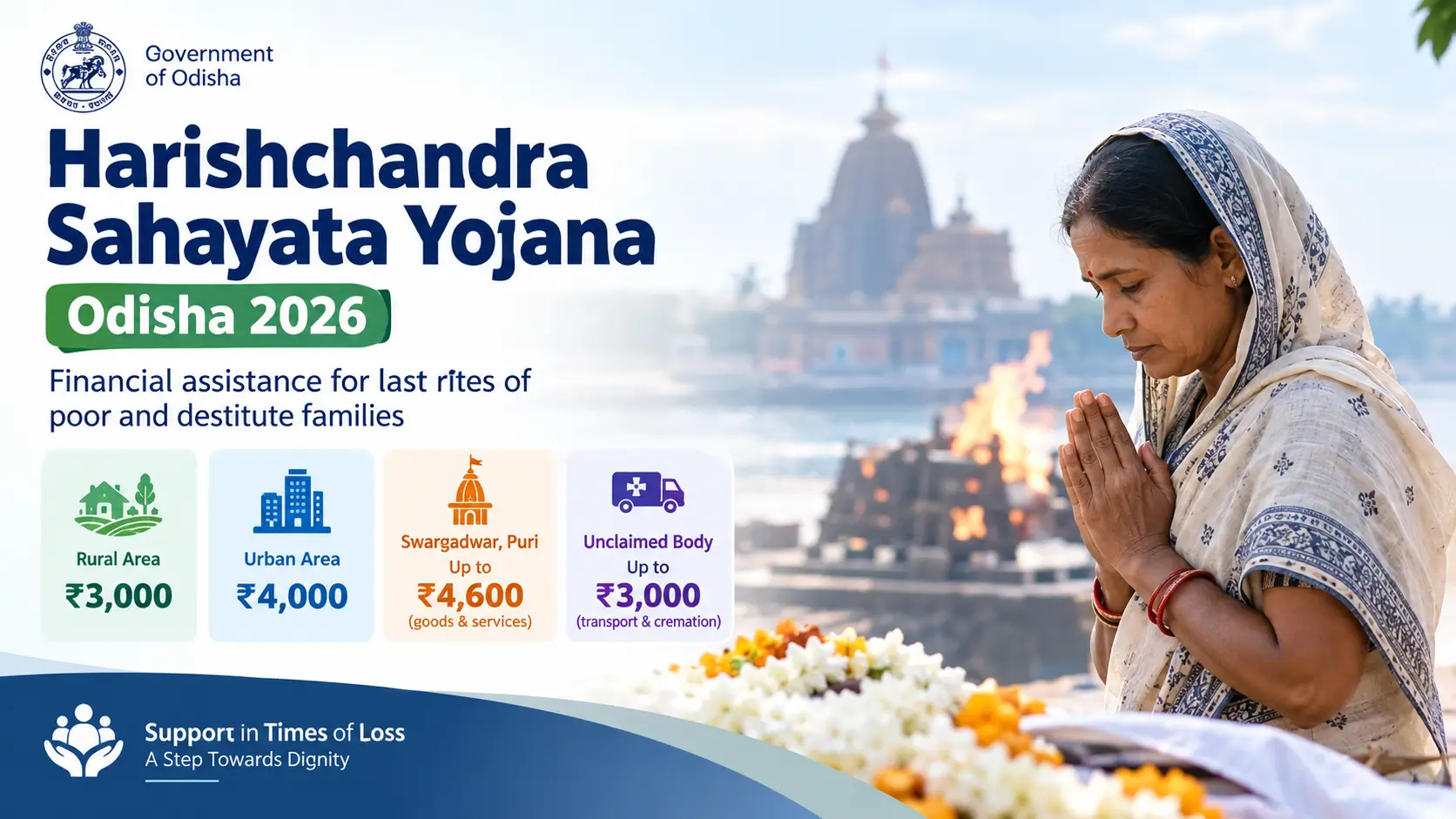
The scheme operates under the Chief Minister’s Relief Fund (CMRF), Odisha. Under the official guidelines, eligible families can receive ₹3,000 in rural areas and ₹4,000 in urban areas. At Swargadwar in Puri, assistance has increased to ₹4,600 from 7 April 2026.
One important detail is how the assistance reaches the family. In the standard rural and urban process, the local authority sanctions the assistance, and the money is intended to be paid in cash on the date of death. Officials subsequently claim reimbursement through the CMRF portal.
This guide explains the latest assistance amounts, eligibility conditions, required documents, application procedure, beneficiary list and steps to take if assistance is delayed.
Harishchandra Sahayata Yojana 2026: Overview
| Detail | Information |
|---|---|
| Scheme name | Harishchandra Sahayata Yojana (HSY) |
| State | Odisha |
| Implementing department | General Administration & Public Grievance Department, through CMRF |
| Purpose | Financial assistance for last rites of eligible deceased persons |
| Rural assistance | ₹3,000 |
| Urban assistance | ₹4,000 |
| Swargadwar, Puri | Up to ₹4,600 in goods and services |
| Unclaimed bodies | Up to ₹3,000 per body for transport and cremation |
| Rural sanctioning authority | Sarpanch |
| Urban sanctioning authority | Chairperson or Mayor, as applicable |
| Official website | cmrfodisha.gov.in |
The amounts and procedures above are based on the official CMRF guidelines (cmrfodisha.gov.in/sites/default/files/misc/CMRF_GUIDELINES_2026.pdf).
What Is Harishchandra Sahayata Yojana?
Harishchandra Sahayata Yojana is an Odisha government assistance scheme for the next of kin of poor and destitute people who have died. Its purpose is to help eligible families perform the last rites of the deceased with dignity.
The scheme also provides for the transportation and cremation of unclaimed dead bodies through an administrative process involving the police, the Sub-Collector and designated NGOs.
The scheme operates through Gram Panchayats and Urban Local Bodies (ULBs). For eligible rural and urban families, the local authority assesses the case and sanctions assistance under the prescribed guidelines.
The government also maintains an online system for processing reimbursements and publishing beneficiary information.
Harishchandra Sahayata Yojana Amount in 2026
The assistance amount depends on where the last rites take place and whether the case concerns an unclaimed body.
| Type of case | Assistance amount | Authority or arrangement |
|---|---|---|
| Rural area | ₹3,000 | Sarpanch |
| Urban area | ₹4,000 | Chairperson or Mayor |
| Swargadwar, Puri | Up to ₹4,600 | Swargadwar Seva Samiti |
| Unclaimed dead body | Up to ₹3,000 | Sub-Collector |
Why do some websites still show ₹2,000 and ₹3,000?
Older websites may display the previous assistance rates of ₹2,000 for rural areas and ₹3,000 for urban areas.
The government revised the rural amount to ₹3,000 and the urban amount to ₹4,000 in March 2023. It subsequently increased the Swargadwar, Puri limit from ₹4,000 to ₹4,600 with effect from 7 April 2026.
Who Is Eligible for Harishchandra Sahayata Yojana?
The scheme is intended for poor and destitute families that need assistance with the last rites of a deceased family member.
The official guidelines specify five exclusion conditions. A family is ordinarily ineligible if:
- Any family member owns a four-wheeler mechanised vehicle.
- Any family member is a government servant.
- Any family member receives an honorarium from the government.
- The family has joint Record of Rights (ROR) land exceeding five acres.
- Any family member is an income tax assessee.
Can NFSA or SFSS ration cardholders receive assistance?
Yes. The guidelines specifically state that a deceased person’s family covered under either of the following is eligible for HSY assistance:
- National Food Security Act, 2013 (NFSA)
- State Food Security Scheme, 2018 (SFSS)
This provision is particularly useful for families that already receive food security benefits.
However, a ration card should not be treated as a substitute for checking the prescribed declaration and local authority’s requirements. If your family is covered under NFSA or SFSS, mention this when approaching the Sarpanch or the relevant urban authority.
Official reference: CMRF Odisha Guidelines 2026.
How to Apply for Harishchandra Sahayata Yojana
For standard rural and urban cases, the official guidelines describe a process in which the local authority sanctions assistance and officials submit the reimbursement request online afterwards. Families should not assume that they must personally upload an income certificate and wait for a bank transfer.
Step 1: Contact the local authority
If the deceased lived in a rural area, contact the village Sarpanch or Gram Panchayat.
For an urban case, contact the relevant municipal office and ask for the officer responsible for Harishchandra Sahayata Yojana.
Explain that your family needs assistance under HSY and ask how the case will be processed under the current local procedure.
Step 2: Complete the prescribed declaration
The official guidelines provide a declaration form in Annexure A. The recipient must declare that the applicable exclusion conditions do not apply or that the family is covered under NFSA or SFSS, as appropriate.
The declaration includes the recipient’s signature, two witnesses and a countersignature by the Sarpanch, Chairperson or Mayor.
Make sure the information is accurate before signing.
Step 3: Provide the required Aadhaar copies
For the standard rural and urban procedure, Annexure A specifies copies of:
- The deceased person’s Aadhaar card.
- The recipient’s Aadhaar card.
Keep the recipient’s mobile number available as well, because the guidelines provide for an SMS after reimbursement is processed.
Step 4: Receive the assistance
Under the standard procedure, the Sarpanch, Chairperson or Mayor is responsible for providing the sanctioned amount in cash on the date of death, subject to eligibility and the prescribed process.
Gram Panchayats maintain an HSY revolving fund for immediate assistance. The urban arrangement uses funds available to the relevant local body.
Step 5: Allow the officials to complete reimbursement
After the assistance is paid, the local authority submits the reimbursement request through the CMRF portal.
The request then goes through verification and authentication by the designated officials. The family does not ordinarily need to complete this reimbursement workflow itself.
Important: Some local authorities may provide additional online service options. If your local office directs you to an official application facility, confirm that it applies to your particular area and case before submitting information.
Documents Required for Harishchandra Sahayata Yojana
For the standard rural and urban process, the official declaration in Annexure A identifies the following documents:
| Document | Purpose |
|---|---|
| Deceased person’s Aadhaar copy | Identification of the deceased |
| Recipient’s Aadhaar copy | Identification of the person receiving assistance |
| Prescribed declaration | Confirms eligibility conditions or NFSA/SFSS coverage |
The standard declaration does not list an income certificate, bank passbook or death certificate as mandatory attachments.
However, this does not mean that every local office will handle every case without any additional verification. Ask the responsible authority whether any additional information is needed for your particular case.
It is sensible to keep other available records, including death-related documents and ration card details, accessible if the office requests them. Do not delay contacting the local authority while waiting to collect documents that the standard declaration does not specify.
How Does the HSY Payment Reach the Family?
The reimbursement procedure explains why the scheme is designed to provide assistance quickly.
The ₹15,000 revolving fund
Every Gram Panchayat is required to maintain a ₹15,000 revolving fund in its HSY account. This money allows the Sarpanch to provide eligible beneficiaries with immediate assistance before the Panchayat receives reimbursement.
The official reimbursement process
The process for standard rural and urban cases works as follows:
- The Sarpanch, Chairperson or Mayor submits the online reimbursement request within 15 days of the death.
- A designated middle-level officer, such as a GPEO or Extension Officer, verifies the request.
- The BDO or Executive Officer authenticates the verified request using the official system and OTP procedure.
- The reimbursement is transferred from the state CMRF account to the mapped Panchayat or urban local body account.
- An SMS is sent to the beneficiary family’s mobile number after reimbursement.
- HSY beneficiary information is made available through the CMRF website.
The guidelines specify a 15-day period for the initial submission and another 15-day period for authentication and payment at the next stage. These are administrative timelines, not a guarantee that every case will be completed without delay.
The key point for families is that the standard process is designed to provide the sanctioned assistance locally, rather than requiring the family to wait for the reimbursement to arrive in its own bank account.
Harishchandra Sahayata Yojana Beneficiary List: How to Check Online
The Odisha CMRF portal provides a dedicated page for checking Harischandra Sahayata Yojana beneficiary details.
You can use the official facility here:
Check HSY Beneficiary Details on the CMRF Portal
Follow these steps:
- Open the official beneficiary details page.
- Enter the required start date and end date.
- Select the district.
- Enter or select the relevant block or municipality details.
- Choose the applicable Swargadwar option.
- Submit the search and review the results.
The portal’s available fields may change, so follow the instructions shown on the official page.
If you cannot find a record, do not immediately assume that your family has been rejected. Check the dates and local authority details again, then contact the Gram Panchayat or municipal office to confirm whether the case has been processed and the reimbursement recorded.
The portal may not display a case immediately after the initial assistance is provided because the online record is linked to the administrative processing.
Special Assistance at Swargadwar, Puri
Harishchandra Sahayata Yojana operates differently at Swargadwar, Puri.
Instead of receiving cash, eligible families can receive goods and services worth up to ₹4,600 for performing the last rites.
How to receive assistance at Swargadwar
- A near relative of the deceased approaches the Swargadwar counter.
- The relative registers the deceased person’s details.
- The authorised staff provide the prescribed application form.
- The family submits the completed form, declaration and required information.
- The staff issue an acknowledgement and tokens for collecting the covered items and services.
The assistance can include firewood, puja materials and other specified funeral supplies, along with applicable Pujari and fireman charges.
The Swargadwar Seva Kendra counter is intended to operate around the clock in shifts.
The same general eligibility exclusions apply, along with an additional restriction: a family that has already received HSY assistance through a Panchayat or Urban Local Body for the same death cannot claim the Swargadwar benefit again for that case.
NFSA and SFSS coverage is also recognised under the guidelines.
For the exact process, consult the official CMRF guidelines.
Assistance for Unclaimed Dead Bodies
HSY also covers the transportation and cremation of unclaimed dead bodies registered by the police.
This is an administrative process rather than a normal family application.
- The police complete the necessary legal formalities and register the body.
- The Superintendent of Police identifies suitable NGOs to carry out the cremation.
- The Sub-Collector sanctions the actual transportation and cremation cost, up to ₹3,000 per body.
- The cremation follows the person’s known religious customs, where applicable.
- The NGO submits its bill, the police station countersigns it, and the Sub-Collector arranges payment by electronic transfer.
The ₹3,000 limit applies to the unclaimed-body procedure and should not be confused with the standard assistance for a rural or urban family.
What to Do If Your HSY Assistance Is Delayed or Refused
If your case is delayed, first establish whether the local authority has received and processed the request.
1. Contact the Sarpanch or municipal office
Ask whether your declaration and identification documents have been accepted and whether the assistance has been sanctioned.
If the request is refused, ask for the reason and which eligibility condition was applied.
2. Approach the BDO or Executive Officer
For a Panchayat case, contact the Block Development Officer (BDO). For an urban case, contact the relevant Executive Officer or municipal authority.
These officials are involved in verifying or authenticating reimbursement requests under the standard process.
3. Escalate the matter to the district administration
If the issue remains unresolved, approach the Collector’s office or the district officer responsible for monitoring HSY. Explain what happened, when you contacted the local authority and what response you received.
4. Keep your records
Retain copies of the declaration, Aadhaar documents submitted, any acknowledgement, relevant dates and the names or designations of officials you contacted.
The official guidelines provide for district-level monitoring and review of the scheme.
The CMRF portal lists contact information for its office, including the Officer on Special Duty at Lokseva Bhawan, Bhubaneswar. You can check the latest details on the official CMRF website.
Do not pay an agent or middleman to obtain HSY assistance. The scheme is government assistance, and you should verify any claimed processing fee directly with the responsible authority.
Harishchandra Sahayata Yojana: Common Misunderstandings
| Common misunderstanding | What the official guidelines indicate |
|---|---|
| Rural assistance is still ₹2,000 | The current rural amount is ₹3,000 |
| Urban assistance is ₹3,000 | The current urban amount is ₹4,000 |
| Swargadwar assistance is always ₹4,000 | The limit increased to ₹4,600 from 7 April 2026 |
| Every family must upload an income certificate online | The standard declaration specifies eligibility statements and Aadhaar copies |
| The family must wait for a bank transfer | Standard rural and urban assistance is intended to be paid in cash by the local authority |
| A ration card is the only eligibility test | The guidelines specify five exclusions and separately recognise NFSA/SFSS coverage |
| Swargadwar pays the assistance in cash | The Swargadwar benefit is provided as goods and services |
| Families process the Panchayat’s reimbursement themselves | Officials handle the standard reimbursement workflow |
Mahaprayan Hearse Service: Separate Help for Transportation
Harishchandra Sahayata Yojana provides assistance for last rites, but families may also need help transporting a body from a government hospital.
Odisha has a separate initiative called Mahaprayan, which provides hearse services for transporting bodies from government hospitals to the family’s home.
If transportation is an immediate concern, ask the hospital administration about the availability of this service. Do not assume that HSY funeral assistance automatically covers transportation from every location.
Other Odisha Schemes You May Find Useful
Families looking for additional government support may also want to explore other schemes, depending on their circumstances.
- Subhadra Yojana — information about Odisha’s financial assistance scheme for eligible women.
- Odisha Pashupalan Yojana — information for people researching livestock-related support.
- Odisha State Post-Matric Scholarship — scholarship information for eligible students.
- Samrudha Krushak Yojana 2026
- Banishree Scholarship 2026-27: Eligibility, Amount, Last Date and How to Apply
Check each scheme’s own eligibility rules before applying. Eligibility for HSY does not automatically establish eligibility for another programme.
Frequently Asked Questions
1. Is Harishchandra Sahayata Yojana active in Odisha in 2026?
The Odisha CMRF website continues to provide HSY information and beneficiary details. The official guidelines dated 7 April 2026 also confirm the updated Swargadwar assistance limit of ₹4,600.
2. What is the Harishchandra Sahayata Yojana amount in 2026?
Eligible families can receive ₹3,000 in rural areas and ₹4,000 in urban areas. At Swargadwar, Puri, assistance is available up to ₹4,600 in goods and services. The unclaimed-body provision allows up to ₹3,000 for transportation and cremation per body.
3. Can I apply online for Harishchandra Sahayata Yojana?
Under the standard rural and urban procedure in the CMRF guidelines, the local authority sanctions assistance and submits the reimbursement request online. Some local bodies may provide separate online service facilities, so check the process applicable to your location.
4. Which documents are required for HSY?
The standard rural and urban declaration specifies Aadhaar copies of the deceased and recipient, along with the prescribed eligibility declaration. Ask your local authority whether any additional information is needed for your case.
5. Is an income certificate compulsory?
An income certificate is not listed among the attachments specified in the standard HSY declaration in Annexure A. The family must still satisfy the scheme’s eligibility requirements and complete the prescribed declaration.
6. Is a ration card compulsory for Harishchandra Sahayata Yojana?
The guidelines do not make a ration card the only route to eligibility. However, families covered under NFSA or SFSS are specifically recognised as eligible. Confirm the documentation needed to establish that coverage with the local authority.
7. When is the money paid?
Under the standard rural and urban process, assistance is intended to be paid in cash on the date of death. Reimbursement is processed afterwards through the CMRF system.
8. How can I check the HSY beneficiary list?
Visit the official HSY Beneficiary Details page (cmrfodisha.gov.in/citizen/check-hsy-status.ph). Use the date range, district, block or municipality and other available filters to check the records.
9. Can a family claim assistance at both the Panchayat and Swargadwar?
No. The guidelines exclude a family that has already received HSY assistance through the Panchayat or Urban Local Body for the same death from receiving the Swargadwar benefit again for that case.
10. Who should I contact if my application is delayed?
Start with the Sarpanch or relevant municipal office. If the matter is not resolved, approach the BDO or Executive Officer and then the district administration.
Last updated: 22 October 2026. Scheme procedures and assistance amounts may change through government orders. Verify the latest instructions with the local authority or CMRF before acting.
Disclaimer: This is an independent information website and is not affiliated with the Government of Odisha. The article is for informational purposes and does not replace official government instructions. HSY assistance should not require payment to an agent or middleman.