Shree Anna Abhiyan Odisha 2026-27: Farmer Benefits, Eligibility, Ragi MSP and Latest Updates
Read in another language:
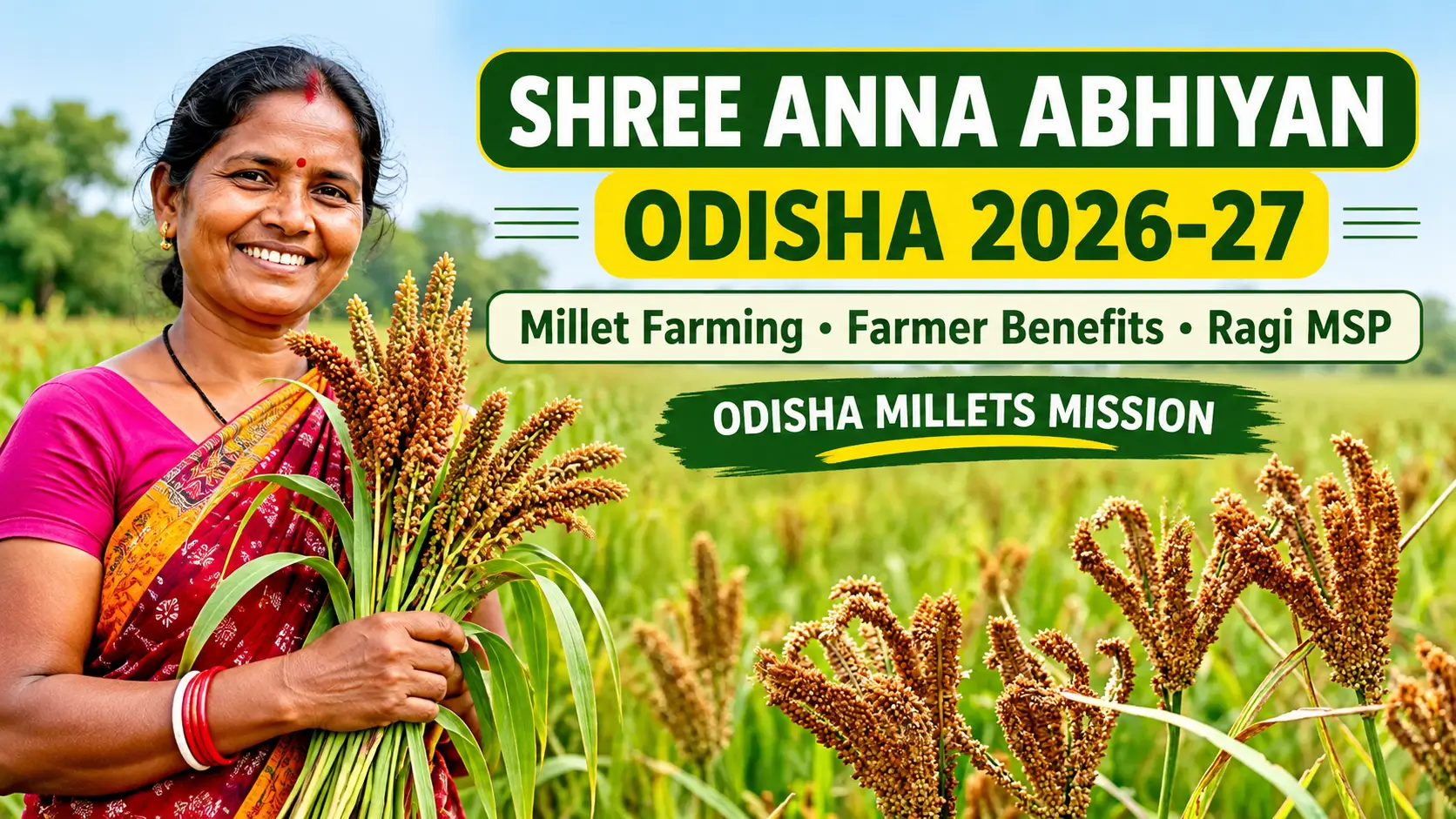
Shree Anna Abhiyan Odisha is a state government programme that supports millet cultivation, farmer livelihoods, food processing and the consumption of traditional grains. Earlier known as the Odisha Millets Mission, the initiative started in 2017 and now operates under the name Shree Anna Abhiyan.
Under its 2025-26 to 2026-27 operational guidelines, the programme covers 177 blocks across all 30 districts of Odisha. It provides support through improved farming practices, seeds, agricultural training, machinery, processing facilities and government procurement of ragi (finger millet).
Farmers selected for approved millet demonstrations may also receive Aadhaar-based financial incentives. However, this is not a universal cash-transfer scheme, and there is no single online application form for every farmer.
This guide explains the scheme’s benefits, eligibility conditions, available incentives, farmer registration process, Ragi MSP for 2026-27 and the latest budget update.
What Is Shree Anna Abhiyan in Odisha?
Shree Anna Abhiyan is the flagship millet promotion programme of the Odisha Government’s Department of Agriculture and Farmers’ Empowerment.
It was launched in 2017 as the Odisha Millets Mission, initially focusing on the revival of millet cultivation in tribal and rain-fed regions. On 29 August 2024, the state government officially renamed the programme Shree Anna Abhiyan.
The programme aims to bring traditional millets back into farming systems and household diets while improving the income opportunities of small and marginal farmers.
It also promotes millet-based businesses, local seed conservation, processing facilities and market connections.
Important: Odisha Millets Mission and Shree Anna Abhiyan are not two separate schemes. They are the old and current names of the same government programme.
Main Objectives of Shree Anna Abhiyan
The programme focuses on improving millet production as well as creating demand for millet products.
Its major objectives include:
- Increasing household consumption of millets by 25% over the baseline.
- Reviving traditional millet-based food habits in rural and urban areas.
- Conserving local millet varieties through community seed systems.
- Establishing post-harvest and primary processing facilities.
- Improving crop productivity through better agricultural practices.
- Supporting millet-based businesses and value-added products.
- Including millets in the Public Distribution System (PDS), Anganwadi nutrition programmes and school meals.
- Developing better market opportunities for millet farmers.
- Establishing Odisha as a major millet production and processing hub.
For 2024-25 to 2026-27, the programme also set targets for at least 1,000 processing units, millet service centres at the district level, improved farming practices across 1,000 to 2,000 hectares per programme block, and one Farmer Producer Organisation (FPO) in each programme block.
Shree Anna Abhiyan Benefits for Farmers
One of the most important things farmers want to know is what they can actually receive under this programme.
Shree Anna Abhiyan provides different types of support depending on the farmer’s participation and the activity approved under the scheme.
| Benefit | Details |
|---|---|
| Financial incentives | Support for adopting approved millet cultivation practices |
| Quality seeds | Access to traditional and improved millet varieties |
| Agricultural training | Guidance on sowing, transplantation, weeding and crop management |
| Farm equipment | Access to agricultural tools and machinery |
| Custom Hiring Centres | Shared machinery that farmers can hire |
| Processing facilities | Support for millet cleaning, grinding, dehulling and processing |
| Government procurement | Opportunity to sell eligible ragi through the procurement system |
| Market support | Assistance through FPOs, SHGs and millet-based enterprises |
Financial Incentives for Millet Cultivation
The 2025-26 to 2026-27 operational guidelines specify financial incentives for farmers who adopt approved improved agronomic practices.
The guideline provides the following total incentive amounts:
| Cultivation method | 1st year | 2nd year | 3rd year | 4th year | 5th year |
|---|---|---|---|---|---|
| Ragi – SMI | ₹10,000 | ₹7,500 | ₹5,000 | ₹2,000 | ₹2,000 |
| Non-ragi millets | ₹10,000 | ₹7,500 | ₹5,000 | ₹2,000 | ₹2,000 |
| Ragi – Line Transplanting / Line Sowing | ₹10,000 | ₹7,500 | ₹5,000 | ₹2,000 | ₹2,000 |
These figures are guideline-based incentive amounts, not guaranteed payments to every farmer.
The amount is linked to approved farming activities and the farmer’s year of participation. The maximum area eligible for the demonstration incentive is 2 hectares per year, while the minimum demonstration area is 0.2 hectare.
Payments to approved demonstration beneficiaries are made through Aadhaar-based transfers.
Farmers should confirm the applicable season’s incentive conditions with their Block Agriculture Office before making cultivation decisions.
Who Is Eligible for Shree Anna Abhiyan?
Shree Anna Abhiyan does not work like a conventional scheme with one universal eligibility form. Farmers are selected for specific programme activities through the local implementation system.
The operational guidelines give priority to:
- Small and marginal farmers.
- Tribal farmers.
- Farmers interested in cultivating millets in selected programme blocks.
- Farmers in areas with a history of millet production or suitable geographical conditions.
- Farmers with suitable land for approved millet cultivation.
- Single women farmers and other priority groups identified during programme implementation.
The guidelines specify the following land-related conditions for demonstration incentives:
- Minimum demonstration area: 0.2 hectare.
- Maximum incentive-supported area: 2 hectares per year.
- Participation is linked to approved millet crops and cultivation methods.
A recent soil health card is preferred, but farmers without one may also be considered after soil suitability testing.
Krushak Odisha registration or updating the existing farmer record is mandatory for the demonstration process.
Note: Meeting these conditions does not automatically guarantee selection. The final decision depends on field verification, programme coverage and approval by the concerned agriculture authorities.
Shree Anna Abhiyan Coverage: 177 Blocks in 30 Districts
According to the 2025-26 to 2026-27 operational guidelines, Shree Anna Abhiyan covers 177 blocks across all 30 districts of Odisha.
The district-wise block distribution is given below.
| District | Blocks | District | Blocks |
|---|---|---|---|
| Angul | 5 | Malkangiri | 5 |
| Bargarh | 8 | Mayurbhanj | 16 |
| Bolangir | 7 | Nabarangpur | 10 |
| Boudh | 3 | Nayagarh | 5 |
| Dhenkanal | 5 | Nuapada | 5 |
| Gajapati | 6 | Rayagada | 10 |
| Ganjam | 7 | Sundargarh | 15 |
| Jharsuguda | 5 | Baleswar | 2 |
| Kalahandi | 8 | Bhadrak | 1 |
| Kandhamal | 11 | Cuttack | 3 |
| Keonjhar | 11 | Deogarh | 1 |
| Koraput | 12 | Jagatsinghpur | 1 |
| Jajpur | 2 | Kendrapara | 2 |
| Khordha | 2 | Puri | 1 |
| Sambalpur | 6 | Subarnapur | 2 |
Total: 177 blocks across 30 districts.
Mayurbhanj has the highest coverage with 16 blocks, followed by Sundargarh with 15 and Koraput with 12.
The government guidelines also allow additional blocks to be included after a feasibility assessment and government approval.
Farmers should check the official block list before assuming that their village is covered.
How to Participate in Shree Anna Abhiyan
Many farmers search for an online application form for Shree Anna Abhiyan. However, the programme uses a local selection and implementation process rather than a single direct online application for all individual farmers.
The following steps explain how interested farmers can approach the programme.
Step 1: Visit your Block Agriculture Office
Contact the Block Agriculture Office or the agriculture staff working in your area to ask whether Shree Anna Abhiyan activities are being implemented in your block.
Step 2: Contact the local Facilitating Agency or FPO
The programme works through Facilitating Agencies, Farmer Producer Organisations and community-based organisations. They help identify interested farmers and organise village-level activities.
Step 3: Share your farmer and land details
The field team collects details about the farmer, landholding, proposed crop, cultivation method and seed requirements.
Step 4: Complete Krushak Odisha registration
Farmers must have their Krushak Odisha records registered or updated according to their proposed demonstration plan.
You can also read our guides on:
Step 5: Wait for field verification and approval
The proposed farmer list is examined by the relevant agriculture officials. The Block Agriculture Officer or Assistant Agriculture Officer verifies and approves the list before it moves through the programme’s reporting and payment process.
Step 6: Follow the approved cultivation practices
Selected farmers must follow the approved cultivation method and programme requirements to qualify for the applicable incentive.
Documents and Details Farmers Should Keep Ready
Farmers should keep the following information available when approaching the local programme team:
- Aadhaar details.
- Krushak Odisha registration details.
- Land records, including Khata and Plot information.
- Bank account details.
- Mobile number.
- Information about the proposed millet crop and cultivation area.
The field authorities will confirm the documents actually required for the relevant activity.
How to Sell Ragi Under Shree Anna Abhiyan
Another important part of the programme is government procurement of ragi at the Minimum Support Price (MSP).
The programme uses the Millet Procurement Automation System (M-PAS) to facilitate farmer registration and procurement.
The general registration process is as follows:
- Visit the local PACS or LAMPCS cooperative society.
- Collect and submit the ragi procurement registration form.
- The cooperative society enters the farmer’s details into the M-PAS portal.
- District officials coordinate verification of land and bank details.
- Land records are checked against the Bhulekh database.
- After verification, the farmer can participate in the designated procurement process.
- The farmer sells the eligible produce at the assigned procurement centre.
The programme website describes an Aadhaar-linked verification and payment process. Its procurement information page states that payment is transferred within 72 hours of sale.
However, farmers should confirm the current procurement season’s registration dates, mandi location, quality requirements and payment arrangements with their local cooperative society.
Ragi MSP in Odisha for 2026-27
The Minimum Support Price (MSP) is an important part of the millet programme because it provides a government-announced reference price for eligible agricultural produce.
For the 2026-27 Kharif Marketing Season, the Central Government has approved an MSP of:
₹5,205 per quintal for Ragi.
| Particular | Amount |
|---|---|
| Ragi MSP 2025-26 | ₹4,886 per quintal |
| Ragi MSP 2026-27 | ₹5,205 per quintal |
| Increase | ₹319 per quintal |
The Union Cabinet approved the revised MSP on 13 May 2026.
This is the central MSP. It should not be confused with a separate state bonus or programme incentive.
The Odisha Government’s procurement arrangements, including registration and quality requirements, must also be followed before selling ragi through the government procurement system.
Shree Anna Abhiyan Budget 2026-27
The programme receives financial support through the Odisha State Plan and funds from sources such as the District Mineral Foundation (DMF) and Odisha Mineral Bearing Areas Development Corporation (OMBADC).
There are two different financial figures that readers should understand.
Three-year outlay under the operational guidelines
The approved operational guidelines for 2024-25 to 2026-27 provide the following financial plan:
| Financial Year | Programme Implementation | Ragi Procurement | Distribution | Total |
|---|---|---|---|---|
| 2024-25 | ₹201.87 Cr | ₹408.24 Cr | ₹38.51 Cr | ₹648.61 Cr |
| 2025-26 | ₹207.12 Cr | ₹453.95 Cr | ₹45 Cr | ₹706.07 Cr |
| 2026-27 | ₹198.36 Cr | ₹503 Cr | ₹52.25 Cr | ₹753.60 Cr |
| Total | ₹607.34 Cr | ₹1,365.19 Cr | ₹135.75 Cr | ₹2,108.28 Cr |
These figures represent the approved three-year programme plan, including ragi procurement and distribution. They are not individual farmer payments.
Small differences may appear when rounded component amounts are added because the official totals are calculated from more precise figures.
Latest 2026-27 budget allocation
The Odisha Government’s 2026-27 Budget Speech proposes an outlay of ₹400 crore for Shree Anna Abhiyan.
Separately, Down To Earth reported on 18 May 2026 that a Directorate memo dated 7 May 2026 reduced the programme’s annual action-plan outlay from ₹600 crore to ₹415 crore.
OrissaPOST reported a figure of ₹400 crore.
These numbers should not be treated as identical financial statements. The ₹400 crore figure appears in the state budget speech, while ₹415 crore is reported in connection with the Directorate memo.
The reported changes have raised concerns about demonstration coverage, field-level support and the future of millet promotion in certain districts.
For farmers, the practical point is to confirm which activities and incentives are available in their block during the current season rather than relying only on the overall state budget.
Who Implements Shree Anna Abhiyan?
The programme involves several government departments and supporting organisations.
| Organisation | Main Responsibility |
|---|---|
| Department of Agriculture and Farmers’ Empowerment | Lead department and overall supervision |
| Directorate of Agriculture and Food Production | Programme administration and implementation |
| WASSAN | Programme Secretariat and technical support |
| NCDS | Research and policy support |
| Facilitating Agencies | Field-level coordination and farmer mobilisation |
| FPOs and SHG federations | Local implementation, farmer support and enterprise activities |
| TDCCOL | Ragi procurement |
| Other government departments | Nutrition, distribution and institutional coordination |
Women Self-Help Groups, farmer organisations and local community institutions also play an important role in connecting millet producers with processing and marketing opportunities.
Difference Between Shree Anna Abhiyan and Other Farmer Schemes
Shree Anna Abhiyan is sometimes confused with direct financial assistance schemes.
However, its main focus is millet cultivation, processing, procurement and market development.
For example:
- CM Kisan Yojana: Provides income support to eligible farmers under a separate state scheme.
- PM-KISAN: Provides income support to eligible landholding farmer families under central government guidelines.
- Shree Anna Abhiyan: Supports millet production, improved farming practices, processing facilities, procurement and millet-based businesses.
Farmers interested in other Odisha agriculture services can also visit our guides to the Odisha SAFAL Portal and Mission Shakti Interest Subvention for SHGs.
Official Website and Important Links
Farmers should use official government sources for the latest scheme information, guidelines and procurement announcements.
| Purpose | Official Website |
|---|---|
| Shree Anna Abhiyan information | Millets Odisha |
| Scheme details and guidelines | Odisha Agriculture Department (https://agri.odisha.gov.in/en/node/192863) |
| Operational Guidelines 2025-26 to 2026-27 | Download Official PDF (https://milletsodisha.com/uploads/files/Letter%20No-13626,%20date-22.04.2025%20Guideline%20Shree%20Anna%20Abhiyan.pdf) |
| Agriculture Department | agri.odisha.gov.in |
| Farmer registration | Krushak Odisha (https://krushak.odisha.gov.in/) |
| Ragi MSP announcement | Press Information Bureau (https://www.pib.gov.in/) |
Official contact details listed on the programme website:
- Address: Krushi Bhavan, Bhubaneswar, Odisha.
- Phone: +91-674-2395532.
- Email: shreeanna.agri@odisha.gov.in.
Confirm the latest contact details before visiting or contacting the office.
Frequently Asked Questions
1. What is Shree Anna Abhiyan in Odisha?
Shree Anna Abhiyan is the Odisha Government’s flagship millet promotion programme. It began in 2017 as the Odisha Millets Mission and focuses on millet farming, processing, consumption and market development.
2. Is Odisha Millets Mission the same as Shree Anna Abhiyan?
Yes. Odisha Millets Mission is the earlier name, while Shree Anna Abhiyan is the current official name adopted in 2024.
3. How many districts are covered under Shree Anna Abhiyan?
The 2025-26 to 2026-27 operational guidelines list 177 blocks across all 30 districts of Odisha.
4. How much financial assistance can a farmer receive?
Under the operational guidelines, approved demonstration incentives can reach ₹10,000 in the first year, ₹7,500 in the second year and ₹5,000 in the third year, depending on the cultivation method. The amount is subject to selection and programme conditions.
5. Can farmers apply for Shree Anna Abhiyan online?
There is no single direct online application for all individual farmers. Interested farmers should contact their Block Agriculture Office, local Facilitating Agency or FPO.
6. What is the minimum land requirement?
The operational guidelines specify a minimum demonstration area of 0.2 hectare and a maximum incentive-supported area of 2 hectares per year.
7. What is the Ragi MSP in Odisha for 2026-27?
The Central Government has approved an MSP of ₹5,205 per quintal for ragi for the 2026-27 Kharif Marketing Season.
8. How can farmers register to sell ragi?
Farmers can approach their local PACS or LAMPCS cooperative society and submit the procurement registration form. The society enters the details into the M-PAS system for verification.
9. What is the Shree Anna Abhiyan budget for 2026-27?
The Odisha Government’s 2026-27 Budget Speech proposes ₹400 crore for Shree Anna Abhiyan. A separate report has cited ₹415 crore in connection with the Directorate’s annual action plan.
10. Does Shree Anna Abhiyan provide machinery to farmers?
The programme supports agricultural mechanisation, Custom Hiring Centres and millet processing equipment. Availability depends on the approved activity and local implementation arrangements.
11. Which department manages Shree Anna Abhiyan?
The Department of Agriculture and Farmers’ Empowerment, Government of Odisha, is the lead department.
12. What happens after 2026-27?
More Odisha related schemes
Subhadra Yojana
Mukhyamantri Kalakar Sahayata Yojana Odisha 2026: ₹3,000 Assistance Update, Eligibility & Status Check
The current operational guidelines cover 2025-26 and 2026-27. Farmers should check the Agriculture Department’s website for any new guidelines or extension announcements.
Disclaimer: This is an independent information website and is not affiliated with the Government of Odisha. Scheme conditions, procurement dates and financial incentives may change. Always verify the latest information through official government sources before making any decision.