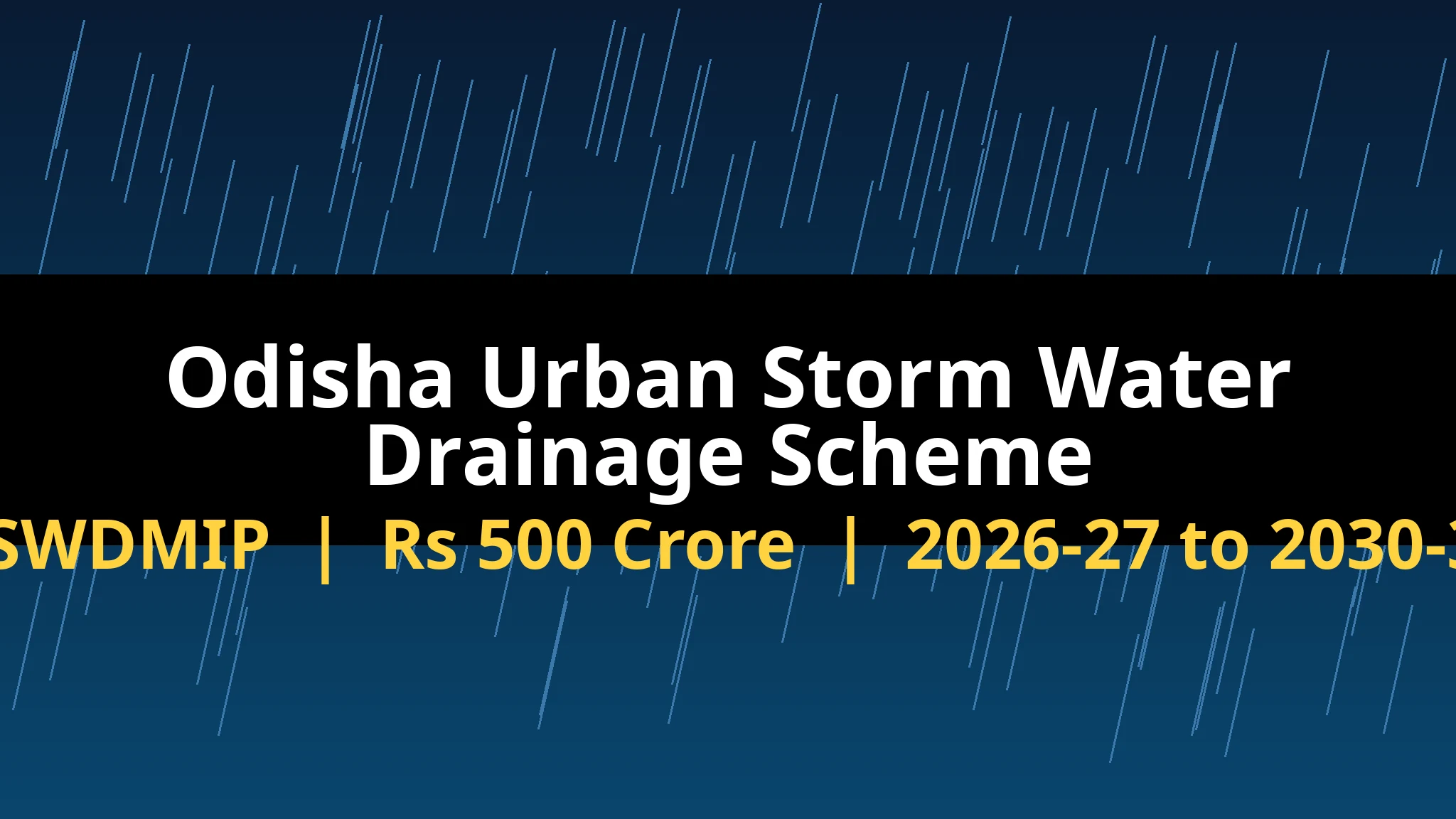
Odisha USWDMIP 2026: ₹500 Crore Urban Storm Water Drainage Scheme Explained
Read in another language:
The Odisha government has approved a ₹500 crore programme to tackle recurring waterlogging and urban flooding across towns and cities. Known as the Urban Storm Water Drainage Management and Improvement Programme (USWDMIP), the initiative will focus on repairing existing drains, constructing new storm water channels and restoring natural drainage systems.
The Odisha Cabinet approved the programme on 13 October 2026 during its 48th meeting, chaired by Chief Minister Mohan Charan Majhi. The project will run for five years, covering FY 2026-27 to FY 2030-31.
Unlike welfare schemes that provide financial assistance to individuals, USWDMIP is a public infrastructure programme. Residents do not need to submit an application, register online or pay any fee to receive its benefits.
The government has announced the overall budget and broad coverage, but a detailed list of selected towns, project guidelines and implementation schedules has not yet been identified in the public announcements reviewed for this article.
Odisha USWDMIP Scheme 2026: Overview
| Particular | Details |
|---|---|
| Scheme name | Urban Storm Water Drainage Management and Improvement Programme |
| Short name | USWDMIP |
| State | Odisha |
| Approved on | 13 October 2026 |
| Approved by | Odisha Cabinet |
| Cabinet meeting | 48th meeting |
| Chief Minister | Mohan Charan Majhi |
| Total budget | ₹500 crore |
| Funding source | Odisha government’s own resources |
| Implementation period | Five years |
| Starting financial year | 2026-27 |
| Ending financial year | 2030-31 |
| Coverage | Urban Local Bodies and selected block headquarters |
| Main objective | Reduce urban flooding and waterlogging |
| Responsible department | Water Resources Department, as reported |
| Individual application | Not required |
| Latest status | Cabinet approved |
The official Chief Minister’s Office announcement (cm.odisha.gov.in/en/latest-news/odisha-cabinet-approves-16-proposals-11-departments-its-48th-meeting-resolution) confirms the approval of a ₹500 crore urban storm-water drainage programme.
The more detailed scheme name, five-year duration and planned engineering interventions have been reported by Odisha news organisations.
What Is the Odisha Urban Storm Water Drainage Scheme?
The Odisha Urban Storm Water Drainage Scheme is a state-funded infrastructure initiative designed to improve how towns and cities collect and discharge rainwater.
During heavy rainfall, water can accumulate on roads, in residential neighbourhoods and around public buildings when drainage systems are blocked, damaged or too small to handle the volume of water.
The problem becomes more serious when natural drainage channels are encroached upon or disconnected from nearby water bodies.
USWDMIP aims to address these problems through planned drainage improvements rather than relying only on temporary pumping and emergency water removal during the monsoon.
The programme is expected to focus on existing drainage networks as well as natural water channels that help carry excess rainwater away from populated areas.
What Work Will Be Carried Out Under USWDMIP?
The programme includes several types of drainage improvement work. These interventions are intended to improve water movement and reduce the risk of localised flooding.
1. Desilting of Existing Drains
Over time, drains collect mud, silt, plastic waste and other materials. These blockages reduce their ability to carry rainwater.
Desilting involves removing accumulated material so that existing drainage channels can function more effectively.
2. Construction of RCC Storm Water Drains
The programme includes the construction of reinforced cement concrete (RCC) storm water drains.
These structures can replace damaged or inadequate drainage channels and provide a more suitable route for rainwater to flow through urban areas.
3. Covering of Open Drains
Open drains can create public safety problems and become dumping points for household waste.
Drain covering is among the planned interventions. However, proper access points for cleaning and maintenance will remain important to prevent future blockages.
4. Restoration of Natural Drainage Channels
Natural drainage channels, locally known as nalas, help rainwater move towards suitable outlets.
Encroachment, construction and land filling can interrupt these natural routes. Restoring them can improve the movement of rainwater and reduce pressure on artificial drainage systems.
5. Connecting Drains with Suitable Water Bodies
The programme also includes linking drainage channels with suitable water bodies.
Where technically and environmentally appropriate, ponds, lakes and other water bodies can help manage excess rainwater and support groundwater recharge.
The final designs and locations will depend on the detailed engineering plans prepared for individual projects.
How Will the ₹500 Crore Budget Be Used?
The Odisha government has approved a total outlay of ₹500 crore for the five-year programme.
The funding will come from the state’s own resources, according to reports on the Cabinet decision.
If the total allocation is divided equally over five years, the average would be ₹100 crore annually.
However, this is only a mathematical estimate. The government has not published a confirmed year-wise allocation or town-wise budget distribution in the announcements reviewed.
| Budget detail | Amount |
|---|---|
| Total approved outlay | ₹500 crore |
| Programme duration | 5 years |
| Simple annual average | ₹100 crore |
| Confirmed annual allocation | Not published |
| Confirmed town-wise allocation | Not published |
The actual expenditure may vary depending on project requirements, engineering estimates, construction progress and administrative approvals.
Which Towns and Areas Will Be Covered?
The programme is intended to cover:
- Urban Local Bodies (ULBs) across Odisha.
- Selected block headquarters.
- Urban areas requiring improvements to existing drainage infrastructure.
- Locations affected by recurring waterlogging and localised flooding.
However, the Cabinet announcement does not provide a complete list of selected towns.
This means residents should not assume that every municipality, NAC or block headquarters will automatically receive a drainage project under the programme.
The final coverage will become clearer when the government publishes detailed guidelines, project approvals or an official town-wise work list.
Odisha has also expanded its urban local body network, with 28 new NACs and seven municipalities announced and Puri upgraded to a municipal corporation. This wider urban network makes drainage planning and infrastructure maintenance increasingly important.
Why Did Odisha Need a New Urban Drainage Programme?
Urban flooding is not caused by rainfall alone. The condition of drainage networks, construction patterns, natural water channels and waste management also influence how quickly rainwater accumulates.
Several factors have increased pressure on Odisha’s urban infrastructure.
Rapid urbanisation: Growing towns and expanding residential areas increase the amount of paved land. Rainwater that once soaked into open ground runs off more quickly.
Blocked drainage channels: Plastic waste, silt and construction materials can reduce the capacity of existing drains.
Encroachment on natural water channels: Filling or obstructing traditional drainage routes can leave rainwater with fewer places to flow.
Insufficient drainage capacity: Older drains may not be designed to handle the volume of water generated by current rainfall patterns and urban development.
Poor connectivity: Even when individual drains exist, disconnected channels can prevent rainwater from reaching suitable outlets.
The new programme aims to address these infrastructure-related problems through long-term improvements.
How Odisha’s Earlier Urban Flood Measures Led to USWDMIP
The ₹500 crore programme is part of a wider effort to improve urban flood preparedness in Odisha.
Several developments during 2026 provide useful context.
May 2026: Monsoon Preparedness SOP
In May 2026, the Housing and Urban Development Department issued a standard operating procedure for Urban Local Bodies ahead of the monsoon.
The instructions included:
- Verification of drain networks and manholes.
- Regular drain desilting.
- Repair or secure covering of damaged structures.
- Removal of encroachments obstructing water flow.
- Identification of vulnerable and low-lying areas.
- Establishment of 24-hour control rooms in ULBs.
These measures focused on immediate preparedness and emergency response.
July 2026: Bhubaneswar Urban Flood Mitigation Project
The State Executive Committee approved a ₹222.20 crore project to address urban flooding and waterlogging in Bhubaneswar.
The reported funding arrangement was:
- Central contribution: ₹200 crore.
- State contribution: ₹22.20 crore.
- Total project cost: ₹222.20 crore.
The project covers drainage strengthening, drain rejuvenation, rainwater harvesting and early-warning measures.
This is a separate initiative with a different geographical focus and funding arrangement.
13 October 2026: Cabinet Approval of USWDMIP
The Odisha Cabinet approved the ₹500 crore Urban Storm Water Drainage Management and Improvement Programme.
The five-year initiative will cover ULBs and selected block headquarters.
28 October 2026: Proposed Statewide Natural Drainage SOP
The Housing and Urban Development Department discussed a proposed statewide framework for identifying, protecting and restoring natural drainage channels, water bodies and flood-retention areas.
The proposal includes better mapping, monitoring and coordination between government departments.
Importantly, this SOP was still in draft form as of 31 October 2026.
Together, these developments show two different aspects of urban flood management: improving physical drainage infrastructure and protecting the natural routes through which rainwater flows.
USWDMIP vs Other Odisha Urban Water Projects in 2026
Several Odisha government announcements involve water bodies, drainage and urban development. Their objectives are different, so they should not be treated as the same scheme.
| Project | Approved amount | Main purpose |
|---|---|---|
| USWDMIP | ₹500 crore | Urban storm water drainage improvement |
| Jalatat Bikash Yojana | ₹500 crore | Waterfront and urban water body development |
| Bhubaneswar urban flood mitigation project | ₹222.20 crore | Flood mitigation in Bhubaneswar |
| Mahanadi Waterfront Development, Kataka | ₹133.72 crore | Mahanadi riverfront development |
USWDMIP
This programme focuses on drainage networks, desilting, RCC drains, natural drainage restoration and waterlogging reduction.
Jalatat Bikash Yojana
The separate Jalatat Bikash Yojana is a ₹500 crore waterfront development initiative approved in June 2026.
It focuses on improving riversides and urban water bodies, including their surrounding public spaces and environmental facilities.
Bhubaneswar Flood Mitigation Project
This project is specifically focused on long-term flood management in Bhubaneswar and has a different funding arrangement.
Mahanadi Waterfront Development
The ₹133.72 crore project concerns riverfront development at Kataka (Cuttack). It is not the same as the statewide storm water drainage programme.
Who Will Benefit from the Odisha Drainage Scheme?
The programme is designed to provide indirect public benefits rather than individual financial assistance.
Potential beneficiaries include:
- Residents of urban areas affected by recurring waterlogging.
- Families living in flood-prone neighbourhoods.
- Shopkeepers and small businesses operating in affected areas.
- Commuters who face road blockages during heavy rainfall.
- Communities located near drainage channels requiring restoration.
- Public institutions and facilities affected by urban flooding.
The actual benefits will depend on which locations receive projects and whether the drainage improvements are properly implemented and maintained.
Is There an Online Application for the Odisha USWDMIP Scheme?
No. Individuals do not need to apply online or offline for USWDMIP.
It is a government-funded public infrastructure programme, not an individual beneficiary scheme.
There is currently no publicly identified individual registration process, beneficiary list or application portal for this programme.
Residents should avoid websites or agents asking for:
- Aadhaar details to register for the scheme.
- Bank account information to receive a scheme benefit.
- Registration fees.
- Payment for inclusion in a town-wise beneficiary list.
Such requests are not part of the publicly announced programme.
What Should Residents Do If Their Area Faces Waterlogging?
Residents experiencing repeated waterlogging can report the problem to their local municipality, NAC or municipal corporation.
The May 2026 monsoon SOP directed ULBs to establish 24/7 control rooms for public complaints relating to drainage, water supply and road blockages.
When submitting a complaint, provide:
- Your ward number and locality.
- The exact road or neighbourhood affected.
- Photographs or videos showing the waterlogging.
- The date and approximate time of the incident.
- Details of repeated flooding, if the problem occurs regularly.
Ask the municipal authority for a complaint reference number so that you can follow up.
You can also check your municipality’s official website or contact its office for the currently available grievance channels.
A complaint does not automatically guarantee that your location will be selected under USWDMIP, but it helps the local authority understand the drainage problem.
Technical Standards for Storm Water Drainage Projects
Building a drain is only one part of effective flood management. Its design, capacity, connection with other channels and maintenance arrangements are equally important.
Odisha municipalities have used national technical guidance while preparing drainage plans.
For example, the request for proposals issued for Bhawanipatna Municipality’s storm water drainage master plan refers to the storm water drainage manual published by the Ministry of Housing and Urban Affairs.
You can consult the following resources:
- MoHUA – Publications and Technical Resources (mohua.gov.in/publication.php)
- Bhawanipatna Storm Water Drainage Master Plan RFP (kalahandi.odisha.gov.in/sites/default/files/2024-10/RFP_Preparation%20of%20Storm%20Water%20Dranage_MPL_BhPatna_09.10.2024.pdf)
- NDMA Guidelines on Urban Flooding (https://www.niti.gov.in/sites/default/files/2021-03/Annexure-NDMA-Guidelines-compressed.pdf)
The National Disaster Management Authority’s urban flooding guidance also highlights the importance of drainage planning, natural water channels and coordinated flood preparedness.
More related schemes
Subhadra Yojana
PM Vishwakarma Yojana 2026: What Traditional Artisans Should Know Before Applying
Seva Setu Kendra 2026: What It Is, Services Available, Documents and How to Use It
Basudha Scheme Odisha: New Water Connection 2026
Odisha Govt Holiday List 2027 PDF: 29 General Holidays, 4 Optional Holidays & Long Weekends
Latest Status of Odisha USWDMIP as of 31 October 2026
The Odisha Cabinet has approved the ₹500 crore programme, but several implementation details remain unavailable in the public information reviewed.
| Information | Latest available position |
|---|---|
| Cabinet approval | Confirmed |
| Total budget | ₹500 crore |
| Funding source | State’s own resources |
| Programme duration | FY 2026-27 to FY 2030-31 |
| Broad geographical coverage | ULBs and selected block headquarters |
| Detailed town list | Not identified |
| Town-wise budget | Not identified |
| Year-wise budget | Not identified |
| Detailed implementation guidelines | Not identified |
| Tender schedule | Not identified |
| Dedicated application portal | Not identified |
| Individual registration | Not required |
The next important development will be the publication of implementation guidelines, project lists and administrative approvals.
Until then, claims about particular towns receiving funds or construction starting on a specific date should be treated cautiously unless supported by an official government document.
Where to Check Official Odisha Government Updates
Residents can follow government announcements through these official websites:
- Chief Minister’s Office, Odisha (cm.odisha.gov.in/en/news-updates)
- Government of Odisha
- Housing and Urban Development Department
The Chief Minister’s Office is particularly useful for Cabinet announcements, while the Housing and Urban Development Department provides information about municipal administration and urban infrastructure.
Frequently Asked Questions
1. What is the Odisha USWDMIP Scheme 2026?
USWDMIP stands for Urban Storm Water Drainage Management and Improvement Programme. It is a ₹500 crore Odisha government programme approved to improve drainage systems and reduce waterlogging in urban areas.
2. When was the Odisha Urban Storm Water Drainage Scheme approved?
The Odisha Cabinet approved the programme on 13 October 2026 during its 48th meeting, chaired by Chief Minister Mohan Charan Majhi.
3. What is the total budget of the USWDMIP scheme?
The total approved outlay is ₹500 crore, funded through the Odisha government’s own resources.
4. How long will the programme continue?
The programme is planned for five years, from FY 2026-27 to FY 2030-31.
5. Which areas will receive benefits?
The programme will cover Urban Local Bodies and selected block headquarters. The complete list of selected locations has not yet been identified in the published announcements reviewed.
6. Can residents apply online for USWDMIP?
No. There is no individual application process. The programme is intended for public infrastructure improvements rather than direct financial assistance.
7. Which works are included in the programme?
The reported interventions include drain desilting, construction of RCC storm water drains, drain covering, restoration of natural drainage channels and connections with suitable water bodies.
8. Is USWDMIP the same as Jalatat Bikash Yojana?
No. Both have a ₹500 crore budget, but their purposes are different. USWDMIP focuses on storm water drainage, while Jalatat Bikash Yojana focuses on waterfront and urban water body development.
9. Which department is responsible for USWDMIP?
The Water Resources Department has been identified in reports as the department associated with the proposal. The detailed implementation and administrative responsibilities have not yet been fully published.
10. When will construction work begin?
A confirmed statewide construction start date has not been identified in the available public announcements. Individual project schedules may become clear after administrative approvals and tender processes.
11. How can I complain about waterlogging in my town?
Contact your local municipality, NAC or municipal corporation. The May 2026 monsoon SOP directed ULBs to operate 24/7 control rooms for drainage-related complaints.
12. Will every town in Odisha receive funds under this programme?
Not necessarily. The announced coverage includes ULBs and selected block headquarters. The government has not yet published the final location-wise project list.
Disclaimer: Subhadra-yojanain.com is an independent informational website and is not affiliated with the Government of Odisha. This article is based on publicly available government announcements and news reports reviewed as of 31 October 2026. Scheme implementation details may change when official guidelines are published. Always verify important information through the relevant government department.