Odisha Paddy Procurement 2026-27: ₹3,100 Price, Registration & Dates
Read in another language:
The Odisha government has approved its Food and Paddy Procurement Policy for the Kharif Marketing Season (KMS) 2026-27, setting a target of procuring 53 lakh metric tonnes (LMT) of rice, equivalent to approximately 78 LMT of paddy.
The decision was approved by the Odisha Cabinet, chaired by Chief Minister Mohan Charan Majhi, on 9 November 2026.
Under the new policy, eligible farmers will receive ₹3,100 per quintal, including the Minimum Support Price (MSP) and state government input assistance. The government has also outlined measures for digital verification, direct bank payments, quality testing and the participation of eligible sharecroppers (Bhaga Chasis).
For farmers, the important questions are how procurement works, whether registration is still open, what documents were required and when payments are expected.
This guide explains the KMS 2026-27 policy, using available government information and clearly identifying details that still need district-level confirmation.
Odisha Paddy Procurement 2026-27: Key Highlights
| Particulars | Details |
|---|---|
| Policy name | Food and Paddy Procurement Policy 2026-27 |
| Marketing season | Kharif Marketing Season (KMS) |
| Cabinet approval | 9 November 2026 |
| Chief Minister | Mohan Charan Majhi |
| Rice procurement target | 53 LMT |
| Paddy procurement target | Approximately 78 LMT |
| Announced farmer price | ₹3,100 per quintal |
| Procurement period | 1 November 2026 to 31 March 2027 |
| Payment method | Direct bank transfer through the prescribed digital payment system |
| Expected payment timeline | Within 24–48 hours of procurement |
| Procurement agencies | OSCSC and authorised procurement societies |
| Main procurement centres | PACS, LAMPCS and Pani Panchayats |
| Farmer helpline | 1967 |
Combined Paddy Procurement Target for 2026-27: 98 Lakh Metric Tonnes
The Odisha government has set a combined paddy procurement target of 98 lakh metric tonnes for 2026-27, covering both the Kharif and Rabi seasons. The Kharif target is 78 lakh metric tonnes of paddy, equivalent to 53 lakh metric tonnes of rice, as approved in the Food and Paddy Procurement Policy on 9 November 2026.
Chief Secretary Anu Garg said 22.27 lakh farmers have registered to sell their paddy. The Kharif procurement window runs from 1 November 2026 to 31 March 2027, and farmers receive ₹3,100 per quintal, including the minimum support price and input assistance.
What Is the Odisha Paddy Procurement Policy 2026-27?
The Odisha Paddy Procurement Policy is the state government’s arrangement for purchasing eligible farmers’ marketable paddy surplus at the announced procurement price.
For KMS 2026-27, the government has introduced a farmer-focused and technology-driven system to improve transparency and reduce irregularities during procurement.
The policy aims to:
- Give eligible farmers access to government procurement facilities.
- Ensure timely payment for paddy sold at authorised procurement centres.
- Verify cultivated land and registered crop details.
- Improve monitoring of paddy quality.
- Make the procurement and transportation process more transparent.
- Ensure sufficient rice stocks for public distribution and other welfare programmes.
The government has set a target of 53 LMT of rice, which is equivalent to approximately 78 LMT of paddy.
Odisha Paddy Price 2026-27: Farmers to Receive ₹3,100 Per Quintal
The most important announcement for farmers is the ₹3,100 per quintal procurement price.
This amount includes the Central Government’s MSP and additional input assistance from the Odisha government under its farmer support arrangement.
The Central Government has fixed the following MSP rates for KMS 2026-27:
| Paddy category | Central MSP |
|---|---|
| Common Paddy | ₹2,441 per quintal |
| Grade A Paddy | ₹2,461 per quintal |
For Common Paddy, the difference between ₹2,441 and the announced state-level total of ₹3,100 is ₹659.
A Subarnapur district procurement meeting report also described the ₹3,100 rate as ₹2,441 MSP plus ₹659 input assistance for FAQ paddy.
However, farmers should not automatically assume that the assistance component is identical for every grade without checking the applicable procurement instructions.
Important: ₹3,100 is the announced combined procurement price, not the Central Government’s MSP alone.
What Changes Under the New KMS 2026-27 Policy?
The new policy places considerable emphasis on digital monitoring and timely procurement.
1. Digital Land and Crop Verification
The Paddy Procurement Automation System (P-PAS) will be integrated with Aadhaar-based e-KYC, Bhulekh land records and NPCI-related payment systems.
Satellite imagery will be used to cross-check registered paddy-growing areas. Digital Crop Survey data will provide an additional layer of verification.
These measures are intended to reduce incorrect land declarations and improve the accuracy of farmer registration.
2. Payment Within 24–48 Hours
The policy provides for payment within 24 to 48 hours after paddy procurement.
The amount will be transferred directly to the farmer’s Aadhaar-linked bank account through the prescribed digital payment arrangement.
Farmers should ensure that their bank account and Aadhaar details are correct. The 24–48-hour period is the announced payment timeline, not a guarantee that every bank transaction will be completed without delay.
3. SMS Alerts in Odia
Registered farmers will receive advance SMS notifications regarding their procurement date and the quantity scheduled for purchase.
Farmers should check their registered mobile numbers regularly and follow the instructions provided by their procurement society.
4. AI-Based Grain Testing
The government plans to strengthen quality monitoring through FAQ testing and AI-based grain analysers at procurement centres handling more than 5,000 metric tonnes.
CCTV cameras and live monitoring are also included in the transparency measures.
5. Better Transportation and Mill Management
Mill tagging and route planning under the Mill Movement and Delivery Framework (MMDF) are intended to improve transportation and reduce unnecessary delays.
Vehicle tracking and monitoring will also help authorities supervise the movement of paddy from procurement centres to mills.
6. Stronger Border Monitoring
The government plans to strengthen border checks and surveillance to prevent unauthorised paddy inflow from neighbouring states.
District-level control rooms and the 1967 helpline will support grievance handling during the procurement season.
Odisha Paddy Farmer Registration 2026-27: Is It Still Open?
No. The announced registration period for Kharif 2026-27 has already closed.
According to the published schedule, farmer registration started on 6 August 2026 and was initially scheduled to close on 31 August 2026.
The government subsequently extended the deadline by seven days, up to 7 September 2026, after farmers faced difficulties due to heavy rainfall, flooding and technical problems.
Farmers who completed registration should retain their acknowledgement and contact their local PACS if any correction or verification issue remains.
Those who missed the deadline should contact their nearest procurement society or call 1967 to ask whether any late-registration or correction facility is available in their district.
Do not assume that a new registration window has opened unless the department officially announces it.
Documents Required for Odisha Paddy Procurement
The published registration modalities listed the following documents and details for farmer registration:
- Completed farmer registration form.
- Copy of the Record of Rights (RoR) or land record.
- Copy of the first page of the bank passbook.
- Aadhaar card copy.
- Aadhaar-linked mobile number.
- Other land and cultivation details required by the registration process.
Farmers were required to provide their details through the authorised PACS, LAMPCS or Pani Panchayat.
The registration form was available free of cost through the concerned society.
Always check the latest instructions from the Food Supplies and Consumer Welfare Department before submitting any additional documents.
Is AgriStack ID Mandatory for Paddy Procurement?
No. The Odisha government clarified in August 2026 that an AgriStack Farmer ID is not mandatory for registering to sell paddy under the Kharif procurement programme.
Farmers can complete the prescribed registration process even if they do not have an AgriStack ID.
However, other verification requirements, including Aadhaar authentication and land-record checks, may still apply.
Farmers should not confuse the optional AgriStack ID with the separate registration and verification requirements of the procurement system.
Sharecropper Registration in Odisha: Rules for Bhaga Chasis
The new procurement policy also provides for eligible sharecroppers, locally known as Bhaga Chasis, to participate in government paddy procurement.
This is important for cultivators who grow paddy on land owned by another person.
Under the registration modalities, the sharecropper must obtain the landowner’s consent.
The process includes:
- Obtaining a consent letter from the landowner.
- Providing the required Aadhaar and mobile details.
- Submitting a copy of the landowner’s Aadhaar as prescribed.
- Completing the required identity verification and e-KYC.
- Submitting the consent documentation through the prescribed registration process.
The department has published a separate consent-letter format for sharecroppers.
Farmers should contact their PACS or check the official registration instructions if they have questions about authentication or documentation.
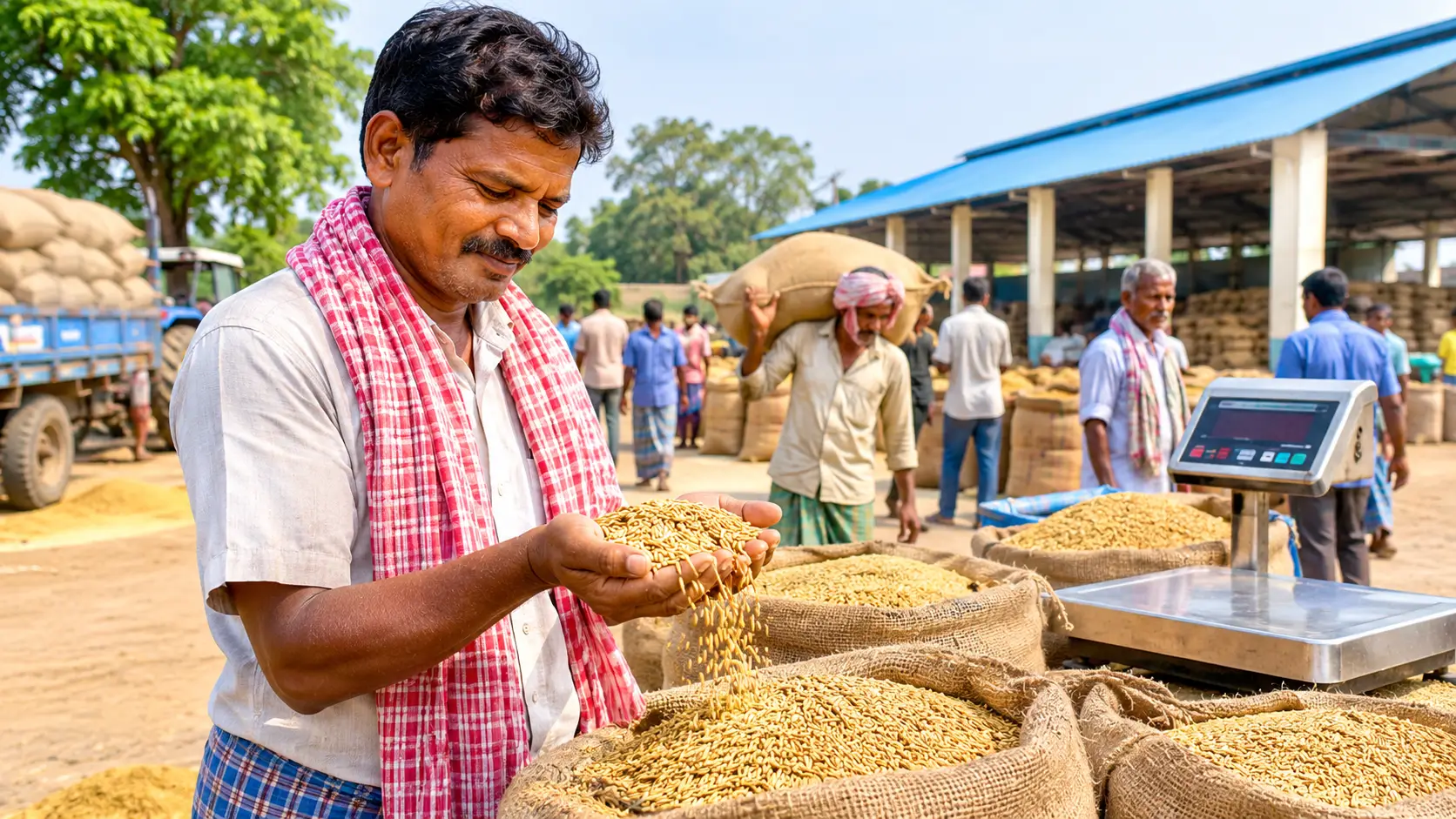
How Does Paddy Procurement Work at the Mandi?
Once the farmer’s registration and verification are complete, the procurement process generally follows these steps.
Step 1: Check Your Procurement SMS
Wait for the advance SMS containing the procurement date and scheduled quantity.
Step 2: Visit the Assigned Procurement Centre
Take your paddy to the authorised Paddy Procurement Centre on the date communicated to you.
Step 3: Quality Inspection
The paddy is checked against the prescribed Fair Average Quality (FAQ) specifications.
Step 4: Weighing and Procurement
The accepted quantity is weighed and recorded through the procurement system.
Step 5: Payment
The payment is processed through the prescribed digital system and credited to the farmer’s linked bank account according to the announced timeline.
Farmers should keep their procurement receipt and transaction details for future reference.
Paddy Quality Rules: What Farmers Should Know
One important document for this season is the Uniform Specification of Paddy, Rice and Coarse Grains issued by the Food Supplies and Consumer Welfare Department on 21 August 2026.
For KMS 2026-27, the prescribed paddy specifications include:
| Quality parameter | Maximum permitted limit |
|---|---|
| Inorganic foreign matter | 1% |
| Organic foreign matter | 1% |
| Damaged, discoloured, sprouted and weevilled grains | 5% |
| Immature, shrunken and shrivelled grains | 3% |
| Admixture of lower class | 6% |
| Moisture content | 17% |
The separate conditions for damaged and weevilled grains must also be followed.
These are official procurement specifications, not an assurance that every lot will automatically be accepted. The actual quality assessment is carried out at the procurement centre.
Farmers should dry, clean and properly store their paddy before taking it to the mandi.
More related Odisha schemes
Odisha MGNREGA e-KYC 2026 (VB-G RAM G): Job Card Verification Process & Latest Update
PMAY Odisha List 2026: Check PMAY-Gramin & PMAY-Urban Beneficiary List Online
Odisha PM Awas Yojana List 2026: District-Wise PMAY-G Beneficiary List, Status Check & PDF Download
Cyclone Arnab Odisha Relief Package 2026: ₹2,500 Cash, Compensation & Payment Details
Vasundhara Yojana Odisha 2026: Eligibility, 4-Decimal Rule and How to Get Land
PM Awas Yojana Gramin Odisha 2026: Latest Status, Eligibility, Awaas Plus Survey, List Check and Benefits
Antyodaya Gruha Yojana Odisha 2026: Eligibility, Benefits & How to Apply
Odisha MMKY Scheme 2026: 17 Components, Benefits, Eligibility and How to Apply
DALKHAI Yojana Odisha 2026: Full Form, ₹220 Crore Budget, Benefits and Latest Status
Odisha Paddy Procurement Dates: District-Wise Schedule
The overall Kharif procurement period is 1 November 2026 to 31 March 2027.
However, the actual opening dates of mandis can differ between districts depending on local harvesting schedules and decisions of district procurement committees.
Subarnapur District Procurement Update
According to a report published on 16 November 2026, paddy procurement in Subarnapur district is scheduled to begin on 11 December 2026.
The reported arrangements include:
| Particulars | Subarnapur |
|---|---|
| Registered farmers | 80,130 |
| Mandis | 78 |
| Participating PACS | 75 |
| Procurement days | Six days a week |
| Mandi timings | 8 AM to 2 PM |
| Procurement price | ₹3,100 per quintal |
Vehicles transporting paddy from mandis to mills will also require location-tracking devices under the reported district arrangements.
These details apply to Subarnapur and should not be treated as the schedule for all Odisha districts.
Farmers in other districts should check their procurement SMS, PACS notices or district Civil Supplies office for the latest mandi opening date.
What If You Missed Paddy Registration?
The Kharif 2026-27 registration window has closed, and I could not verify any fresh statewide registration announcement.
If you missed the deadline:
- Contact your nearest PACS or LAMPCS.
- Ask whether your district allows any correction or late-entry facility.
- Call the 1967 helpline for guidance.
- Check the Food Odisha website for new registration notices.
Never pay an agent who promises guaranteed registration outside the official process.
What If Payment Is Delayed or Paddy Is Deducted?
Farmers should retain their procurement acknowledgement, weighment receipt and relevant SMS notifications.
If you face a payment delay, an unexplained deduction or a dispute involving paddy quality, contact the concerned procurement society first.
You can also:
- Call the Food Supplies and Consumer Welfare Department’s toll-free helpline at 1967.
- Submit a complaint through the Odisha PDS Grievance Portal.
- Contact the District Grievance Redressal Officer.
- Check the official department website for district-level contact details.
The government has announced AI-based grain analysers and CCTV monitoring to improve transparency. However, farmers should still keep their own transaction records.
Paddy Procurement Limits: How Much Can a Farmer Sell?
The maximum quantity of paddy that an individual farmer can sell may depend on verified cultivated land, irrigation classification and the applicable procurement instructions.
Figures such as 19 quintals per acre for irrigated land and 13 quintals per acre for non-irrigated land have appeared in reports concerning earlier procurement arrangements.
I could not confirm these figures as the applicable 2026-27 limits from the official material reviewed for this guide.
Similarly, the continuation of the earlier 150-quintal input-assistance ceiling needs confirmation.
Farmers should ask their PACS about the applicable verified area and quantity limits before planning their sale.
Why Odisha’s Paddy Procurement Policy Matters
Paddy procurement is important not only for farmers but also for Odisha’s food distribution system.
The rice procured under the government arrangement supports the National Food Security Act (NFSA), the State Food Security Scheme and other welfare programmes.
Surplus rice is also supplied to the Food Corporation of India for the Central Pool.
The 2026-27 procurement target of 53 LMT of rice reflects the scale of the state’s procurement and food supply responsibilities.
For farmers, the main concerns remain fair weighing, transparent quality checks, timely payment and access to authorised procurement centres.
Frequently Asked Questions
1. What is the Odisha paddy procurement price for 2026-27?
The Odisha government has announced ₹3,100 per quintal, including Central MSP and state input assistance.
2. What is the Common Paddy MSP for KMS 2026-27?
The Central Government has fixed the Common Paddy MSP at ₹2,441 per quintal.
3. What is the Grade A Paddy MSP for 2026-27?
The Central Government has fixed Grade A Paddy MSP at ₹2,461 per quintal.
4. When was the Odisha paddy procurement policy approved?
The Odisha Cabinet approved the Food and Paddy Procurement Policy on 9 November 2026.
5. What is the paddy procurement target for Odisha in 2026-27?
For Kharif alone, the target is 53 lakh metric tonnes of rice, equivalent to approximately 78 lakh metric tonnes of paddy. For the full 2026-27 season, including Rabi, the combined target is 98 lakh metric tonnes of paddy.
6. Is Odisha paddy registration open now?
No. The announced Kharif registration deadline was extended to 7 September 2026 and has closed.
7. Is AgriStack ID compulsory for paddy registration?
No. The Odisha government clarified that AgriStack ID is not mandatory for Kharif 2026-27 paddy registration.
8. Can sharecroppers sell paddy to the government?
Eligible sharecroppers can participate by following the prescribed consent, documentation and authentication requirements.
9. How long does Odisha take to pay farmers?
The policy provides for payment within 24–48 hours after procurement. Actual credit may depend on successful transaction processing.
10. What is the maximum moisture content allowed in paddy?
The official KMS 2026-27 uniform paddy specifications set the maximum moisture content at 17%.
11. When will paddy procurement start in Subarnapur?
According to the 16 November district report, procurement is scheduled to start on 11 December 2026.
12. What is the Odisha paddy procurement helpline number?
Farmers can call 1967, the toll-free helpline of the Food Supplies and Consumer Welfare Department.
Official Websites and Important Documents
Farmers should use government websites for the latest procurement notices, registration instructions and grievance information.
- Food Supplies and Consumer Welfare Department, Odisha (https://www.foododisha.in/) – Official department website.
- Odisha Farmer Registration Portal (https://www.foododisha.in/FarmerRegistration.html) – Kharif 2026-27 registration modalities, form and sharecropper consent letter.
- Uniform Paddy Specifications 2026-27 (https://foododisha.in/Download/uniform-specification-of-paddy-rice-and-coarse-grains.pdf) – Official quality standards.
- Paddy Procurement Automation System (P-PAS) (https://ppas.pdsodisha.gov.in/) – Procurement-related digital system.
- Odisha PDS Public Dashboard (https://portal.pdsodisha.gov.in/Home/PublicDashboard) – Public distribution information.
- Odisha PDS Grievance Portal (https://grs.pdsodisha.gov.in/) – Submit procurement-related complaints.
- Chief Minister of Odisha (https://cm.odisha.gov.in/en/node/1825) – Official Cabinet decision dated 9 November 2026.
- Press Information Bureau (https://www.pib.gov.in/PressReleasePage.aspx?PRID=2260618&lang=1®=48) – Central MSP announcement for KMS 2026-27.
Disclaimer: subhadra-yojanain.com is an independent informational website and is not affiliated with the Government of Odisha. Information is provided for general awareness. Farmers should verify district-specific procurement dates, eligibility, quantity limits and payment details with the concerned PACS or official government department before taking action.