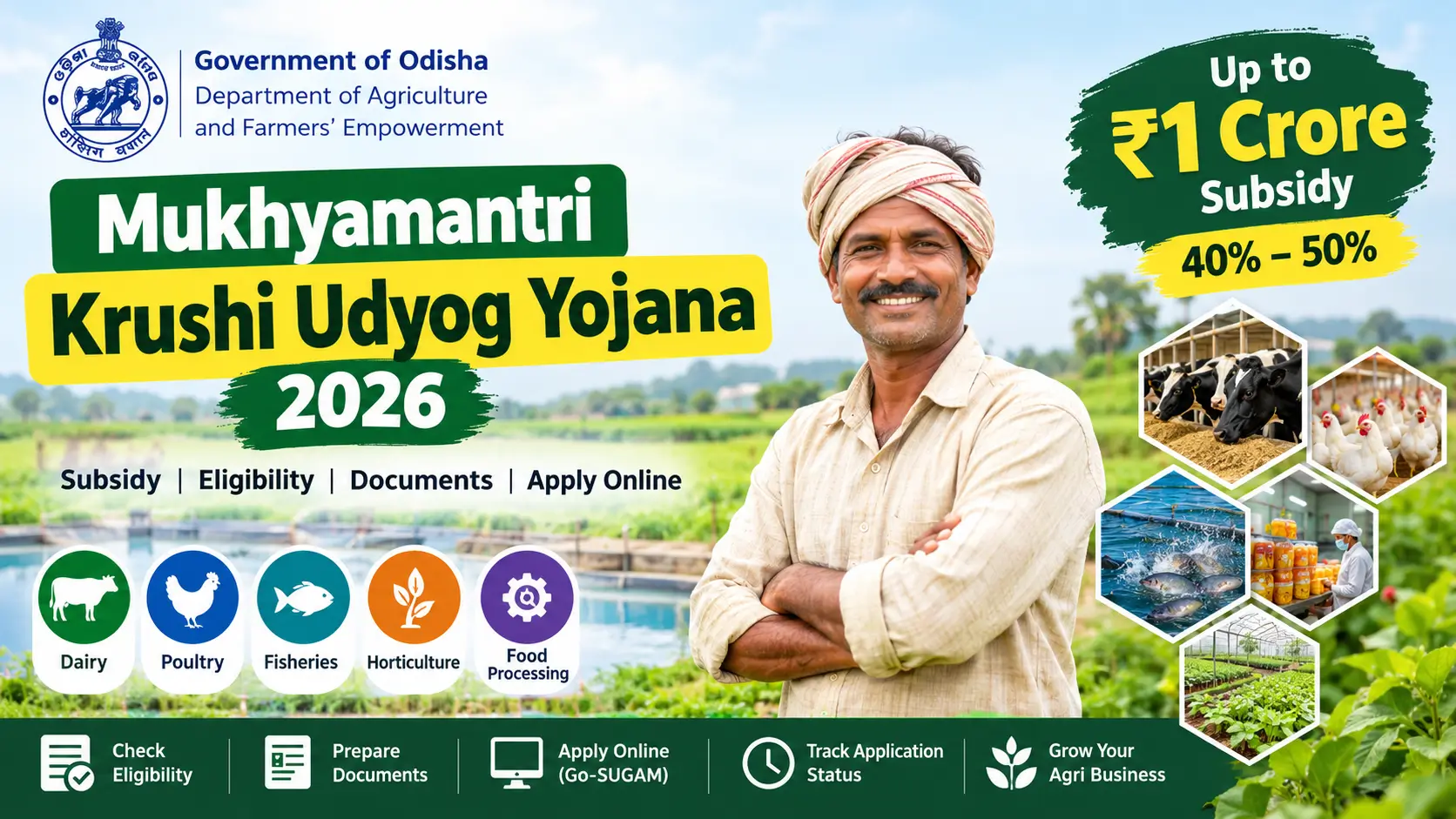
Mukhyamantri Krushi Udyog Yojana 2026: Eligibility, Subsidy Amount, Documents and Apply Online
Read in another language:
Odisha Mukhyamantri Krushi Udyog Yojana 2026
Want to start a dairy farm, poultry unit, fish farm, food-processing business or another agriculture-related enterprise in Odisha? The Mukhyamantri Krushi Udyog Yojana (MKUY) 2026 offers capital investment subsidies to eligible entrepreneurs who establish commercial agricultural businesses in the state.
Under the MKUY-2024 guidelines, eligible applicants can receive a subsidy of 40% or 50% of eligible fixed capital investment, subject to a maximum of ₹1 crore per entrepreneur or family. The applicable rate depends on the applicant’s category and the scheme’s conditions. Land purchase costs are not included in the subsidy calculation.
The Odisha Cabinet approved the continuation of the scheme from 2026-27 to 2030-31, with a reported outlay of ₹2,496.40 crore. However, applicants should check APICOL and the official Go-SUGAM portal for any updated operational guidelines before investing.
This guide explains the subsidy calculation, eligibility requirements, eligible businesses, documents, application process, approval timeline and conditions you should understand before starting your project.
Important: Obtain the required approval before starting project work. Do not assume that an already-started business or construction project will automatically qualify for assistance.
Mukhyamantri Krushi Udyog Yojana 2026: Overview
| Particular | Details |
|---|---|
| Scheme name | Mukhyamantri Krushi Udyog Yojana (MKUY) |
| State | Odisha |
| Launched | June 1, 2018 |
| Nodal agency | Agricultural Promotion and Investment Corporation of Odisha Limited (APICOL) |
| Implementing department | Department of Agriculture and Farmers’ Empowerment, Odisha |
| Type of assistance | Capital Investment Subsidy (CIS) |
| General subsidy rate | 40% of eligible fixed capital investment |
| Special-category subsidy rate | 50%, subject to eligibility |
| Maximum subsidy | ₹1 crore per entrepreneur or family |
| Maximum project cost | Below ₹50 crore |
| Application portal | sugam.odisha.gov.in |
| Applicable guidelines | MKUY-2024, subject to subsequent official changes |
| Reported extension | 2026-27 to 2030-31 |
What Is Mukhyamantri Krushi Udyog Yojana?
Mukhyamantri Krushi Udyog Yojana is an Odisha government initiative designed to encourage commercial investment in agriculture and allied sectors.
The scheme supports eligible entrepreneurs establishing businesses such as commercial dairy farms, poultry farms, fishery units, cold storage facilities, agricultural service centres and food-processing businesses.
APICOL acts as the nodal agency, while applications are processed through the state’s Go-SUGAM platform and the prescribed departmental approval system.
MKUY provides a capital investment subsidy, not a direct business loan. Applicants may finance their projects through their own funds or, where suitable, a bank loan. The subsidy is calculated according to eligible investment and scheme rules after the required verification.
Official resources:
- agri.odisha.gov.in/en/schemes/state-sector-scheme/mukhyamantri-krushi-udyog-yojana
- apicol.nic.in
- Go-SUGAM application portal
What Is New in MKUY in 2026?
1. Scheme continuation until 2030-31
On July 14, 2026, reports stated that the Odisha Cabinet had approved the continuation of MKUY for five additional years, covering 2026-27 to 2030-31. The reported outlay is ₹2,496.40 crore, with approximately 8,500 commercial agri-enterprise projects planned.
See the Odisha Cabinet extension report.
This announcement concerns continuation of the scheme. Do not assume that every operational rule has changed or that a new application is automatically approved. Check APICOL for subsequent notifications.
2. Separate support may be available for specific businesses
Certain sectors may have additional or separate assistance programmes. For example, eligible commercial dairy projects purchasing cattle from outside Odisha may qualify for a separate 15% top-up on eligible animal costs under the applicable dairy guidelines.
Check the Odisha Animal Husbandry and Veterinary Services guidelines (dahvs.odisha.gov.in/en/guidelines/page/4/) for the current conditions.
Large automated layer farms may also need to examine the separate Commercial Layer Farming Scheme rather than assuming that MKUY alone covers every requirement. Check the applicable scheme guidelines before preparing a poultry project.
MKUY Subsidy Amount: How Much Can You Receive?
The subsidy rate depends on the applicant’s category and the eligible fixed capital investment accepted during assessment.
| Applicant category | Subsidy rate | Maximum subsidy |
|---|---|---|
| General male entrepreneur | 40% | ₹1 crore |
| Eligible women entrepreneurs | 50% | ₹1 crore |
| Eligible SC/ST applicants | 50% | ₹1 crore |
| Eligible transgender applicants | 50% | ₹1 crore |
| Eligible persons with disabilities | 50% | ₹1 crore |
| Eligible agriculture and allied-subject graduates | 50% | ₹1 crore |
| Eligible groups and organisations | 40% or 50%, depending on the composition and rules | ₹1 crore |
The applicable scheme guidelines determine whether an applicant qualifies for the higher rate. For groups, the special-category rate is subject to the prescribed membership conditions.
MKUY subsidy calculation example
Suppose your proposed commercial dairy project has ₹2 crore in eligible fixed capital investment. The following examples show how the rates work.
| Calculation | General category | Eligible special category |
|---|---|---|
| Eligible investment | ₹2 crore | ₹2 crore |
| Applicable rate | 40% | 50% |
| Calculated subsidy before cap | ₹80 lakh | ₹1 crore |
| Maximum applicable subsidy | ₹1 crore | ₹1 crore |
| Illustrative subsidy | ₹80 lakh | ₹1 crore |
These figures are examples, not guaranteed payments. The final subsidy depends on the eligible investment verified by the authorities, the applicable cap and all other scheme conditions.
Remember: The cost of purchasing land is excluded. Your total project budget and the investment accepted for subsidy purposes may therefore be different.
Who Can Apply for MKUY?
The scheme permits applications from eligible individuals and various forms of organisations, subject to the relevant guidelines.
Eligible applicant types may include:
- Individual entrepreneurs
- Partnership firms and groups of individuals
- Farmer Producer Organisations (FPOs)
- Farmer Producer Companies (FPCs)
- Farmer Producer Groups (FPGs)
- Eligible Self-Help Groups (SHGs)
- Registered societies meeting the scheme requirements
- Eligible farmers’ cooperatives and federations
- Gram Panchayats and eligible block or district-level federations
- Companies registered under the Companies Act, 2013
The complete list and conditions should be checked in the current MKUY guidelines before an organisation applies.
Basic eligibility conditions
Applicants should review the following requirements before preparing a project proposal:
- Age: The applicant must be at least 18 years old when applying.
- Aadhaar and identification: Keep the required identity documents ready.
- Farmer ID and mobile number: The official MKUY registration instructions identify Farmer ID, Aadhaar and mobile number as mandatory registration details. Confirm the current portal requirements before proceeding.
- Project location: The commercial enterprise must be established in Odisha.
- Project cost: The total project cost must remain below ₹50 crore under the applicable guidelines.
- Income potential: The project should satisfy the prescribed average annual net-income requirement, generally ₹2 lakh and ₹1 lakh for women SHGs, subject to the guidelines.
- Land documents: You must provide acceptable ownership, lease or other prescribed land documentation.
- Prior approval: Obtain the required District Level Committee approval and Go-Ahead Letter before beginning the project.
The guidelines allow applicants who are not Odisha residents to establish eligible enterprises in the state, subject to the other requirements.
Land ownership and lease conditions
Land documentation is an important part of the application.
Depending on your situation, you may need:
- A Record of Rights (RoR) or other accepted land record
- A registered lease deed meeting the prescribed duration, generally at least 15 years
- A registered rental agreement meeting the applicable requirements, generally at least nine years
- A spouse’s No Objection Certificate where permitted
- A prescribed affidavit for jointly owned land
- A Tahasildar’s certificate where applicable for unsurveyed villages
Civil construction on rented premises is not eligible for subsidy under the stated guidelines.
Because the correct document depends on the ownership arrangement, confirm your case with the relevant District Nodal Officer before submitting the application.
Which Businesses Are Eligible Under MKUY?
The scheme’s illustrative project list covers a wide range of commercial activities. Eligibility depends on the specific activity, technical requirements and applicable guidelines.
1. Agriculture-related businesses
Examples include:
- Agricultural Service Centres
- Soil-testing laboratories
- Seed-processing units
- Organic and biofertiliser production
- Millet, pulse, maize and oilseed processing
- Farm machinery manufacturing
- Agricultural drone-related enterprises
- Hydroponics and other eligible modern farming projects
2. Horticulture businesses
Potentially eligible activities include:
- Protected cultivation
- Mushroom cultivation
- Nurseries and tissue-culture facilities
- Eligible perennial fruit plantations
- Honey production and beekeeping
- Fruit and vegetable processing
- Onion storage and ripening chambers
- Cashew and coir-related enterprises
3. Dairy, poultry and livestock businesses
Depending on the approved activity and project design, eligible enterprises may include:
- Commercial dairy farms
- Calf-rearing units
- Broiler and layer poultry farms
- Duck farming
- Goat and sheep farming
- Pig farming
- Hatcheries
- Animal-feed manufacturing
- Milk, meat and egg processing
- Veterinary clinics meeting qualification requirements
4. Fisheries businesses
Potentially eligible projects include:
- Fish and prawn farming
- Crab farming
- Fish hatcheries
- Biofloc aquaculture
- Recirculatory aquaculture systems
- Cage culture
- Fish-feed manufacturing
- Ice plants and processing facilities
5. Storage, logistics and other projects
The illustrative list also includes eligible projects such as:
- Cold storage facilities
- Solar cold storage
- Cold-chain logistics
- Rural godowns and silos
- Agricultural processing and storage infrastructure
- Integrated farming projects
- Eligible agro-eco-tourism enterprises
- Renewable energy systems for agricultural use
This list is not an automatic approval list. Some activities have specific technical standards, equipment requirements or exclusions.
For example, an Agro Service Centre must meet the prescribed equipment requirements. Check the approved machinery list and tractor subsidy limits before including equipment in your DPR.
Documents Required for MKUY Application
Prepare clear, readable scans of the documents relevant to your applicant type and project.
Documents for registration and application
- Aadhaar and the identity documents required by the portal
- Farmer ID and registered mobile number
- Passport-size photograph
- Land record, registered lease deed or applicable rental agreement
- Spouse’s NOC or co-sharer affidavit, where applicable
- Detailed Project Report (DPR)
- Project financial abstract
- Five geo-tagged photographs of the proposed site, as prescribed
- Family declaration and subsidy non-availing declaration
- Caste, disability or agriculture qualification certificate, if claiming the higher subsidy rate
- Partnership deed, incorporation documents or other organisation records, where applicable
- Any additional documents requested by the portal or department
Documents for subsidy release after completion
The completion-stage requirements may include:
- Bills and vouchers for eligible purchases
- GST details for applicable purchases
- Civil construction estimates and verification reports
- Purchase records for livestock, birds, plants or fingerlings
- Bank sanction documents for bank-financed projects
- Insurance documents for eligible assets
- Geo-tagged photographs of completed assets
- The prescribed project display board
- Udyam registration and FSSAI documents for applicable processing businesses
- Pollution-control documentation where required
Practical tip: The application-stage checklist and the completion-stage checklist are different. Keep your purchase bills, payment records, photographs and insurance documents organised from the beginning.
How to Apply Online for Mukhyamantri Krushi Udyog Yojana 2026
Applications are processed online through the Odisha government’s Go-SUGAM platform, subject to the current scheme workflow.
Step 1: Open the official portal
Visit https://sugam.odisha.gov.in/ and complete the required registration.
Use the correct mobile number and identification details.
Step 2: Complete the registration requirements
Keep your Farmer ID, Aadhaar and mobile number ready. Upload the documents requested by the registration form.
The official APICOL MKUY registration page (mkuy.apicol.nic.in/Prerequisites/Prerequisites) lists the registration prerequisites and document requirements.
Step 3: Select the MKUY scheme
Locate the relevant agriculture scheme and choose Mukhyamantri Krushi Udyog Yojana, following the options displayed on the portal.
Step 4: Prepare and submit the DPR
The Detailed Project Report should explain your proposed business, capital investment, equipment, construction requirements, estimated income and financial feasibility.
Prepare realistic estimates. Inflated or unsupported costs may be reduced during assessment.
You may seek professional assistance from an eligible technical agency or consultant, but make sure you understand the figures submitted in your name.
Step 5: Upload documents and site photographs
Upload the land documents, applicant certificates, DPR and prescribed geo-tagged site photographs.
Check the spelling of names, plot details and financial figures before submission.
Step 6: Pay the applicable application fee
The MKUY-2024 information lists a non-refundable application fee of ₹2,000 for general applicants and ₹500 for specified eligible categories.
Confirm the exact fee displayed for your applicant type on the official portal before paying. Do not pay an unofficial agent to secure approval.
Step 7: Submit and save your acknowledgement
After submission, save your application or reference number and payment receipt.
Check portal notifications and registered contact details for queries, requests for corrections and application updates.
Important: Submitting an application does not mean the project has been approved. Wait for the prescribed approval and Go-Ahead Letter before starting construction or other project work.
MKUY Application Approval Timeline
The MKUY-2024 guidelines prescribe a time-bound process, but the actual duration can depend on the completeness of your application and the actions required from different officials.
| Stage | Main responsibility | Timeline stated in the guidelines |
|---|---|---|
| Application submission | Applicant | Depends on preparation |
| Document scrutiny and queries | Block Level Officer (BLO) | Queries and returns follow prescribed limits |
| Site inspection and feasibility report | BLO | 7 days |
| District-level review | District Nodal Officer (DNO) | Prescribed review period |
| District Level Committee decision | DLC | Meeting scheduled for the 10th of each month or the next working day |
| Go-Ahead Letter | DNO after approval | Maximum 52 days from a complete application, under the stated guidelines |
These are guideline timelines, not a guarantee that every applicant will receive approval within 52 days. Incomplete documents, additional queries and other procedural issues can affect progress.
The responsible District Nodal Officer depends on the nature of the project. Agriculture, horticulture, animal husbandry, fisheries and certain processing activities may be handled by different departmental officers.
What Happens After Your Project Is Approved?
After receiving the Go-Ahead Letter, follow the approved project plan and the applicable construction, procurement and reporting requirements.
Project completion deadline
The stated guidelines generally require completion within two years of the Go-Ahead Letter. Specific provisions may apply when a bank loan is delayed.
The guidelines also prescribe subsidy reductions for certain delays:
| Delay beyond the prescribed completion period | Stated consequence |
|---|---|
| Up to 6 months | 20% deduction |
| More than 6 months and up to 1 year | 50% deduction |
| More than 1 year | No subsidy under the stated delay provisions |
Confirm the applicable calculation with APICOL or your District Nodal Officer before relying on these figures for a project schedule.
Subhadra yojana
Baristha Nagarika Tirtha Yatra Yojana Odisha 2026-27: Eligibility, Selection List & Next Round
Bidesh Sikhyabruti Scholarship Odisha 2026: Eligibility, ₹25 Lakh Benefits & How to Apply
Central govt schemes
Important requirements during construction
- Follow the approved DPR and permitted project specifications.
- Upload geo-tagged photographs at the required stages.
- Maintain genuine invoices and payment records.
- Obtain required insurance for eligible assets.
- Use the prescribed payment methods for purchases where required.
- Install the required permanent MKUY display board at the project site.
- Complete the project and submit the completion report and supporting evidence.
Do not assume that expenditure on an item automatically makes it eligible. The item must comply with the scheme’s rules and verification requirements.
Which Expenses Are Covered by MKUY?
MKUY focuses on eligible fixed capital investment. The accepted amount is determined according to the applicable guidelines and verification process.
| Potentially eligible expenditure | Generally excluded expenditure |
|---|---|
| Approved new buildings and business sheds | Purchase of land |
| Eligible plant and machinery | Working capital and recurring operating expenses |
| Eligible tools and implements | Residential buildings |
| Approved electrical installations | Guard rooms and masonry boundary walls |
| Eligible water sources, pumps and irrigation systems | Internal roads |
| Approved animals, birds, plants and other eligible assets | Civil construction on rented premises |
| Eligible one-year insurance premium | Existing civil infrastructure |
| Admissible DPR preparation costs | Items already subsidised from another source |
Additional size limits and valuation rules may apply to construction, machinery and other expenses.
How is eligible investment calculated?
Your DPR is not the only figure used to determine the subsidy. The authorities assess the investment against the applicable valuation standards, verified expenses and other prescribed checks.
The accepted amount may be lower than your original estimate. Spending more than the approved project budget does not automatically increase the subsidy.
Avoid claiming the same asset under two subsidy programmes unless the applicable rules expressly permit it.
How Is the MKUY Subsidy Paid?
The payment procedure differs according to whether the project is self-financed or financed through a bank.
Self-financed projects
For eligible self-financed projects, subsidy release generally follows project completion, the prescribed inspection and verification, and completion of the required documentation and agreement.
The approved subsidy is released to the entrepreneur’s Aadhaar-linked bank account according to the applicable procedure.
Bank-financed projects
For eligible bank-financed projects, the scheme provides a separate process involving the lending bank and a mirror account.
Under the MKUY-2024 procedure, the advance subsidy is subject to prescribed limits and is calculated using the applicable formula. It is not an unconditional payment to spend freely.
After project completion and verification, the final subsidy is calculated and adjusted against the bank-financed project according to the guidelines.
A bank loan is not compulsory for every MKUY project. If you choose bank financing, confirm the minimum financing and documentation conditions with the bank and APICOL.
How to Check MKUY Application Status
To follow your application:
- Open the official Go-SUGAM portal (https://sugam.odisha.gov.in).
- Log in using the registered credentials.
- Open the relevant application or scheme dashboard.
- Check the displayed status, pending requirements and departmental remarks.
- Respond promptly if documents or corrections are requested.
- Contact the relevant District Nodal Officer if the status remains unclear.
Keep your acknowledgement number and registered contact details available when requesting help.
If an application is rejected, read the stated reason carefully. Correct the specific problem and ask the relevant office whether you can submit a fresh application.
Common Mistakes That Can Delay an MKUY Application
Starting the project too early: Beginning construction before the required approval can make the project ineligible.
Submitting incomplete land documents: Incorrect plot details, an unsuitable lease or missing consent documents can delay scrutiny.
Preparing an unrealistic DPR: Unsupported investment estimates and weak financial projections may create problems during assessment.
Using incorrect photographs: Follow the prescribed geo-tagging and photograph requirements.
Losing invoices and payment records: Completion-stage verification may require evidence of actual eligible expenditure.
Ignoring insurance requirements: Check which capital assets must be insured and retain the supporting documents.
Missing the completion deadline: Delays may lead to subsidy deductions or loss of assistance under the applicable rules.
Relying on old online information: Earlier MKUY pages may contain superseded amounts, fees or application procedures. Use the current official guidelines.
Frequently Asked Questions
1. What is Mukhyamantri Krushi Udyog Yojana 2026?
It is an Odisha government scheme that provides capital investment subsidies to eligible commercial agricultural and allied-sector enterprises. The applicable MKUY-2024 guidelines provide assistance at 40% or 50% of eligible fixed capital investment, subject to a maximum of ₹1 crore per entrepreneur or family.
2. What is the maximum subsidy under MKUY?
The maximum stated subsidy is ₹1 crore per entrepreneur or family. The actual amount depends on the eligible investment, applicant category and scheme conditions.
3. Can women apply for a 50% subsidy?
Eligible women entrepreneurs fall within the special-category subsidy provisions. They must still satisfy the project, documentation and approval requirements.
4. Is MKUY a loan or a subsidy?
MKUY provides a capital investment subsidy, not a direct loan. Applicants may use their own funds or qualifying bank finance, subject to the applicable rules.
5. Can a person from outside Odisha apply?
The guidelines allow non-residents to establish eligible enterprises in Odisha, provided they meet the scheme’s other requirements.
6. Which businesses qualify for MKUY?
Eligible projects may include commercial dairy, poultry, fisheries, horticulture, food processing, cold storage and other approved agriculture-related enterprises. Check the activity-specific guidelines before investing.
7. What is the MKUY application fee?
The stated fee is ₹2,000 for general applicants and ₹500 for specified eligible categories. Verify the applicable fee on the official portal before payment. The fee is non-refundable under the stated scheme provisions.
8. How long does MKUY approval take?
The guidelines state a maximum of 52 days for the Go-Ahead Letter from a complete application, subject to the prescribed process. Incomplete applications or other procedural issues may affect the actual timeline.
9. Can I start construction before approval?
No. Obtain the required District Level Committee approval and Go-Ahead Letter before beginning the project.
10. When is the MKUY subsidy released?
Subsidy release follows the applicable completion, inspection, verification and documentation requirements. Bank-financed projects follow a separate process involving the lending bank.
11. Is there a final application date for MKUY 2026?
The MKUY-2024 guidelines reviewed for this guide do not establish a single annual closing date. However, applicants should check the current Go-SUGAM portal for notices, application availability and any subsequent deadlines.
12. Has MKUY been extended until 2030-31?
News reports dated July 2026 state that the Odisha Cabinet approved continuation for 2026-27 to 2030-31 with an outlay of ₹2,496.40 crore. Check official government or APICOL notifications for the latest implementation details.
Final Words
Mukhyamantri Krushi Udyog Yojana can help eligible entrepreneurs establish commercial agricultural businesses in Odisha through capital investment assistance. However, the maximum subsidy is not guaranteed, and not every expense qualifies.
Before investing, confirm your business’s eligibility, arrange valid land documents, prepare a realistic DPR, check the current fee and registration requirements, and obtain the required approval. Keep your invoices, payment records and completion documents organised so that the verification and subsidy-release process can proceed smoothly.
Disclaimer: This is an independent informational guide and is not affiliated with the Government of Odisha or APICOL. Scheme rules, application requirements and assistance may change. Verify current details through the official portal and relevant authorities before making investment decisions.