PM Surya Ghar Yojana Odisha 2026: Get Up to ₹1.38 Lakh Subsidy
Read in another language:
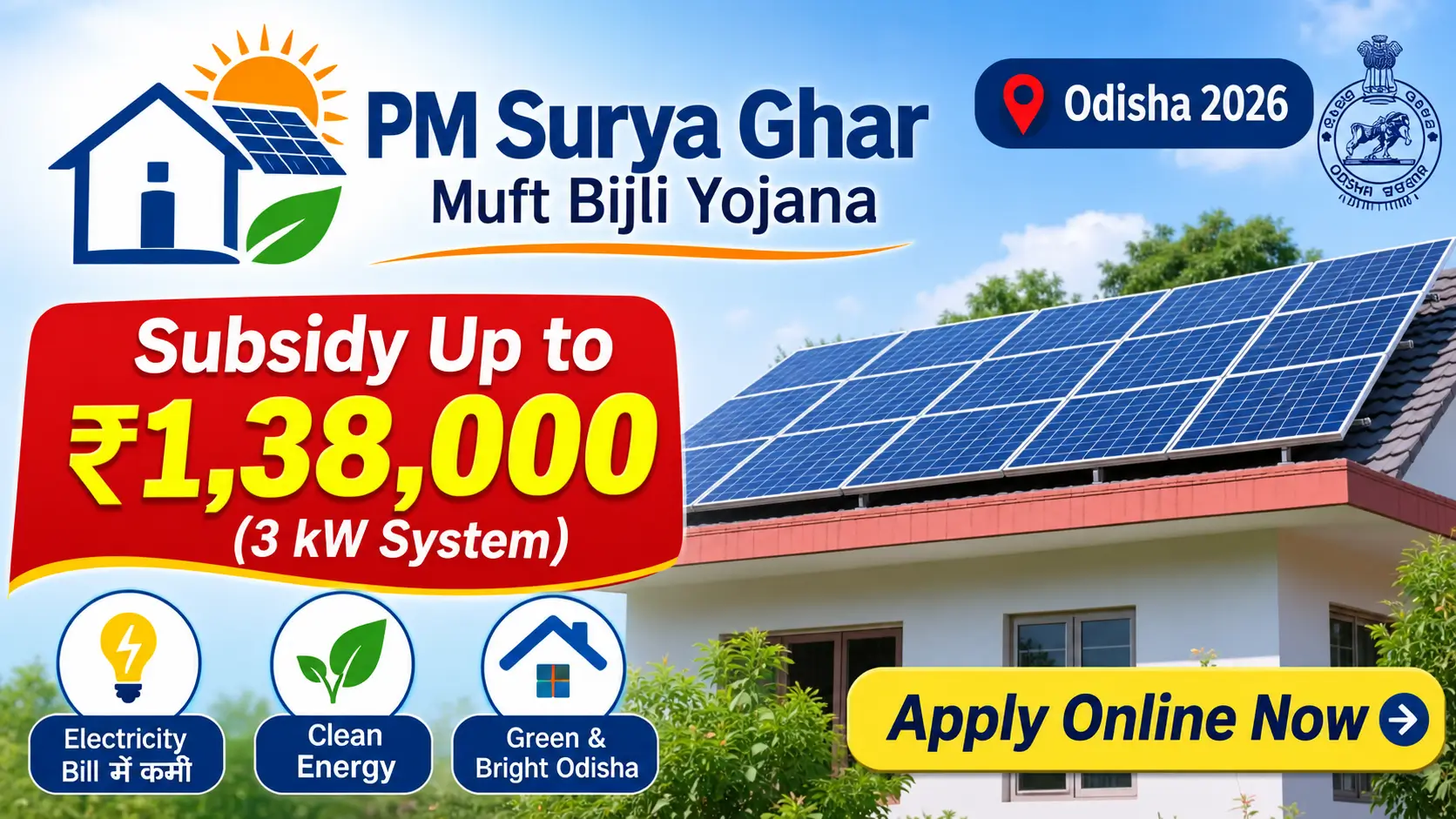
If you live in Odisha and own your house, PM Surya Ghar Yojana Odisha 2026 is probably the cheapest way to cut your electricity bill for the next 25 years. The Government of India pays a rooftop solar subsidy of up to ₹78,000, and the Odisha Government adds its own state financial assistance of up to ₹60,000 on top. For a 3 kW home system, that adds up to ₹1,38,000.
This guide explains the subsidy amount in plain numbers, who can apply, which documents you need, how to apply online step by step, what happens after installation, and the mistakes that delay subsidy payments. Every key claim here is checked against official government sources, which are linked at the end.
PM Surya Ghar Yojana Odisha 2026: Key Highlights
| Detail | Information |
|---|---|
| Scheme name | PM Surya Ghar: Muft Bijli Yojana (PMSG: MBY) |
| Launched | February 2024 |
| Run by | Ministry of New and Renewable Energy (MNRE) |
| Target | Rooftop solar for 1 crore households by FY 2026-27 |
| Maximum central subsidy | ₹78,000 (for 3 kW and above) |
| Odisha state assistance | ₹25,000 for 1st kW, ₹25,000 for 2nd kW, ₹10,000 for 3rd kW |
| Maximum combined subsidy (3 kW) | ₹1,38,000 |
| Apply at | pmsuryaghar.gov.in |
| National helpline | 15555 |
| Subsidy paid by | Direct Benefit Transfer (DBT) to your bank account |
What Is PM Surya Ghar Yojana?
PM Surya Ghar: Muft Bijli Yojana is a central scheme that helps households install rooftop solar panels at a much lower cost. You put solar panels on your roof, the panels run your home during the day, and any extra power goes back to the grid through a net meter. Your monthly bill drops, and in many homes it falls close to zero.
The scheme works through your local electricity company (DISCOM). In Odisha, that means TPCODL, TPNODL, TPSODL or TPWODL, depending on your area.
Rooftop Solar Subsidy in Odisha 2026: Central + State
Odisha households get two layers of support. The first comes from the Centre. The second comes from the state.
Central subsidy (MNRE)
| System size | Central subsidy |
|---|---|
| 1 kW | ₹30,000 |
| 2 kW | ₹60,000 |
| 3 kW or more | ₹78,000 (maximum) |
The rate is ₹30,000 per kW for the first 2 kW and ₹18,000 for the third kW. Install 5 kW or 10 kW and the central subsidy still stops at ₹78,000.
Odisha state financial assistance
The Odisha Cabinet approved extra assistance in January 2025 for households that install rooftop solar under PM Surya Ghar. The state has set a target of 3 lakh households to be covered by March 2027.
| System size | Odisha assistance |
|---|---|
| 1 kW | ₹25,000 |
| 2 kW | ₹50,000 |
| 3 kW | ₹60,000 |
Total subsidy you can expect
| System size | Central | Odisha | Combined |
|---|---|---|---|
| 1 kW | ₹30,000 | ₹25,000 | ₹55,000 |
| 2 kW | ₹60,000 | ₹50,000 | ₹1,10,000 |
| 3 kW | ₹78,000 | ₹60,000 | ₹1,38,000 |
A note on conflicting information: a few websites still say Odisha gives no state subsidy. That is outdated. The Odisha Cabinet decision and the Odisha Energy Department’s own announcements confirm the state top up. Still, budgets are reviewed every year, so confirm the current amount with your DISCOM before you book an installer.
How Much Will Solar Actually Cost You in Odisha?
Subsidy numbers look great, but the subsidy is paid after your system is installed and inspected. That means you pay the vendor first and get money back later. Plan for that cash flow.
Market prices vary by brand, panel type and location, so treat the numbers below as a rough guide only. Always get written quotes from at least two approved vendors.
| System size | Typical market cost (estimate) | Combined subsidy | Approximate out of pocket |
|---|---|---|---|
| 1 kW | ₹60,000 to ₹75,000 | ₹55,000 | ₹5,000 to ₹20,000 |
| 2 kW | ₹1.2 to ₹1.4 lakh | ₹1,10,000 | ₹10,000 to ₹30,000 |
| 3 kW | ₹1.8 to ₹2.2 lakh | ₹1,38,000 | ₹40,000 to ₹80,000 |
A simple savings example
Say you install a 3 kW system. In Odisha, a good rooftop system usually produces around 4 units per kW on a sunny day, so roughly 360 units a month. If you pay about ₹5 per unit, that is around ₹1,800 saved every month. On an out of pocket cost of ₹60,000, you would earn it back in a little under three years. Your actual numbers depend on shade, roof direction, cloudy months and your tariff.
Which Solar System Size Do You Need?
The scheme guidelines link system size to your monthly electricity use.
| Average monthly use | Suggested size |
|---|---|
| 0 to 150 units | 1 to 2 kW |
| 150 to 300 units | 2 to 3 kW |
| More than 300 units | 3 kW or higher |
Check your last 6 to 12 electricity bills and take the average. If your roof can only fit 2.5 kW, do not force a 3 kW system just to touch the maximum subsidy. Shadows and cramped panels will cost you more than you gain.
Is Solar Electricity Really Free?
The scheme is called Muft Bijli, which means free electricity, and you will see claims about 300 free units a month. Here is what that means in practice. The government does not send you free units. Your own panels generate power, and that generation offsets what you would otherwise buy from the DISCOM. A household that uses around 300 units a month can cover most or all of that with a well sized system. If you use more, or your panels produce less in the monsoon, you will still get a small bill. You also still pay fixed and meter charges.
Eligibility for PM Surya Ghar Yojana Odisha
You can apply if all of the following are true:
- You are an Indian citizen.
- You own a residential house with a roof suitable for solar panels.
- You have a valid electricity connection from your DISCOM, in your household.
- Your household has not already taken a subsidy for solar panels.
Can tenants apply? Not on their own. The scheme requires house ownership with usable roof space. If you rent, the owner can apply for the house.
Can apartment residents apply? Individual flats with no roof rights usually cannot. Group Housing Societies and Residents Welfare Associations can get central support of ₹18,000 per kW for common facilities such as lighting and EV charging, up to 500 kW, counted at 3 kW per house.
Commercial or industrial connections are not covered by the household subsidy.
Documents Required
Keep digital copies ready before you register:
- Aadhaar card
- Latest electricity bill showing your consumer number
- Active mobile number and email ID
- Proof of house ownership or roof rights
- Bank account details with a cancelled cheque (needed at the subsidy stage)
- Address proof
How to Apply for PM Surya Ghar Yojana Odisha Online
You apply on the National Portal for Rooftop Solar. Here is the full process in order.
Step 1: Register on the portal. Go to pmsuryaghar.gov.in and choose “Apply for Rooftop Solar”. Select Odisha as your state and your electricity distribution company. Enter your consumer account number, mobile number and email.
Step 2: Log in. Use your consumer number and mobile number to log in.
Step 3: Submit the rooftop solar application. Fill in the form and choose your preferred capacity.
Step 4: Wait for DISCOM approval. Your DISCOM checks the application and gives feasibility approval. Do not buy or install anything before this.
Step 5: Choose a registered vendor. Pick an installer listed on the national portal for your DISCOM area and get the system installed.
Step 6: Submit installation details and apply for the net meter. Upload the plant details on the portal.
Step 7: Inspection and commissioning. The DISCOM installs the net meter, inspects the plant and issues a commissioning certificate.
Step 8: Claim your subsidy. Enter your bank details and upload a cancelled cheque. The central subsidy is sent to your account within about 30 days.
For the state share, ask your DISCOM or OREDA whether any extra form or document is needed in your district and how the amount reaches your bank account. Procedures can change, and this is the step people most often skip.
Loan Options for Solar Installation
If you do not want to pay the full upfront amount from savings, the scheme allows collateral free loans from banks for rooftop systems up to 3 kW. The interest rate is linked to the repo rate plus a small margin (reported at about 7 percent when the scheme was announced), with a tenure of up to 10 years. Ask your bank which rate applies today, and compare the monthly EMI against your expected monthly savings.
Common Mistakes That Delay Your Subsidy
- Installing before approval. If the system goes up before DISCOM approval, your subsidy can be rejected.
- Using an unregistered vendor. Only installers registered on the national portal count.
- Name mismatch. The name on the electricity bill, Aadhaar and bank account should match.
- Wrong bank details. One wrong digit in the account number can hold the payment for weeks.
- Skipping the net meter. Without net metering and commissioning, there is no subsidy claim.
- Paying someone to “release” your subsidy. The subsidy goes straight to your bank account. Nobody needs a fee for that.
How to Avoid Solar Scams
Be careful with people who call you saying they are from the “solar department” or ask for an advance to “book” your subsidy. Apply only through the official portal. Never share your OTP, Aadhaar number or bank password with an agent. Check that your installer appears on the national portal’s vendor list, and ask for a written quotation that names panel brand, inverter brand, warranty and the exact kW capacity.
PM Surya Ghar and PMAY Housing in Odisha: Latest Update
In July 2026, Deputy Chief Minister and Energy Minister Kanak Vardhan Singh Deo said the state will link PM Surya Ghar with housing schemes such as the Pradhan Mantri Awaas Yojana (PMAY). Solar will be offered as an option to housing scheme beneficiaries. For an urban beneficiary installing a 1 kW system, reports said the Centre gives ₹30,000, Odisha gives ₹25,000, and the beneficiary pays ₹1,875. If you are building or have just received a PMAY house, ask your urban local body or DISCOM office how to add solar.
The state also announced an underground cabling project worth ₹3,708 crore across all four DISCOMs to improve power safety.
Last Date for PM Surya Ghar Yojana Odisha
The scheme is planned to run until FY 2026-27, which ends in March 2027, with a national target of 1 crore households. Odisha’s own target for state assistance is also March 2027. No separate application deadline has been announced, but you should not wait. Installation and subsidy approvals take weeks, and funding or rules can change after the target period. If you are planning to go solar, start the process now and check the national portal for any extension.
How to Check Application Status and Get Help
Log in to the national portal with your consumer number to see where your application stands, whether approval, installation, inspection or subsidy. For questions about registration, vendors or subsidy delays, call the national helpline on 15555, which works in several languages. You can also visit your DISCOM’s consumer office.
Is PM Surya Ghar Yojana Worth It for Odisha Households?
For most owner occupied homes with a shadow free roof and monthly use above 150 units, yes. The subsidy is large, the loan option is available, and panels last 25 years or more. It is less attractive if your roof is heavily shaded, you plan to sell the house soon, or your bill is already very low. Panels in coastal districts should be mounted with strong structures, so choose a vendor who explains wind load and warranty clearly.
Frequently Asked Questions
How much subsidy do I get under PM Surya Ghar Yojana in Odisha?
The central subsidy is ₹30,000 for 1 kW, ₹60,000 for 2 kW and ₹78,000 for 3 kW or more. Odisha adds ₹25,000, ₹50,000 and ₹60,000 for the same sizes, so a 3 kW system can get up to ₹1,38,000 in total.
Is there a state subsidy for rooftop solar in Odisha?
Yes. The Odisha Cabinet approved state financial assistance in January 2025 for households installing rooftop solar under PM Surya Ghar. Confirm the current rate with your DISCOM, as state budgets are reviewed each year.
How do I apply for PM Surya Ghar Yojana in Odisha online?
Register at pmsuryaghar.gov.in with your state, DISCOM, consumer number, mobile number and email. Log in, submit the application, wait for approval, install through a registered vendor, apply for net metering, and then claim the subsidy with your bank details.
What documents are required?
Aadhaar, electricity bill, address proof, proof of house ownership or roof rights, mobile number, email, and bank details with a cancelled cheque.
Can I get the subsidy if I rent my house?
No. The applicant must own a house with a suitable roof. The owner can apply instead.
Will the subsidy be paid before or after installation?
After. You pay the vendor first. The central subsidy is credited to your bank account after commissioning, usually within about 30 days of your claim.
Can I install more than 3 kW?
Yes, but the central subsidy is capped at ₹78,000, and the announced Odisha assistance is counted up to 3 kW. Larger systems make sense only if your electricity use is high.
Do I get 300 units of free electricity?
Your panels offset up to around 300 units of monthly use if the system is sized well. It is not a separate free supply from the government, and some fixed charges still apply.
What is the helpline number?
15555 is the national helpline for PM Surya Ghar Muft Bijli Yojana.
Can residents of apartments and housing societies get a subsidy?
Group Housing Societies and Residents Welfare Associations can get ₹18,000 per kW for common facilities, up to 500 kW, counted at 3 kW per house.
Official Sources Used in This Guide
- Government of Odisha
- National Portal for Rooftop Solar (MNRE) (pmsuryaghar.gov.in)
- Consumer login on the national portal (consumer.pmsuryaghar.gov.in/consumer/)
TPSODL Solar Rath (16 October 2026): TP Southern Odisha Distribution Limited flagged off its Solar Rath from the Koraput Collectorate as part of the month-long Seva Sankalp Abhiyan. The Rath will travel across all 14 blocks of Koraput district, spreading awareness about the PM Surya Ghar Muft Bijli Yojana and the Utility-Led Aggregation (ULA) model — using radio jingles, IEC leaflets and Solar Sanga members who guide households through the application process on the spot.
More Odisha and Central Government Schemes You May Like
- Women in your family can also check the Subhadra Yojana 5th installment update for payment news and support tips.
- Read about the Pradhan Mantri Samajik Sahayata Yojana and its new allocation.
- Browse more central government schemes explained in simple language.
Subhadra Yojana
OPSC AEE Civil Exam 2026: 3-Week Delay Gives Candidates More Time
OSSC CPGLRE Result Out 2026: 193 Candidates Shortlisted, Check Cut Off Marks
Conclusion
PM Surya Ghar Yojana Odisha 2026 gives owners of houses a real chance to lower their power bills for decades, and Odisha’s extra assistance makes the numbers better than in many other states. Start by checking your average monthly units, get quotes from registered vendors, apply on the official portal before you install anything, and keep every receipt and certificate. If you follow the steps in order, the subsidy process is smooth.
Disclaimer: subhadra-yojanain.com is an independent website and is not affiliated with the Government of India or the Government of Odisha. Subsidy amounts, rules and deadlines can change. Always confirm the latest details on pmsuryaghar.gov.in or with your DISCOM before applying or paying any vendor.