PM-RAHAT Scheme 2026: Benefits, Eligibility, Cashless Treatment & Latest Update
Read in another language:
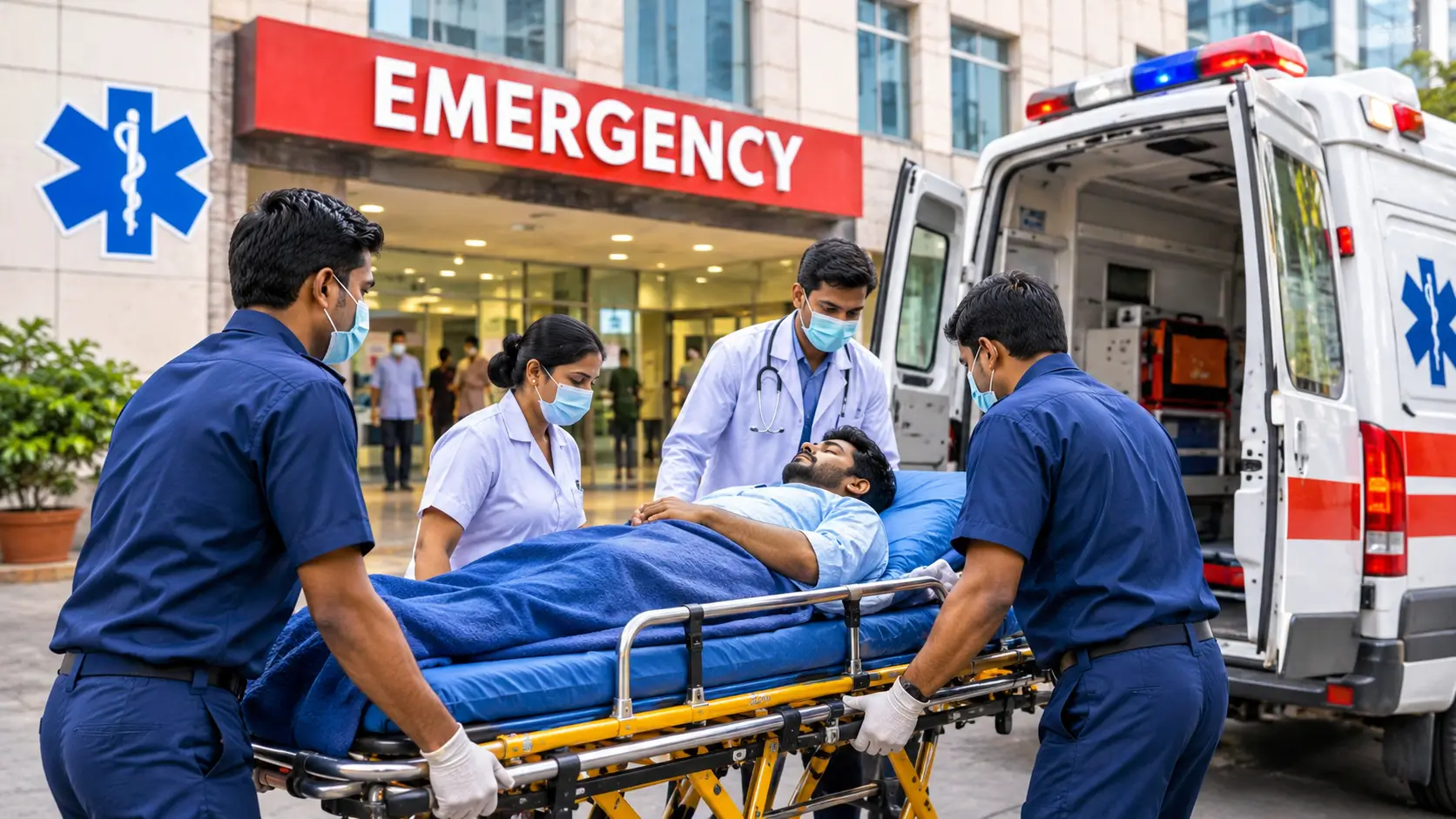
The PM-RAHAT Scheme provides cashless medical treatment of up to ₹1.5 lakh to eligible road accident victims in India. The treatment cover is available for a maximum of seven days from the date of the accident, regardless of the category of road. The scheme is designed to ensure that accident victims receive timely medical care without having to arrange money before treatment.
The National Medical Commission (NMC) issued a public notice on 16 November 2026 asking all government medical colleges and their attached hospitals to take steps towards joining the PM-RAHAT Scheme. The move follows a request from the Union Health Ministry to expand the network of participating healthcare institutions.
PM-RAHAT Scheme 2026: Overview
| Particulars | Details |
|---|---|
| Scheme name | Prime Minister – Road Accident Victims’ Hospitalisation and Assured Treatment (PM-RAHAT) |
| Nodal Ministry | Ministry of Road Transport and Highways |
| Implementing authority | National Health Authority and participating State/UT agencies |
| Legal provision | Section 162, Motor Vehicles Act, 1988 |
| Original notification | 5 May 2025 |
| Implementation guidelines | 4 June 2025 |
| Launch date | 13 February 2026 |
| Official naming notification | 19 February 2026 |
| Maximum treatment cover | ₹1.5 lakh per victim |
| Treatment period | Up to 7 days from the accident |
| Road coverage | Any category of road |
| Emergency number | 112 |
| Hospital reimbursement | Within 10 days of claim approval |
What Is the PM-RAHAT Scheme?
The PM-RAHAT Scheme is a Government of India initiative that provides cashless treatment to people injured in road accidents involving motor vehicles.
Its main purpose is to reduce delays in emergency treatment, particularly during the Golden Hour. This is the critical first hour after a traumatic injury when timely medical intervention can significantly improve the chances of survival.
The scheme operates under Section 162 of the Motor Vehicles Act, 1988. It was initially notified on 5 May 2025 through S.O. 2015(E). The government subsequently issued implementation guidelines on 4 June 2025 through S.O. 2489(E).
Prime Minister Narendra Modi approved its launch on 13 February 2026. The scheme received its official PM-RAHAT name through notification S.O. 952(E), dated 19 February 2026.
PM-RAHAT Scheme Benefits
The scheme offers several benefits to road accident victims and their families.
1. Cashless Treatment Up to ₹1.5 Lakh
Eligible accident victims can receive cashless treatment worth up to ₹1.5 lakh per person. The amount is subject to the applicable Health Benefit Packages and scheme guidelines.
2. Treatment for Up to Seven Days
The maximum treatment coverage is seven days from the date of the accident. This helps victims receive necessary medical attention during the initial recovery period.
3. Coverage on Any Category of Road
The scheme is not restricted to national highways or expressways. It covers eligible motor vehicle accidents occurring on any category of road.
4. Emergency Stabilisation Treatment
Designated hospitals must provide stabilisation treatment for up to:
- 24 hours in non-life-threatening cases.
- 48 hours in life-threatening cases.
These periods are subject to the police response provisions under the scheme.
5. Emergency Ambulance Assistance
The scheme is integrated with the 112 Emergency Response Support System (ERSS). Victims and Good Samaritans can use this service to obtain information about nearby designated hospitals and request ambulance assistance.
6. No Upfront Payment for Covered Treatment
The scheme uses a cashless hospital reimbursement mechanism. The government system processes eligible treatment claims, rather than paying the ₹1.5 lakh directly to the victim.
Who Is Eligible for PM-RAHAT Scheme?
The scheme provides treatment coverage to victims involved in road accidents caused by the use of motor vehicles.
The official PIB explanation describes coverage in terms of the accident and the vehicle involved, rather than the victim’s income or employment status.
Important points:
- The accident must involve a motor vehicle.
- The scheme applies to any category of road.
- Treatment coverage is subject to the scheme’s hospital and package rules.
- The maximum treatment cover is ₹1.5 lakh per victim.
- The maximum coverage period is seven days from the accident.
Important: Do not confuse the 24-hour police authentication timeline with a separate eligibility deadline for reaching the first hospital. The PIB release describes the former as part of the claim verification process.
How to Get Cashless Treatment Under PM-RAHAT
There is no conventional advance application process for an accident victim. The hospital and the authorities handle the treatment registration and claim workflow.
Here is how the process works:
Step 1: Call Emergency Number 112
If a road accident occurs, call 112 for emergency assistance. The system can help identify the nearest designated hospital and arrange ambulance support.
Step 2: Reach a Hospital
The victim should receive emergency medical attention without unnecessary delay. Designated hospitals provide treatment under the scheme’s applicable packages.
Step 3: Hospital Registers the Treatment
The hospital records the patient’s treatment details through the National Health Authority’s Transaction Management System (TMS 2.0).
Step 4: Police Authentication
The hospital generates a treatment ID and sends the relevant details to district police through the Electronic Detailed Accident Report (eDAR) platform.
The police response period is up to 24 hours in ordinary cases and up to 48 hours in life-threatening cases, as determined by the hospital administrator.
Step 5: Claim Verification and Approval
The hospital submits its claim through the prescribed digital process. The State Health Agency (SHA) handles claim approval according to the scheme guidelines.
Step 6: Payment to the Hospital
After the claim is approved, payment is made to the hospital within the prescribed 10-day period.
The payment source depends on whether the offending vehicle was insured, uninsured or involved in a hit-and-run accident.
Who Pays for PM-RAHAT Treatment?
The scheme uses the Motor Vehicle Accident Fund (MVAF) to reimburse hospitals for eligible treatment.
The funding mechanism works as follows:
| Accident situation | Payment source |
|---|---|
| Offending vehicle is insured | Contributions from general insurance companies |
| Offending vehicle is uninsured | Government budgetary support |
| Hit-and-run accident | Government budgetary support |
The important point for victims is that the treatment process is not supposed to be delayed simply because the offending vehicle is uninsured or cannot be identified.
Types of Hospitals Under PM-RAHAT
The National Health Authority’s hospital onboarding framework provides different participation routes.
1. AB PM-JAY Empanelled Hospitals
Hospitals already empanelled under Ayushman Bharat Pradhan Mantri Jan Arogya Yojana can be treated as designated hospitals under PM-RAHAT when they comply with the scheme’s applicable NHA guidelines.
2. PM-RAHAT Only Hospitals
Hospitals that are not empanelled under PM-JAY can participate separately if they meet the required trauma-care and hospital eligibility standards.
They can provide the applicable PM-RAHAT treatment packages after completing the prescribed onboarding process.
3. PM-RAHAT Lite Hospitals
Hospitals that can provide initial stabilisation treatment can participate through the PM-RAHAT Lite category, subject to the applicable guidelines.
Their role is to provide initial emergency care and arrange referral to an appropriate higher-level hospital when required.
Latest NMC Update: Government Medical Colleges Asked to Join PM-RAHAT
The National Medical Commission issued an important public notice dated 16 November 2026 concerning the expansion of PM-RAHAT hospital participation.
The notice is addressed to the Deans, Directors and Principals of government medical colleges and the Medical Superintendents of their attached hospitals.
The development followed two important events:
- 24 September 2026: A Steering Committee meeting was held under the chairmanship of the Secretary, Ministry of Road Transport and Highways. The meeting highlighted the need for wider participation from the medical community.
- 28 October 2026: The Ministry of Health and Family Welfare’s Trauma and Burn Cell requested the NMC to facilitate the onboarding of government medical colleges and their attached hospitals.
Following this request, the NMC asked the institutions to take necessary steps to participate in the scheme and give the matter priority.
The notice also refers to NHA guidelines for hospital onboarding and empanelment.
What does this mean for accident victims?
Government medical colleges and their attached hospitals can play an important role in emergency and trauma care. Expanding their participation could strengthen the network of facilities available to road accident victims.
However, the NMC notice is an onboarding request. It does not establish that every government medical college has already completed registration or started providing PM-RAHAT treatment.
PM-RAHAT Scheme Implementation Status 2026
The government has also shared figures showing how the scheme was being implemented across India.
According to a Ministry of Road Transport and Highways statement published by PIB on 12 August 2026, the position as of 31 July 2026 was:
| Particulars | Reported figures |
|---|---|
| Total beneficiaries | 22,481 |
| States and UTs covered | 34 |
| Claims approved by State Health Agencies | ₹12.59 crore |
| Amount paid to hospitals | ₹10.56 crore |
| Cases approved | 18,149 |
| Cases discharged after no police response within the prescribed timelines | 3,674 |
| Life-threatening cases found ineligible by State Police | 658 |
These figures provide an indication of the scheme’s implementation during its initial months.
Note: These are figures reported as of 31 July 2026. They should not be treated as the latest live beneficiary count.
More Central Govt Schemes
SVAMITVA Property Card 2026 : Eligibility, Status Check, Download & Odisha Update
Stand Up India Scheme 2026 : Loan, Eligibility & 2031 Extension
PM Surya Ghar Yojana Odisha 2026 : Get Up to ₹1.38 Lakh Subsidy
Ayushman Gopabandhu Jan Arogya Yojana 2026 : ₹5 Lakh Free Health Cover for Odisha Families
PM Vishwakarma Yojana 2026 : What Traditional Artisans Should Know Before Applying
Post Office RD Rules 2026 : Interest Rate, Maturity Chart & New Aadhaar Rule
PF Withdrawal Rules 2026 : Eligibility, Limits, Tax and Online Claim
PM Kisan 24th Installment Odisha : Date, ₹2,000 Payment Status and CM-KISAN Benefits
Pradhan Mantri Samajik Sahayata Yojana 2026 : NSAP Gets a New Name, Disability Pension Increase, Eligibility and ₹53,428 Crore
PM Surya Sarovar Yojana 2026 : Eligibility, Subsidy, Benefits and Latest Status
PM Jan Dhan Yojana 2026 : Benefits, ₹10,000 Overdraft, Documents and Bank Camps
What Facilities Must Hospitals Have to Join?
The NHA onboarding framework sets requirements for hospitals seeking participation.
Depending on the category of participation, relevant facilities and capabilities include:
- A dedicated emergency and trauma care department.
- Round-the-clock emergency services.
- ICU facilities.
- An operation theatre for emergency surgery.
- Diagnostic facilities, including X-ray, CT scan and ultrasound.
- Blood bank or blood storage facilities.
- Ambulance services with appropriate life-support equipment.
- Relevant medical and surgical specialities, including emergency medicine, general surgery and orthopaedics.
Hospitals must follow the applicable NHA empanelment and onboarding requirements.
The National Health Authority’s Hospital Engagement Module (HEM) is the portal used for hospital engagement.
How to File a Complaint Under PM-RAHAT?
If an eligible victim faces a problem with treatment or implementation of the scheme, the government has provided a structured grievance redressal mechanism.
The process works through the following levels:
- District level: Contact the Grievance Redressal Officer or designated point of contact appointed by the District Road Safety Committee (DRSC).
- District Collector: If the complaint is not resolved satisfactorily, it can be escalated to the District Collector.
- State level: The matter can subsequently be taken to the State Road Safety Council (SRSC), the nodal agency for the state or Union Territory.
- National level: An Inter-Ministerial Steering Committee monitors the overall implementation of the scheme.
Keep available hospital records, treatment details and relevant accident information when raising a complaint.
PM-RAHAT vs Ayushman Bharat PM-JAY
Although both schemes are related to healthcare, their purposes are different.
| Comparison | PM-RAHAT | Ayushman Bharat PM-JAY |
|---|---|---|
| Main purpose | Road accident treatment | Hospital treatment for eligible beneficiaries |
| Target group | Victims of motor vehicle road accidents | Eligible families under PM-JAY |
| Main benefit | Cashless accident treatment | Cashless hospitalisation under applicable packages |
| Coverage limit | Up to ₹1.5 lakh | According to PM-JAY rules |
| Treatment duration | Maximum 7 days from the accident | According to applicable scheme rules |
| Hospital network | PM-RAHAT designated hospitals | PM-JAY empanelled hospitals |
An important distinction is that PM-JAY empanelled hospitals that meet PM-RAHAT guidelines are treated as designated hospitals under the accident treatment scheme.
Frequently Asked Questions About PM-RAHAT Scheme
1. What is the PM-RAHAT Scheme?
PM-RAHAT is a Central Government scheme that provides cashless treatment of up to ₹1.5 lakh to victims of road accidents involving motor vehicles, for a maximum period of seven days from the accident.
2. Who can get benefits under PM-RAHAT?
People involved in road accidents caused by the use of motor vehicles can receive treatment under the scheme, subject to its applicable rules and hospital arrangements.
3. Is PM-RAHAT treatment free?
Eligible treatment is provided on a cashless basis within the scheme’s ₹1.5 lakh limit and applicable treatment packages. The amount is paid through the hospital reimbursement system, not directly to the victim.
4. Is there an application form for PM-RAHAT?
There is no conventional advance application process for victims. The hospital handles treatment registration and the associated digital claim process.
5. What is the maximum benefit under PM-RAHAT?
The maximum treatment cover is ₹1.5 lakh per victim for up to seven days from the date of the accident.
6. Does PM-RAHAT cover accidents on state and local roads?
Yes. The scheme covers eligible motor vehicle accidents on any category of road, not just national highways.
7. What is the emergency number for PM-RAHAT?
Call 112 for emergency response assistance, including information about nearby designated hospitals and ambulance support.
8. What happens if the accident involves an uninsured vehicle?
The scheme provides for government budgetary support through the Motor Vehicle Accident Fund in uninsured and hit-and-run cases.
9. What is the role of the NMC in PM-RAHAT?
The NMC has asked all government medical colleges and their attached hospitals to take steps towards onboarding and participation in the scheme.
10. When was the PM-RAHAT Scheme launched?
The Prime Minister approved its launch on 13 February 2026. The official PM-RAHAT name was notified on 19 February 2026.
11. How long does the hospital have to receive payment?
The prescribed payment period is 10 days from the date the State Health Agency approves the claim.
12. Is PM-RAHAT the same as Rah-Veer?
No. PM-RAHAT provides cashless treatment to accident victims. Rah-Veer is a separate initiative associated with recognising people who help road accident victims.
Final Words
The PM-RAHAT Scheme is an important step towards making emergency treatment more accessible to road accident victims in India. Its ₹1.5 lakh cashless treatment cover, seven-day limit and integration with the 112 emergency response system are designed to reduce delays in medical care.
The latest NMC notice dated 16 November 2026 is also significant because it encourages wider participation by government medical colleges and their attached hospitals.
Victims and their families should use the official emergency response system and confirm hospital participation through the relevant authorities when possible.
Official Sources
The following government sources can be used to verify the information in this article:
- PIB – PM-RAHAT Cashless Treatment of Road Accident Victims (11 March 2026) (https://www.pib.gov.in/PressReleasePage.aspx?PRID=2238637®=3&lang=2)
- PIB – Implementation Status of PM-RAHAT Scheme (12 August 2026) (https://www.pib.gov.in/PressReleasePage.aspx?PRID=2298285&lang=2®=48)
- National Medical Commission – Official Notices
- National Health Authority – Hospital Engagement Module (https://hem.nha.gov.in/)
- Ministry of Road Transport and Highways (https://morth.nic.in/)
Disclaimer: Subhadra-yojanain.com is an independent informational website and is not affiliated with the Government of India. Scheme details may change. Readers should verify current rules and hospital participation through official government sources.