MMJJM 2.0 Odisha 2026: ₹30,000 Livelihood Support, Eligibility and Selection Process
Read in another language:
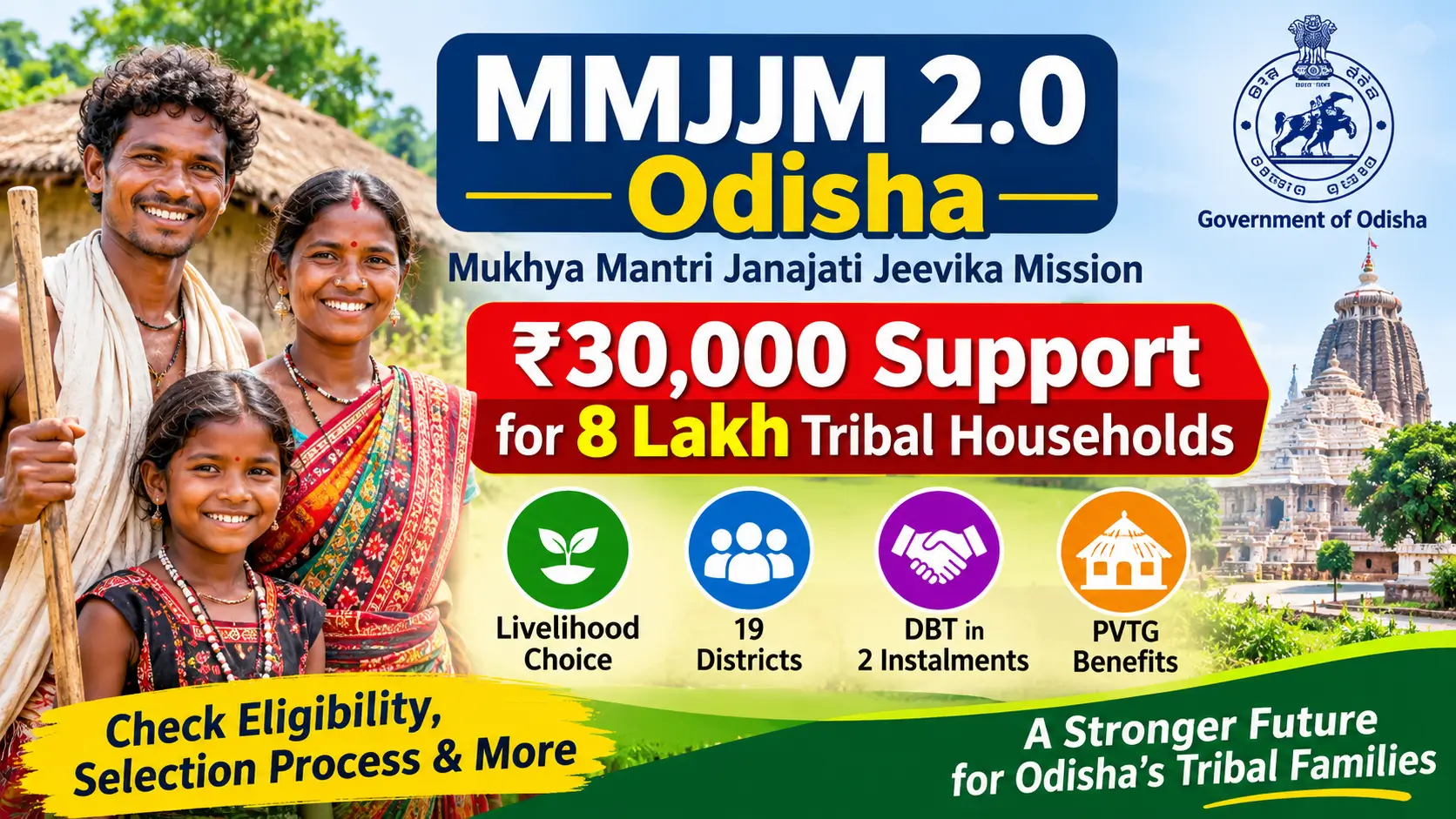
Odisha has approved a major expansion of its tribal livelihood programme. The second phase of the Mukhya Mantri Janajati Jeevika Mission, known as MMJJM 2.0, aims to support around 8 lakh Scheduled Tribe (ST) and Particularly Vulnerable Tribal Group (PVTG) households over five years.
The Odisha Cabinet approved the programme on 1 August 2026, with a total outlay of ₹2,995 crore. Under the scheme, eligible households will receive ₹30,000 in financial assistance through Direct Benefit Transfer (DBT) for livelihood-related activities.
But who can benefit from MMJJM 2.0 Odisha? Is there an online application form? How will families be selected, and when will the money be released?
Here is what is known from the available Cabinet information, department notices and published reports—and what families should verify before taking action.
Quick Answer: MMJJM 2.0 is an Odisha government tribal livelihood programme targeting approximately 8 lakh households across 19 districts. The announced assistance is ₹30,000 per household in two instalments. Selection is expected to take place through local implementing agencies and livelihood planning, rather than a publicly announced individual online registration form.
MMJJM 2.0 Odisha: Overview
| Scheme Detail | Information |
|---|---|
| Full Name | Mukhya Mantri Janajati Jeevika Mission 2.0 |
| Short Name | MMJJM 2.0 |
| State | Odisha |
| Approved By | Odisha Cabinet |
| Approval Date | 1 August 2026 |
| Implementing Department | ST & SC Development, Minorities & Backward Classes Welfare Department |
| Total Outlay | ₹2,995 crore |
| Funding | Fully funded by the Odisha Government |
| Duration | 2026-27 to 2030-31 |
| Target Households | Around 8 lakh |
| Coverage | 19 districts and 134 TSP/MPA blocks |
| Implementing Agencies | 23 ITDAs and 20 Micro Project Agencies |
| Assistance | ₹30,000 per eligible household |
| Payment Method | Direct Benefit Transfer (DBT) |
| PVTG Flexi Fund | ₹500 crore |
The Cabinet announcement describes MMJJM 2.0 as a five-year livelihood programme for tribal and PVTG households. It expands the first phase from 13 districts to 19 districts and increases the intended coverage from around 1.5 lakh to 8 lakh households.
What Is MMJJM 2.0?
Mukhya Mantri Janajati Jeevika Mission is an Odisha government initiative designed to improve the income and living conditions of tribal families through sustainable livelihood activities.
The first phase began in August 2021. A case study published on the Ministry of Tribal Affairs’ knowledge portal describes the programme’s livelihood support and community-based implementation.
MMJJM 2.0 builds on that approach but expands its geographical reach and beneficiary target. Instead of providing assistance through a single fixed occupation, the mission supports different activities based on a family’s resources, skills and local market opportunities.
The programme is intended to strengthen farm, off-farm and non-farm livelihoods. It also includes support for production clusters, infrastructure, processing, storage and market linkages.
Official information can be checked through the MMJJM Odisha portal (https://mmjjm.odisha.gov.in/) and the ST & SC Development Department website. (https://stsc.odisha.gov.in/)
MMJJM Phase 1 vs MMJJM 2.0
| Particular | Phase 1 | MMJJM 2.0 |
|---|---|---|
| District Coverage | 13 districts | 19 districts |
| Target Households | Around 1.5 lakh | Around 8 lakh |
| PVTG Coverage | Selected areas | All PVTG beneficiaries targeted |
| Programme Period | First phase | 2026-27 to 2030-31 |
| Total Outlay | Not specified in the cited Cabinet reports | ₹2,995 crore |
| Livelihood Approach | Farm and non-farm activities | Expanded livelihood clusters and household-level planning |
| Additional PVTG Support | Not detailed in the cited reports | Nutrition, crèches and ₹500 crore Flexi Fund |
The main change is the expansion in coverage. MMJJM 2.0 aims to reach more than five times the number of households covered under the first phase.
How Much Money Will a Household Receive?
Under MMJJM 2.0, the announced financial assistance is ₹30,000 per eligible household. The Cabinet coverage confirms that the amount will be transferred in two instalments through DBT.
According to the reported terms of the department’s Expression of Interest (EOI) for implementing partners, the assistance is linked to an Individual Livelihood Plan.
The reported payment structure is:
| Instalment | Amount | Reported Condition |
|---|---|---|
| First Instalment | ₹15,000 | After preparation of the household livelihood plan |
| Second Instalment | ₹15,000 | After successful implementation of the plan, within the stipulated period |
| Total | ₹30,000 | For the approved livelihood activity |
The reported EOI terms state that the livelihood plan should have a value of at least ₹30,000.
For example, a household may choose an activity such as goat rearing, horticulture, fisheries or a small rural enterprise. The plan should be based on what the family can realistically manage and what is suitable for the local area.
Important: The ₹15,000 instalment conditions are based on reported EOI information. Beneficiaries should check the department’s original guidelines for the final payment conditions. The Cabinet announcement alone does not specify every release condition.
Who Is Eligible for MMJJM 2.0 Odisha?
The programme is intended for Scheduled Tribe and PVTG households living in the selected Tribal Sub-Plan (TSP) and Micro Project Area (MPA) blocks of Odisha.
The announced coverage includes:
- Scheduled Tribe households in the selected programme areas.
- PVTG households covered under the mission.
- Families residing in the notified blocks across 19 districts.
- Households identified through the programme’s beneficiary selection and livelihood planning process.
The Odisha Government has stated that all PVTG beneficiaries will be covered under MMJJM 2.0.
However, the target of covering all PVTG beneficiaries should not be interpreted as automatic payment to every household without verification. Families must follow the applicable identification and implementation process.
Which PVTG Communities Are Covered?
Odisha recognises 13 Particularly Vulnerable Tribal Groups (PVTGs):
- Bonda
- Birhor
- Chuktia Bhunjia
- Didayi
- Dongria Kondh
- Hill Kharia
- Juang
- Kutia Kondh
- Lanjia Saora
- Lodha
- Mankirdia
- Paudi Bhuyan
- Saora
The state has announced coverage for all PVTG beneficiaries under the mission. The district-wise list and detailed beneficiary rules should be confirmed through the department’s official guidelines.
Which Livelihood Activities Are Supported?
MMJJM 2.0 follows a beneficiary-centric approach. Eligible households can choose activities according to their skills, available resources and local market opportunities.
The programme’s reported livelihood areas include:
Agriculture and Horticulture
Families may choose crop cultivation, horticulture or other suitable agricultural activities. Support may also include livelihood infrastructure and production-related assistance.
Livestock and Fisheries
Livestock rearing and fisheries are among the recognised livelihood activities. The final activity should be selected according to local conditions and the household’s capacity.
Forest-Based Livelihoods
The programme supports forest-based activities, including value addition and livelihood opportunities linked to non-timber forest produce (NTFP).
Handloom, Handicrafts and Traditional Arts
Traditional skills may be used to develop income-generating activities through handloom, handicrafts and related enterprises.
Small Enterprises and Rural Entrepreneurship
Families may also explore small rural businesses and self-employment activities where these are suitable for the local market.
The programme also aims to strengthen infrastructure such as irrigation, storage, processing and marketing facilities. These facilities can help families improve the value and sale of their products.
Additional Benefits for PVTG Households
MMJJM 2.0 includes additional support for PVTG communities beyond the livelihood assistance.
The Cabinet-approved programme includes:
- Nutritional support for children, pregnant women and lactating mothers.
- Crèche facilities in PVTG habitations.
- A ₹500 crore PVTG Flexi Fund.
- Infrastructure support based on local community requirements.
The Flexi Fund is intended to address infrastructure gaps identified through bottom-up planning. Depending on local needs, these may include facilities related to water, roads, storage and other community infrastructure.
The exact implementation details and the list of facilities available in each area should be confirmed through the relevant Micro Project Agency or ITDA.
How Are Beneficiaries Selected Under MMJJM 2.0?
One of the most important aspects of the scheme is its local implementation process.
The reported implementation model involves Facilitating NGOs (FNGOs), Janajati Jeevika Sathis and local tribal development agencies.
The expected roles are outlined below.
| Agency or Role | Responsibility |
|---|---|
| Janajati Jeevika Sathi | Works with tribal households at the local level and facilitates participation |
| Facilitating NGO (FNGO) | Supports awareness, household identification, livelihood planning and documentation |
| Community Institutions | Help identify local needs and support beneficiary participation |
| ITDA / Micro Project Agency | Implements the programme in the designated area and oversees the process |
The detailed selection procedure should be checked against the latest official guidelines. The first-phase process may provide useful background, but not every rule from Phase 1 should automatically be assumed to apply to Phase 2.
Is There an MMJJM 2.0 Online Application Form?
As of 6 November 2026, I could not verify a publicly announced individual beneficiary registration form for MMJJM 2.0.
The department has issued an EOI for NGOs and trusts interested in working as implementation partners. This is different from an application form for tribal households.
Based on the information currently available, families should contact their local ITDA, Micro Project Agency or block office to ask about beneficiary identification and the next steps.
Do not confuse an NGO EOI with household registration.
Important: Avoid Fake Registration Websites
Be cautious if a website, agent or individual claims to provide guaranteed MMJJM 2.0 registration in exchange for a fee.
Before sharing personal information or paying money:
- Check whether the information appears on an official Odisha government website.
- Ask the local implementing agency about the beneficiary selection process.
- Do not trust unofficial websites promising guaranteed approval.
- Do not pay anyone simply to get your name added to a beneficiary list.
What Documents Should Families Keep Ready?
The final beneficiary document list should be confirmed through the official programme guidelines.
As a precaution, eligible households may keep commonly required identity and banking records available:
- Scheduled Tribe certificate, where applicable.
- Aadhaar card or another accepted identity document.
- Bank account details.
- Address or residence proof, if required.
- Documents related to the proposed livelihood activity, if requested.
This is a preparation checklist, not an officially confirmed MMJJM 2.0 document list.
MMJJM 2.0 Odisha: Important Dates
| Event | Date |
|---|---|
| Cabinet Approval | 1 August 2026 |
| Minister’s Assembly Statement on PVTG Coverage | 25 September 2026 |
| Reported EOI Deadline for NGOs and Trusts | 7 October 2026 |
| First Instalment Date | Not officially confirmed in the available information |
| Beneficiary Registration Schedule | Not publicly confirmed |
The EOI deadline relates to organisations seeking to participate in implementation. It should not be treated as the deadline for tribal households to apply.
What Should Eligible Families Do Now?
If your household belongs to an ST or PVTG community in Odisha, these practical steps may help:
- Contact your local ITDA, Micro Project Agency or block office.
- Ask whether your village or block is included in MMJJM 2.0.
- Check how beneficiary identification will be carried out in your area.
- Keep your identity, community and bank documents ready.
- Consider which livelihood activity is suitable for your household.
- Wait for official instructions before submitting documents or making any payment.
The district-wise coverage list, detailed beneficiary documents and first instalment date should be confirmed through official announcements.
What Is Still Not Confirmed?
Some important details are not clearly available in the public information reviewed for this article:
- The complete district-wise list of the 19 districts.
- The final beneficiary selection rules.
- The official household document checklist.
- The first instalment release date.
- Whether all Phase 1 benefits, including youth entrepreneur assistance, continue under MMJJM 2.0.
- The final detailed breakdown of the ₹2,995 crore programme budget.
These details should be updated when the department publishes the relevant guidelines or official notices.
Frequently Asked Questions
What is MMJJM 2.0 Odisha?
MMJJM 2.0 is the second phase of Odisha’s Mukhya Mantri Janajati Jeevika Mission. It aims to improve the livelihoods of around 8 lakh tribal and PVTG households over five years.
How much financial assistance is available under MMJJM 2.0?
The announced assistance is ₹30,000 per eligible household, transferred through DBT in two instalments. The detailed payment conditions should be confirmed through the official guidelines.
Is MMJJM 2.0 a central government scheme?
No. The Cabinet announcement describes MMJJM 2.0 as a programme fully funded by the Odisha Government.
Who can benefit from MMJJM 2.0?
The scheme targets ST and PVTG households in the selected TSP and MPA blocks across 19 districts of Odisha. All PVTG beneficiaries are included in the announced coverage.
Can I apply for MMJJM 2.0 online?
A public individual beneficiary registration form has not been verified in the information available as of 6 November 2026. Contact your local ITDA, Micro Project Agency or block office for instructions.
When will the first ₹15,000 instalment be released?
The first instalment date has not been confirmed in the available public information. Follow official department notices for updates.
Is MMJJM 2.0 the same as Subhadra Yojana?
No. MMJJM 2.0 is a tribal livelihood programme, while Subhadra Yojana is a separate financial assistance scheme for eligible women in Odisha.
For related updates, read our Subhadra Yojana application status guide and Subhadra Yojana 5th instalment update.
GOBARdhan CBG Scheme 2026: Subsidy, Eligibility, ₹2,110 Price & Registration
Where can I find official MMJJM 2.0 information?
Visit the MMJJM Odisha portal and the ST & SC Development Department website. (https://stsc.odisha.gov.in/)
More Odisha Government Scheme Updates
For more information about state government schemes, visit our Odisha Government Schemes section.
You can also read about the Odisha EV Subsidy and the Odisha Free Laptop Distribution List.
Disclaimer: This is an independent information website and is not affiliated with the Government of Odisha. Scheme guidelines, eligibility conditions and payment schedules may change. Always verify the latest information through official government sources before taking action.