
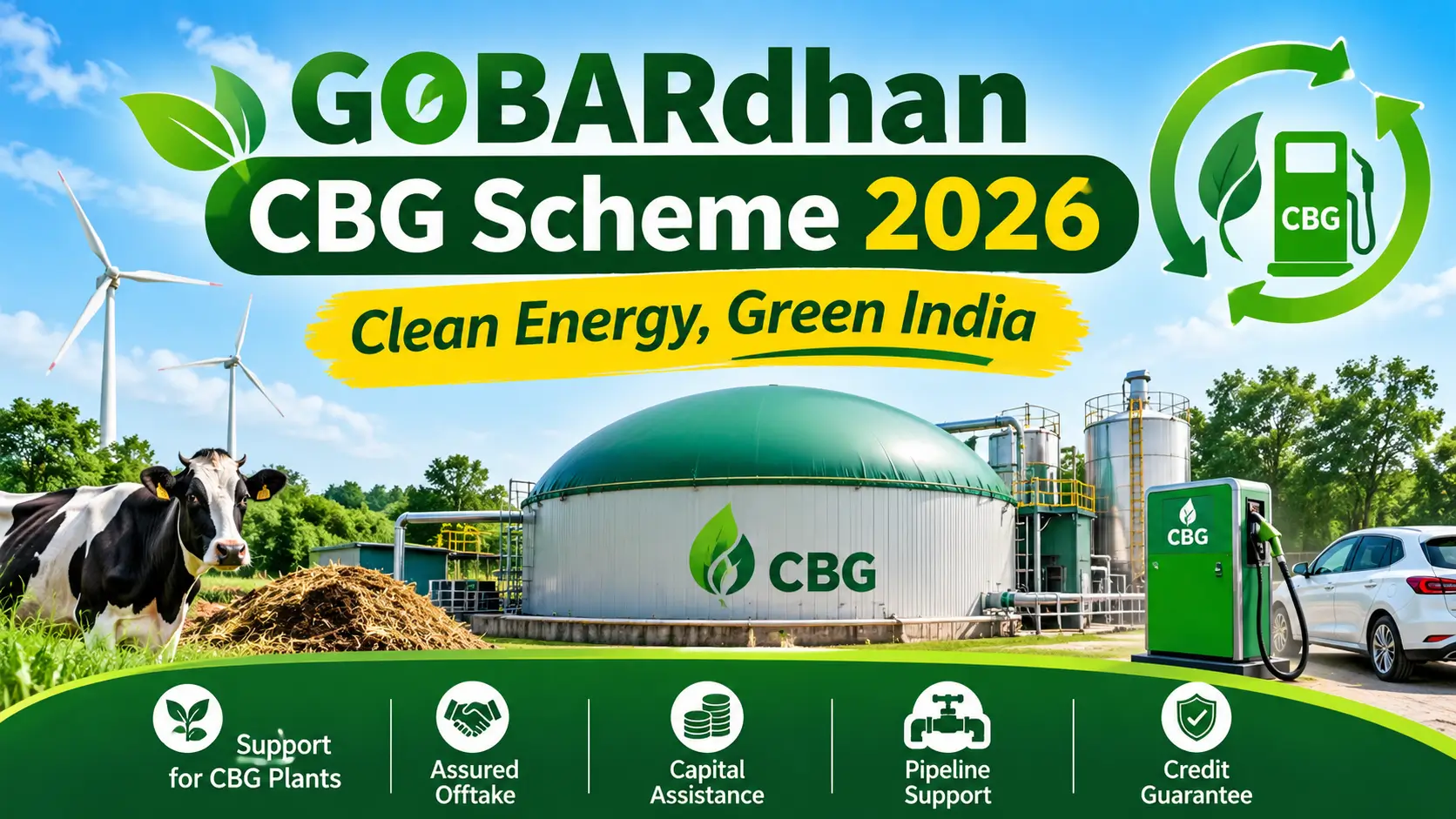
GOBARdhan CBG Scheme 2026: Subsidy, Eligibility, ₹2,110 Price & Registration
Read in another language:
India is looking for ways to produce more energy at home and reduce its dependence on imported natural gas. One of the country’s biggest untapped resources may already be available in its villages, farms and cities: organic waste.
The GOBARdhan CBG Scheme 2026 aims to turn cattle dung, agricultural residue, sugarcane press mud and other organic materials into compressed biogas (CBG). The Union Cabinet has approved a ₹23,731 crore framework to support the sector over the next ten years.
For CBG plant developers, the scheme brings several important changes. These include an administered gas price of ₹2,110 per MMBtu, capital assistance of up to ₹2 crore per tonne per day (TPD) of installed capacity, pipeline support and a credit guarantee mechanism.
But the scheme is not a direct cash benefit for every farmer or household. It is primarily designed to support CBG projects and the businesses involved in producing and supplying renewable gas.
Here is what the GOBARdhan CBG Scheme offers, who can participate, how the subsidy works and where to begin the registration process.
GOBARdhan CBG Scheme 2026: Overview
| Particular | Details |
|---|---|
| Scheme name | GOBARdhan – National Circular Bioenergy Scheme |
| Nodal ministry | Ministry of Petroleum and Natural Gas (MoPNG) |
| Total outlay | ₹23,731 crore |
| Cabinet approval | 6 August 2026 |
| Implementation period | FY 2026-27 to FY 2035-36 |
| Formal launch | 1 October 2026 |
| CBG administered price | ₹2,110 per MMBtu |
| Capital assistance | Up to ₹2 crore per TPD |
| Main beneficiaries | Eligible CBG plant developers and ecosystem participants |
| Registration portal | GOBARdhan Unified Registration Portal |
| Official portal | https://gobardhan.eil.co.in/ |
The scheme aims to increase domestic CBG production nearly ten-fold, reaching approximately 5 MMSCMD over the implementation period.
What Is the GOBARdhan CBG Scheme?
GOBARdhan stands for Galvanizing Organic Bio-Agro Resources Dhan.
The 2026 National Circular Bioenergy Scheme brings several forms of support for the compressed biogas sector under one framework administered by the Ministry of Petroleum and Natural Gas.
Compressed biogas is produced by processing organic waste through anaerobic digestion. The resulting biogas is purified to remove impurities and then compressed for use as fuel.
Depending on the infrastructure available, CBG can be supplied to city gas distribution networks or used in transport, industrial and commercial applications.
The scheme aims to address some of the problems that have held back CBG projects in India:
- High initial investment in plant machinery
- Uncertainty over who will purchase the gas
- Difficulty connecting plants to gas pipelines
- Limited access to finance
- Challenges in collecting and processing feedstock
- Difficulty finding buyers for organic manure
It brings support for these areas into a more coordinated framework.
Is GOBARdhan a New Scheme?
The GOBARdhan initiative originally started in 2018 under the Swachh Bharat Mission (Grameen), with a focus on rural waste management and community-level biogas facilities.
The 2026 National Circular Bioenergy Scheme is a much broader commercial framework for developing the CBG sector.
The two should not be confused. The older rural sanitation initiative and the new commercial CBG scheme have different objectives and implementation arrangements.
Latest GOBARdhan Scheme Updates 2026
The scheme has moved through several important stages since its approval.
| Date | Development |
|---|---|
| 6 August 2026 | Union Cabinet approved the scheme with a ₹23,731 crore outlay |
| 1 September 2026 | Scheme implementation began |
| 15 September 2026 | Component-wise operational guidelines were issued |
| 1 October 2026 | Union Minister Hardeep Singh Puri formally launched the scheme and unified portal |
| 19 October 2026 | MoPNG issued a clarification regarding Online Gas Chromatograph requirements |
October 2026 Update: Temporary Relaxation for Gas Measurement Equipment
The Ministry of Petroleum and Natural Gas issued a clarification on 19 October 2026 concerning the Online Gas Chromatograph (GC) requirement under the administered CBG pricing framework.
Operational CBG plants that are otherwise eligible and have a functional Online Gas Analyser may be considered under the administered pricing mechanism until 31 March 2027.
From 1 April 2027, installation and commissioning of the prescribed Online Gas Chromatograph or Mass Spectrometer will be mandatory for continued eligibility.
This is a time-bound transitional arrangement. Plant operators should review the official clarification before making equipment or compliance decisions.
Six Main Components of the GOBARdhan Scheme
The scheme is built around six major areas of support.
1. Assured CBG Offtake
One of the biggest concerns for a CBG developer is finding a reliable buyer.
Under the GOBARdhan framework, City Gas Distribution (CGD) entities have a notified CBG procurement obligation for the CNG transport and domestic PNG segments.
| Financial Year | CBG Obligation |
|---|---|
| 2026-27 | 3% |
| 2027-28 | 4% |
| 2028-29 onwards | 5% |
The framework is intended to provide a dependable market for eligible CBG producers.
The operational guidelines also establish a structured offtake arrangement involving the producer, the city gas distribution entity and GAIL, subject to the applicable technical and operational conditions.
For a project developer, this can improve revenue visibility and make it easier to assess the commercial feasibility of a plant.
2. Stable CBG Pricing Framework
The scheme introduces an administered CBG price of ₹2,110 per MMBtu.
The price is designed to provide a more predictable revenue framework for CBG producers over a minimum ten-year period.
The government has also explained that this is the procurement price paid to CBG producers. It is not the retail price directly paid by CNG vehicle owners or household PNG consumers.
The per-kilogram conversion should be treated as an approximation because it depends on the gas composition and conversion assumptions used.
3. Capital Assistance for CBG Plants
Capital assistance is one of the most important features of the scheme.
Eligible greenfield CBG projects can receive assistance of up to ₹2 crore per TPD of installed capacity.
However, this does not mean every plant automatically receives ₹2 crore for each TPD.
The assistance covers different parts of the project, including plant machinery, feedstock aggregation and organic manure processing or value-addition equipment. The applicable component guidelines determine the eligible expenditure and limits.
The following table provides a simplified overview.
| Project type | Assistance framework |
|---|---|
| Eligible greenfield CBG plant | Up to ₹2 crore per TPD |
| Feedstock aggregation equipment | Subject to component-specific conditions |
| Organic manure processing | Eligible support under applicable guidelines |
| Brownfield expansion | Support may be available for added capacity |
| Existing biogas plant upgraded to CBG | Subject to separate eligibility conditions |
Important: The ₹2 crore per TPD figure is a maximum assistance framework, not a guaranteed subsidy. The project must meet the relevant conditions, and the approved amount depends on eligible costs and applicable ceilings.
Developers should use the component-wise operational guidelines to prepare their financial estimates rather than relying only on the headline figure.
4. Pipeline Infrastructure Support
A CBG plant needs a practical way to deliver its gas to the buyer.
The scheme supports pipeline infrastructure connecting CBG plants to trunk pipelines and City Gas Distribution networks.
The support framework includes:
- Cluster-based pipeline connections
- Standalone pipeline connections
- Assistance for eligible pipeline expenditure
- Infrastructure development to improve gas evacuation
The reported assistance levels are up to 80% of eligible capital expenditure for cluster connections and up to 50% for standalone connections, subject to the applicable limits and conditions.
A project developer should confirm the distance limits, per-kilometre ceilings and eligibility requirements before finalising a pipeline design.
5. Credit Guarantee Support
Access to finance can be difficult for small CBG developers, particularly those without sufficient collateral.
The scheme includes a credit guarantee mechanism for eligible MSME-based projects.
The guarantee can cover up to 85% of the outstanding amount at default, subject to the scheme’s conditions.
The reported maximum guarantee amount is ₹20 crore per project, with a higher limit of ₹25 crore for eligible women-led projects.
This support is intended to improve access to institutional finance. It is not a direct grant or a guarantee that every loan application will be approved.
6. CBG Ecosystem Challenge Fund
The scheme also includes a dedicated CBG Ecosystem Challenge Fund with an announced outlay of ₹500 crore for FY 2026-27 to FY 2030-31.
The fund is intended to support the development of the wider CBG ecosystem, including:
- Feedstock resource mapping
- Feedstock aggregation infrastructure
- District-level CBG development plans
- Technology improvements
- Organic manure value addition
- Capacity building and awareness
The district-level challenge component is designed to encourage local administrations to improve the conditions needed for CBG projects.
GOBARdhan Scheme Eligibility: Who Can Apply?
The GOBARdhan CBG Scheme is primarily a project-based programme.
It is not a universal cash benefit scheme under which every farmer or household receives a subsidy.
The scheme is intended to support eligible entities involved in developing, operating or participating in CBG projects.
Potential participants include:
- Private CBG plant developers
- Micro, Small and Medium Enterprises (MSMEs)
- Companies and business entities
- Cooperatives
- Rural entrepreneurs
- Eligible government agencies
- Existing biogas plant operators seeking an upgrade
Registration is an important starting point for accessing the relevant scheme workflows.
However, registration alone does not mean a project has been approved for financial assistance.
Can an Individual Farmer Apply?
An individual farmer should not assume that the scheme provides a personal cash payment.
Farmers can participate in the CBG value chain in several ways:
- Supplying cattle dung or agricultural residue to a CBG plant.
- Joining a cooperative or producer group.
- Participating in feedstock aggregation and transportation.
- Establishing an eligible CBG project through a suitable business structure.
- Purchasing organic manure produced by CBG plants.
For farmers planning to supply feedstock, the contract terms are important. The price, quantity, transportation responsibility and payment schedule should be clearly defined.
Are Municipal Solid Waste-Based Plants Eligible?
Municipal waste projects require particular attention.
Some reports concerning the scheme’s operational framework indicate restrictions on projects predominantly based on municipal solid waste for capital assistance and credit guarantee.
Because this condition can materially affect project feasibility, developers should verify the latest official component guidelines before investing in a municipal-waste-based plant.
Do not assume that every type of organic waste qualifies for every form of assistance.
How Much Subsidy Can a CBG Plant Receive?
The scheme announces capital assistance of up to ₹2 crore per TPD of installed CBG capacity for eligible greenfield projects.
For example, a developer planning a 5 TPD CBG plant may use the headline assistance figure to understand the maximum potential support framework.
| Plant Capacity | Headline Assistance Framework |
|---|---|
| 1 TPD | Up to ₹2 crore |
| 2 TPD | Up to ₹4 crore |
| 5 TPD | Up to ₹10 crore |
| 10 TPD | Up to ₹20 crore |
These figures are illustrative calculations based on the announced per-TPD ceiling.
They are not guaranteed sanction amounts. Actual assistance depends on the eligible project components, approved expenditure, applicable project limits and scheme conditions.
Before finalising the project cost, developers should obtain the latest official guidelines and confirm the eligible amount with the implementing authorities.
How Is Capital Assistance Released?
Capital assistance is linked to project milestones and performance.
The operational framework describes a phased release mechanism rather than a single upfront payment.
The broad stages include:
- Initial project approval and establishment milestones
- Commencement of CBG sales
- Operational performance after the plant starts running
The final performance-linked portion is particularly important. A plant that does not achieve the required operating capacity may not receive the full eligible assistance.
This is why feedstock availability, plant design, maintenance and gas-sale arrangements should be considered before construction begins.
The exact tranche conditions, performance thresholds and documentation should be checked in the official component-wise guidelines.
How to Register on the GOBARdhan Portal
The GOBARdhan Unified Registration Portal is the starting point for eligible CBG plant developers and other participating entities.
Step 1: Open the Official Portal
Visit: https://gobardhan.eil.co.in
Use the official portal rather than an unofficial website offering registration services.
Step 2: Review the Registration Requirements
Check the registration instructions and identify the details required for your entity and project.
These may include project information, applicant details and relevant supporting documents.
Step 3: Register Your CBG Plant
Complete the applicable registration process for the plant or project.
Keep the registration acknowledgement and registration number for future reference.
Step 4: Review the Relevant Scheme Component
Identify the support you intend to apply for.
For example:
- Capital assistance
- Pipeline infrastructure support
- Credit guarantee
- Administered CBG pricing
- Other eligible project support
Each component has its own conditions.
Step 5: Prepare the Project Documents
A developer should prepare the project report, feedstock arrangements, technical details, financial information and other required documents.
The exact requirements depend on the support component and project type.
Step 6: Submit the Relevant Application
Follow the instructions provided on the portal and in the official guidelines.
Registration is not the same as subsidy approval. Applicants should track the status of the specific support application and wait for the relevant sanction before treating assistance as confirmed.
What Farmers, Gaushalas and Rural Businesses Can Gain
Although the scheme does not provide a universal personal subsidy, it may create new business opportunities in rural areas.
A CBG plant requires a regular supply of raw materials. This can create demand for:
- Cattle dung
- Agricultural residue
- Sugarcane press mud
- Other eligible organic materials
Farmers, dairy cooperatives, gaushalas and local enterprises may be able to participate in the supply chain.
Transportation, collection, storage and processing can also create local employment opportunities.
Organic Manure as an Additional Opportunity
CBG production generates organic by-products that can be processed into fermented organic manure (FOM) and liquid fermented organic manure (LFOM).
These products can provide an additional source of revenue for eligible plants.
The government has also supported the development of organic manure markets through earlier assistance measures.
However, developers should not assume that every manure product or sale automatically qualifies for assistance. The applicable conditions must be checked separately.
GOBARdhan Scheme: Current CBG Production in India
According to government material published around the scheme’s approval, the existing CBG sector had the following reported figures:
| Indicator | Reported Figure |
|---|---|
| Registered plants as of 6 August 2026 | 1,908 |
| Commissioned plants | 217 |
| Installed capacity | Over 1,700 TPD |
| Production | Approximately 0.4 MMSCMD |
| Plants under construction | 339 |
| Long-term production target | Around 5 MMSCMD |
These figures represent the reported position around the approval date. They should not be presented as the latest live figures without checking the current portal.
The difference between registered and operating plants is important. Registration shows interest in the sector, but actual production depends on construction, feedstock supply, technical performance and commercial operations.
Challenges That CBG Developers Should Consider
The scheme provides financial and infrastructure support, but it does not remove every business risk.
Feedstock Availability
A plant requires a regular supply of organic material.
Agricultural residue can be seasonal, while cattle dung may be spread across many villages. Developers need a practical collection and transportation plan.
Gas Connectivity
A plant may produce gas but still face difficulties delivering it to a buyer.
The availability of a suitable pipeline connection and the applicable technical requirements can affect project costs.
Organic Manure Market
The plant’s financial viability may also depend on the sale of manure.
Developers should identify potential buyers and consider transportation, storage, product quality and market demand.
Project Performance
Capital assistance can be linked to operational milestones.
A plant that fails to achieve the required performance may face delays or reductions in eligible assistance.
State-Level Approvals
Land, environmental permissions, water, electricity and other local requirements can affect implementation.
Developers should check the applicable state and local approvals before committing to a construction schedule.
Official Links for GOBARdhan CBG Scheme 2026
Applicants should rely on official sources when checking the latest conditions.
| Official Resource | Purpose |
|---|---|
| https://gobardhan.eil.co.in/ | Registration and scheme information |
| https://mopng.gov.in/ | Ministry announcements |
| https://www.pib.gov.in/PressReleasePage.aspx?PRID=2295480&lang=1®=3 | Scheme approval and outlay |
| https://www.pib.gov.in/PressReleseDetailm.aspx?PRID=2317937&lang=1®=3 | Scheme launch and major components |
| https://www.gailonline.com/cbgMopngGuideline.html | Operational guidelines and clarifications |
Applicants should confirm the current application process, eligibility and financial assistance conditions before submitting a project.
Subhadra Yojana
PM Surya Sarovar Yojana 2026: Eligibility, Subsidy, Benefits and Latest Status
eDistrict Odisha Certificates 2026: Caste, Income, Residence, OBC and SEBC (Apply, Track, Download)
Odisha EV Subsidy 2026: Amount, Eligibility, Online Apply and Policy Extension
Frequently Asked Questions
What is the GOBARdhan CBG Scheme 2026?
The GOBARdhan CBG Scheme is a ₹23,731 crore central-sector programme aimed at developing India’s compressed biogas industry. It provides a framework for assured offtake, stable pricing, capital assistance, pipeline infrastructure, credit support and ecosystem development.
What is the subsidy under the GOBARdhan Scheme?
Eligible greenfield CBG projects can receive capital assistance of up to ₹2 crore per TPD of installed capacity. The actual amount depends on the eligible project components, expenditure limits and scheme conditions.
What is the CBG price under GOBARdhan?
The administered CBG price is ₹2,110 per MMBtu under the scheme’s pricing framework.
Can farmers apply for GOBARdhan subsidy?
Farmers should not treat the scheme as a personal cash-benefit programme. They may participate by supplying feedstock, joining cooperatives, establishing eligible projects or participating in the CBG supply chain.
Is GOBARdhan registration mandatory?
Registration on the unified portal is an important requirement for accessing relevant scheme support. However, registration does not guarantee subsidy approval.
What is the CBG Obligation under GOBARdhan?
The notified procurement obligation is 3% in FY 2026-27, 4% in FY 2027-28 and 5% from FY 2028-29 onwards for the CNG transport and domestic PNG segments.
What is the GOBARdhan Scheme’s total budget?
The scheme has a total announced outlay of ₹23,731 crore for FY 2026-27 to FY 2035-36.
When was the GOBARdhan Scheme launched?
The Union Cabinet approved the scheme on 6 August 2026. It became effective from 1 September 2026 and was formally launched on 1 October 2026.
Is the GOBARdhan Scheme available for household biogas plants?
The 2026 National Circular Bioenergy Scheme primarily supports the commercial CBG sector. Household and community biogas projects may fall under other government programmes, depending on their structure and eligibility.
Final Thoughts
The GOBARdhan CBG Scheme 2026 creates a more structured framework for India’s compressed biogas industry. Its combination of capital assistance, administered pricing, offtake support and infrastructure development could make eligible projects easier to evaluate and finance.
For developers, the most important step is to understand the applicable component guidelines before investing. The headline subsidy figure is useful, but project eligibility, feedstock availability, gas connectivity and operating performance will ultimately determine whether a plant is commercially viable.
Farmers and rural businesses may also find opportunities in the supply chain, particularly through the collection and supply of organic materials and the development of manure markets.
For the latest scheme conditions, always refer to the official GOBARdhan portal and the Ministry of Petroleum and Natural Gas.
Disclaimer: This article is for informational purposes only. It is not affiliated with any government department. Scheme guidelines, eligibility conditions and assistance amounts may change. Confirm the latest official documents before making financial or project-related decisions.