Vasundhara Yojana Odisha 2026: Eligibility, 4-Decimal Rule and How to Get Land
Read in another language:
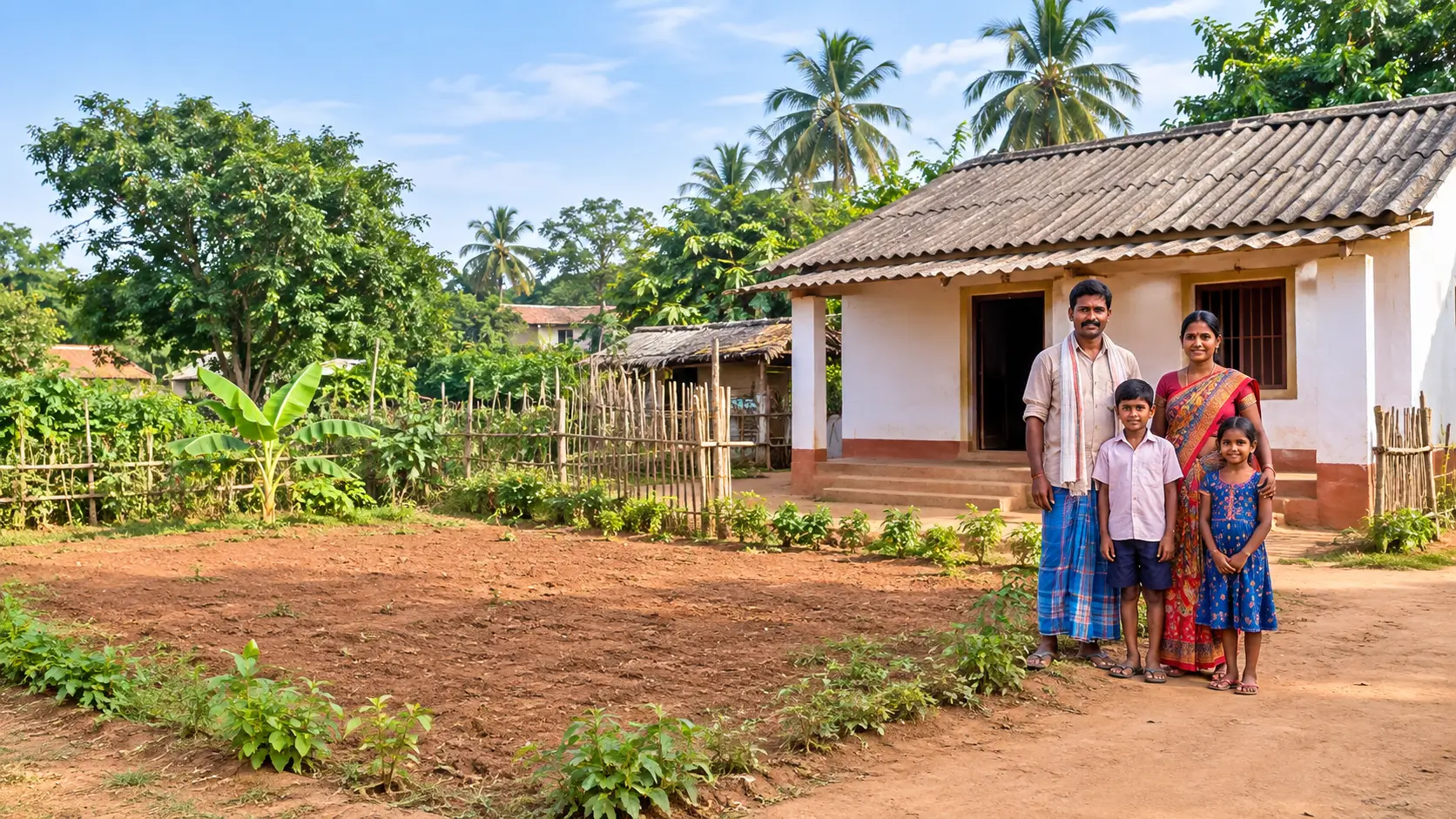
Families in rural Odisha who do not have a proper house site may be eligible for government land under the Vasundhara Yojana, also known as Basundhara Yojana. The scheme provides homestead land free of premium to eligible families so they can have a place to build a home.
A major change came in May 2025, when Odisha amended the definition of a homesteadless person. Under the revised rule, a person who owns no homestead land, or owns less than one-twenty-fifth of an acre, may fall within the definition. The amendment also introduced an important restriction: land settled under the scheme is heritable but not transferable.
This guide explains the latest eligibility rules, the four-decimal limit, the reported income-limit update, the survey and allotment process, and where families can seek help if their names are missing from the survey.
Vasundhara Yojana Odisha 2026: Quick Overview
| Detail | Information |
|---|---|
| Scheme name | Vasundhara Yojana (also written as Basundhara) |
| State | Odisha |
| Department | Revenue and Disaster Management Department |
| Main benefit | Government homestead land free of premium |
| Target group | Eligible homesteadless families in rural Odisha |
| Revised land eligibility rule | No homestead land or less than 1/25 acre |
| Maximum combined homestead area | 1/25 acre, including qualifying family land |
| Legal framework | Odisha Government Land Settlement Act, 1962 and OGLS Rules, 1983 |
| Important amendment | OGLS Amendment Rules, 2025 |
| Land ownership status | Heritable but not transferable |
| Application route | Survey and revenue administration process |
What Is Vasundhara Yojana?
Vasundhara Yojana is an Odisha government programme that provides government land for house-site purposes to eligible homesteadless families in rural areas. The land is settled free of premium under the applicable land-settlement rules.
The scheme is administered by the Revenue and Disaster Management Department. Its purpose is to help families who do not have a suitable residential plot obtain a place where they can build a home.
According to the department’s scheme information, the state has been providing homestead land to eligible families since 1974-75. The programme operates under the Odisha Government Land Settlement Act, 1962 and the Odisha Government Land Settlement Rules, 1983.
Official reference: Revenue Department – Vasundhara Scheme (https://revenue.odisha.gov.in/en/schemes/vasundharas)
Latest Update: What Changed Under the 2025 Amendment?
The most important recent legal change was introduced through the Odisha Government Land Settlement (Amendment) Rules, 2025.
The amendment was published in the Odisha Gazette on 19 May 2025. It changed the definition of a homesteadless person and revised the rule used to calculate the area of land that may be settled.
Under the amended definition, a person may qualify as homesteadless if they:
- Do not own any homestead land; or
- Own homestead land measuring less than one-twenty-fifth of an acre.
The amendment also states that the land settled with a beneficiary, together with the homestead land already owned by that person and the relevant family members living in a common mess, must not exceed one-twenty-fifth of an acre.
This means that owning a very small residential plot does not automatically disqualify a family. However, eligibility and the amount of additional land depend on the family’s existing homestead land and the applicable rules.
What Is the Four-Decimal Land Rule?
One-twenty-fifth of an acre is equal to four decimals.
For a simple understanding:
| Measurement | Equivalent area |
|---|---|
| 1 acre | 100 decimals |
| 1 decimal | 435.6 square feet |
| 4 decimals | 0.04 acre |
| 1/25 acre | 4 decimals |
| 4 decimals | Approximately 1,742.4 square feet |
The four-decimal figure is a maximum combined homestead-land ceiling under the amended rule, not a promise that every beneficiary will receive a fresh four-decimal plot.
For example, if the relevant existing homestead land of a person and family members living in a common mess is one decimal, the additional settlement would generally have to be assessed within the remaining three-decimal ceiling, subject to the rules and land availability.
The amended rule also states that where sufficient land is not available to accommodate all eligible persons, settlement will be subject to the limit of available land.
Does the Family’s Existing Land Count?
Yes. Rule 7(2), as amended in 2025, requires the authorities to consider:
- The homestead land already owned by the applicant; and
- Homestead land owned by family members living with the applicant in a common mess.
The combined area must not exceed one-twenty-fifth of an acre.
This is an important point for families who have inherited a small residential plot or share a household with family members who already own homestead land.
Who Is Eligible for Vasundhara Yojana Odisha?
The amended rules and the Revenue Department’s June 2025 instructions provide the main basis for identifying eligible families.
A family should check the following conditions before approaching the local revenue office:
- Rural residence: The June 2025 department instructions concern homesteadless families in rural areas of Odisha.
- Homestead land: The person must have no homestead land or own less than one-twenty-fifth of an acre under the amended definition.
- Family land: The homestead land owned by family members living together in a common mess is also considered when calculating the total area.
- Land availability: Settlement depends on the availability of suitable government land.
- Other applicable conditions: The Revenue Department and local Tahasil authorities must verify the relevant provisions of the OGLS Rules and the applicant’s records.
What Is the Income Limit?
The income limit needs careful attention because different figures appear in older records and recent news reports.
On 8 September 2026, Revenue Minister Suresh Pujari was reported as saying that the annual family income limit was ₹1 lakh and that the government was considering reviewing it.
The Revenue and Disaster Management Department’s notification dated 12 November 2026 confirms the increase: under the Odisha Government Land Settlement Act, 1962, the annual income ceiling for homestead-land eligibility is now ₹1,50,000 (₹1.5 lakh), superseding the earlier notification of 22 February 2023. The notification was signed by Dr. Arabinda Kumar Padhee, Additional Chief Secretary to Government.
More related Odisha schemes
Subhadra Yojana : More explore related Odisha schemes
Odisha MMKY Scheme 2026 : 17 Components, Benefits, Eligibility and How to Apply
Antyodaya Gruha Yojana Odisha 2026 : Eligibility, Benefits & How to Apply
PM Awas Yojana Gramin Odisha 2026 : Latest Status, Eligibility, Awaas Plus Survey, List Check and Benefits
DALKHAI Yojana Odisha 2026 : Full Form, ₹220 Crore Budget, Benefits and Latest Status
Mukhyamantri Annapurna Yojana 2026 : 10 kg Free Rice Per Person, Eligibility, Benefits and FAQs
Odisha Nirman Shramik Kalyan Yojana 2026 : Eligibility, Benefits, Documents & Apply Online
Odisha Government Schemes : related Odisha govt programs
How Does the Vasundhara Land Allotment Process Work?
The June 2025 Revenue Department letter explains that the state uses a survey and revenue-administration process to identify eligible homesteadless families.
The department also supplied formats for recording the details of identified families and tracking land settlement.
The process generally involves the following stages:
1. Identification Through Survey
Revenue officials identify homesteadless families in rural areas. The June 2025 letter directed the authorities to identify families according to the amended definition introduced in the 2025 rules.
2. Verification of Family and Land Details
The prescribed survey format records information such as:
- Village and applicant’s name
- Father’s or husband’s name
- Caste and occupation
- Homestead land owned by family members
- Agricultural land owned by family members
- Annual income
- Availability of suitable land for settlement
These details help the authorities examine the family’s eligibility and identify suitable government land.
3. Opening of the Lease Case
The survey format includes a field asking whether a lease case has been instituted. This shows that the allotment process involves a formal revenue case record rather than simply adding a name to a survey list.
4. Proclamation and Revenue Proceedings
The prescribed format also records whether a proclamation has been issued. The case then proceeds through the applicable revenue-administration requirements.
5. Land Settlement and RoR Correction
If the case is approved and suitable land is available, the settlement is processed. The Record of Rights (RoR) must be corrected as part of the settlement process.
6. Possession and Demarcation
The department’s reporting format separately records whether possession has been handed over and whether the land has been demarcated.
For this reason, a survey entry or preliminary approval should not automatically be treated as proof that the beneficiary has received possession of the land.
How Can You Check Your Name or Raise a Missing Case?
The June 2025 instructions do not provide a separate public online application portal for Vasundhara Yojana. The published process is based on identification through the revenue administration and the settlement of eligible cases.
If your family appears eligible but was not included in the survey, take these steps:
- Contact your local Revenue Inspector (RI).
- Visit the concerned Tahasil office and explain that your family may qualify under the amended definition.
- Ask whether your family was included in the survey list.
- If a case has already been opened, request its current status and case details.
- If the family was missed, ask the Tahasil office how to submit the relevant land and income details for verification.
- If the matter remains unresolved, approach the appropriate Sub-Collector or District Collector through the available grievance process.
Keep copies of any written application, acknowledgement or case reference you receive.
Important: Do not assume that a name appearing in a survey list means the land has already been settled. Ask whether the RoR has been corrected and whether possession and demarcation have been completed.
Documents to Keep Ready
The June 2025 survey format records land ownership, family details, occupation and annual income. The department’s communication does not provide a single universal public checklist of documents for every applicant.
The following records may help the local authorities verify your case:
- Aadhaar card or another identity document
- Ration card or family details
- Income certificate, if required by the Tahasil
- Existing Record of Rights (RoR), if the family owns any homestead land
- Available land-tax or land-related records
- Details of family members living in a common mess
- Any previous survey acknowledgement or revenue case reference
- Details of the land currently occupied by the family, if relevant
The Tahasil office may ask for additional documents depending on the facts of the case. Confirm the required documents locally rather than relying on an unofficial fixed checklist.
Vasundhara Yojana Survey and Allotment Figures: September 2026 Update
Following a review meeting chaired by Revenue and Disaster Management Minister Suresh Pujari, news reports published on 8 and 9 September 2026 shared the following survey and allotment figures.
| Survey year | Initially identified | Found eligible | Land allotted | Eligible cases pending |
|---|---|---|---|---|
| 2024 | 42,915 | 33,082 | 30,653 | 2,429 |
| 2025 | 58,620 | 11,827 | 3,598 | 8,229 |
| Total | 1,01,535 | 44,909 | 34,251 | 10,658 |
The pending figures are calculated by subtracting the number of allotments from the number of people found eligible.
For the 2024 survey, 33,082 people were found eligible and 30,653 had received land, leaving 2,429 eligible cases pending.
For the 2025 survey, 11,827 people were found eligible and 3,598 had received land, leaving 8,229 cases pending.
Together, the two surveys identified 1,01,535 people initially. After verification, 44,909 were found eligible, and 34,251 had received land according to the reported figures.
Source note: These figures were reported after the minister’s September 2026 review meeting. They should not be described as a live beneficiary database or as figures independently published in the June 2025 government letter.
Kalahandi: Why District-Level Follow-Up Matters
OrissaPOST reported in September 2026 that more than 3,000 people in Kalahandi were waiting for land under the scheme.
This illustrates why applicants should check their own Tahasil records instead of relying only on statewide figures. Land availability, verification and pending revenue proceedings can differ from one location to another.
District-Wise Land Patta Figures Shared in the Assembly
Revenue and Disaster Management Minister Suresh Pujari shared district-wise figures in the Odisha Assembly in November 2026. A total of 44,909 homestead-less families were identified across the state during the financial years 2024-25 to 2026-27, and 34,251 of them have received homestead land pattas under the Vasundhara Scheme.
Kalahandi distributed the highest number of land pattas at 3,908, followed by Bargarh with 2,940, Nabarangpur with 2,806 and Rayagada with 2,703. Rayagada recorded the highest number of identified families at 4,102, while Jagatsinghpur recorded the lowest at 115.
Bargarh identified 3,373 families, Nabarangpur 3,483 and Koraput 3,420, with 2,624 pattas distributed in Koraput. Jajpur identified 2,568 families and distributed 1,306 pattas, while Sambalpur distributed 1,760 pattas out of 2,097 identified families and Sundargarh distributed 1,865 out of 2,186.
Can You Sell Land Received Under Vasundhara Yojana?
No. The 2025 amendment specifically states:
“The land settled in favour of a homesteadless person shall be heritable but not transferable.”
In simple terms, the land may pass to the beneficiary’s legal heirs through inheritance, but it cannot be freely sold or transferred like ordinary private property.
The June 2025 Revenue Department letter also directs that land settled under the scheme should be recorded in Pattadar status.
If someone offers to sell you a plot claiming it was allotted under Vasundhara, do not proceed based only on a private agreement or verbal assurance. Verify the land records and legal status with the Tahasil office.
What If You Already Live on Government Land?
Some families may have lived on government land for years without having a proper record in their names.
The correct treatment of such cases depends on the land classification, the applicable rules and the facts recorded by the revenue authorities.
Do not assume that every government-land occupation automatically qualifies for settlement under Vasundhara. In particular, ask the Tahasil to examine the land classification and whether the plot is suitable and legally available for homestead settlement.
If the existing site cannot be settled, ask the revenue authorities whether another suitable plot can be considered under the applicable provisions.
Difference Between Vasundhara Yojana and Basudha Yojana
The names are similar, but the schemes serve different purposes.
| Scheme | Main purpose |
|---|---|
| Vasundhara Yojana | Settlement of government homestead land for eligible families in rural Odisha |
| Basudha Yojana | Rural drinking-water supply |
Vasundhara is associated with house-site land allotment under the Revenue Department. Basudha is a drinking-water programme. They should not be treated as the same scheme.
Vasundhara Yojana: Important Dates and Rule Changes
| Date or period | Development |
|---|---|
| 1974-75 | The Revenue Department says the provision of government homestead land free of premium dates back to this period. |
| 2004-05 | A department enumeration recorded 2,49,334 homesteadless families. |
| 2005-08 | The department reports that 2,29,885 families received homestead land during this period. |
| 3 July 2008 | The department’s older scheme information records an increase in the maximum land distribution limit to 0.10 acre. |
| 16 August–31 October 2024 | A statewide survey was conducted to enumerate homesteadless families. |
| 17 May 2025 | Odisha Government Land Settlement (Amendment) Rules, 2025 were notified. |
| 19 May 2025 | The amendment came into force upon publication in the Odisha Gazette. |
| 19 June 2025 | The Revenue Department issued instructions for identifying homesteadless families under the amended definition. |
| 31 December 2025 | Deadline set in the June 2025 letter for completing identification. |
| 15 January 2026 | Deadline for sending the prescribed summary to the department. |
| 8–9 September 2026 | News reports shared the latest review figures for the 2024 and 2025 surveys. |
| 13 November 2026 | The Revenue and Disaster Management Department’s notification dated 12 November 2026 officially confirms the annual income ceiling at ₹1.5 lakh (Dr. Arabinda Kumar Padhee, Additional Chief Secretary). |
Common Mistakes to Avoid
- Assuming every family receives exactly four decimals: The rule sets a combined ceiling, including qualifying existing family homestead land.
- Ignoring the 2025 amendment: The revised definition includes people who own less than one-twenty-fifth of an acre.
- Treating old information as current: The Revenue Department’s older scheme page still mentions the earlier 10-decimal limit. Read it alongside the 2025 amendment.
- Believing that survey identification means final allotment: Check RoR correction, possession and demarcation.
- Paying an agent for a guaranteed allotment: Deal with the official revenue authorities and keep written acknowledgements.
- Buying or selling scheme land privately: The amended rules state that settled land is heritable but not transferable.
Frequently Asked Questions
1. What is Vasundhara Yojana in Odisha?
Vasundhara Yojana is an Odisha government programme that provides government homestead land free of premium to eligible homesteadless families in rural areas.
2. Who is eligible for Vasundhara Yojana in 2026?
Under the 2025 amended definition, a person who has no homestead land or owns less than one-twenty-fifth of an acre may qualify as homesteadless. Other applicable conditions and land availability must also be checked.
3. How many decimals of land are available under the scheme?
The amended rule uses a combined ceiling of one-twenty-fifth of an acre, equal to four decimals. Existing homestead land owned by the applicant and family members living in a common mess is counted within this limit.
4. What is the latest income limit for Vasundhara Yojana?
The annual income ceiling is now ₹1.5 lakh, officially confirmed by the Revenue and Disaster Management Department’s notification dated 12 November 2026 (Dr. Arabinda Kumar Padhee, Additional Chief Secretary). It was ₹1 lakh at the September 2026 ministerial review before this revision.
5. Can people who own less than four decimals apply?
The 2025 amendment changed the definition of a homesteadless person to include someone who owns less than one-twenty-fifth of an acre. The actual additional land settlement depends on the family’s existing homestead land and the availability of suitable government land.
6. Is there an online application form?
The official documents reviewed for this guide describe a survey and revenue-administration process. They do not provide a separate public online application form. Contact the local Revenue Inspector or Tahasildar if your family was missed.
7. Can Vasundhara land be sold?
No. Under the 2025 amendment, land settled under the scheme is heritable but not transferable.
8. Can legal heirs inherit Vasundhara land?
The amended rule describes the land as heritable. However, it remains subject to the restriction that it is not transferable.
9. What is the last date to apply for Vasundhara Yojana?
The June 2025 letter set 31 December 2025 as the deadline for completing identification under that instruction. It also stated that settlement of eligible families from the new survey and pending cases from the old list would continue. This date should not be treated as a permanent closing date for all allotments.
10. Is Vasundhara the same as Basudha?
No. Vasundhara concerns homestead land allotment, while Basudha is associated with rural drinking-water supply.
Official Links for Vasundhara Yojana
Applicants should rely on the Revenue and Disaster Management Department for legal rules and official instructions.
- Revenue Department – Vasundhara Scheme
- Distribution of Homestead Land – Official Orders (https://revenue.odisha.gov.in/en/communication/distribution-homestead-land)
- Government of Odisha – 19 June 2025 Vasundhara Identification Letter and Annexures (https://revenue.odisha.gov.in/sites/default/files/2025-12/vasundhara%20with%20annexure.pdf)
- Government of Odisha – Revenue and Disaster Management Department (https://revenue.odisha.gov.in/)
Disclaimer
Subhadra-yojanain.com is an independent informational website and is not affiliated with the Government of Odisha. This article is prepared for general information using available government documents and news reports. Eligibility, income limits, land availability and settlement procedures may depend on current government rules and local verification. Contact your Revenue Inspector or Tahasildar before making decisions based on this information.