PMAY Urban BANDHU Odisha 2026: Benefits, Eligibility, ₹1,615 Crore Budget & How to Apply
Read in another language:
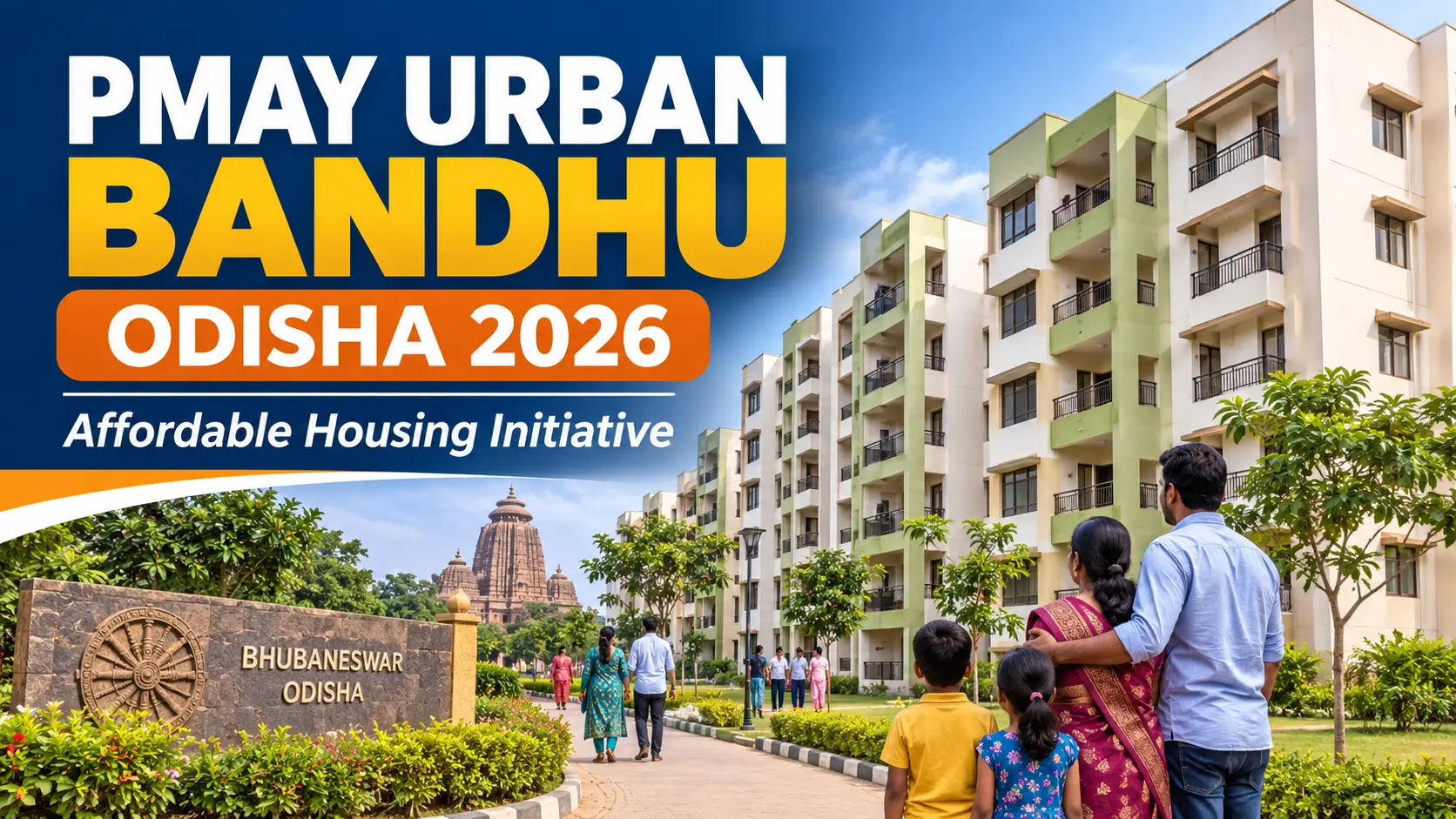
Odisha has introduced a new housing support initiative to make affordable homes more accessible to low-income families in towns and cities. Known as PMAY Urban BANDHU, the scheme is designed to strengthen the implementation of Pradhan Mantri Awas Yojana–Urban 2.0 (PMAY-U 2.0) across the state.
The Odisha Cabinet approved a five-year financial outlay of ₹1,615 crore for the initiative on 1 August 2026. Its four components focus on affordable housing projects, beneficiary assistance, housing loans and support for families displaced by urban development projects.
The scheme also gained attention on 13 October 2026, when Chief Minister Mohan Charan Majhi laid the foundation stone for an affordable rental housing project at Gadakana in Bhubaneswar.
Here is what Odisha residents should know about PMAY Urban BANDHU, including its benefits, eligibility conditions, financial assistance, application process and latest developments.
PMAY Urban BANDHU Odisha 2026: Key Details
| Particular | Details |
|---|---|
| Scheme name | PMAY-Urban BANDHU |
| Full form | Beneficiary Assistance for Nurturing Development of Housing Units |
| State | Odisha |
| Implementing department | Housing and Urban Development Department |
| Scheme type | State-funded complementary housing initiative |
| Cabinet approval | 1 August 2026 |
| Total approved outlay | ₹1,615 crore |
| Implementation period | Five years |
| Main mission | PMAY-U 2.0 |
| Target beneficiaries | Eligible urban households, especially EWS families |
| Main components | Four |
| Official department | HUD Odisha (https://hud.odisha.gov.in/) |
| Central scheme portal | PMAY-U 2.0 (https://pmaymis.gov.in/PMAYMIS2_2024/PmayDefault.aspx) |
What Is PMAY Urban BANDHU?
PMAY Urban BANDHU stands for Pradhan Mantri Awas Yojana (Urban) Beneficiary Assistance for Nurturing Development of Housing Units.
It is a state-funded initiative introduced by the Government of Odisha to complement the central government’s PMAY-U 2.0 housing mission.
The initiative addresses several difficulties that can prevent eligible urban families from getting affordable homes. These include limited financial resources, difficulties in arranging housing loans and the lack of financially viable affordable housing projects in smaller cities.
Unlike a standalone housing scheme with an entirely separate beneficiary system, BANDHU is designed to provide additional support alongside PMAY-U 2.0.
The Odisha government’s housing vision aims to increase pucca house coverage in urban areas from 59% in 2024 to 90% by 2029.
Under the initiative, the state aims to support an additional 3 lakh to 3.5 lakh urban households during the 2025–2030 period.
Why Did Odisha Introduce the BANDHU Scheme?
The state identified three important challenges in implementing affordable housing projects:
- Financial difficulties in housing projects: Affordable Housing in Partnership (AHP) projects, particularly in smaller urban areas, may not attract developers because of limited financial viability.
- Beneficiary contribution: Economically weaker families may struggle to arrange their share of the construction or housing cost.
- Housing loan difficulties: EWS beneficiaries may find it difficult to secure housing loans at affordable interest rates.
PMAY Urban BANDHU is intended to address these challenges through additional financial assistance, project funding and housing credit support.
PMAY Urban BANDHU Budget: Why Are There Different Figures?
Readers may come across ₹100 crore, ₹120 crore and ₹1,615 crore when searching for the scheme.
These figures relate to different budgetary stages and should not be treated as interchangeable.
| Period | Amount | Explanation |
|---|---|---|
| 2025–26 Budget Estimate | ₹100 crore | Earlier provision mentioned in the Odisha Economic Survey 2025–26 |
| 2026–27 Budget | ₹120 crore | Initial budget provision for PMAY Urban BANDHU |
| 1 August 2026 | ₹1,615 crore | Total five-year scheme outlay approved by the Odisha Cabinet |
The ₹120 crore figure relates to the initial 2026–27 budget provision, whereas ₹1,615 crore represents the larger five-year scheme plan.
The Odisha Economic Survey 2025–26 also refers to an earlier ₹100 crore budget estimate for 2025–26.
Therefore, an article quoting ₹120 crore is not necessarily incorrect. It may simply be referring to the annual budget provision rather than the complete five-year outlay.
Four Components of PMAY Urban BANDHU
The Odisha Cabinet approved four major components under the scheme.
| Component | Purpose | Five-year allocation |
|---|---|---|
| Component I | Affordable housing, rental housing and transit housing projects | ₹675 crore |
| Component II | Labour compensation and early completion incentives | ₹685 crore |
| Component III | Affordable housing loans and interest support | ₹100 crore |
| Component IV | Assistance for families displaced by urban planning projects | ₹125 crore |
| Total of listed components | ₹1,585 crore |
Important budget clarification: The reported total scheme outlay is ₹1,615 crore, but the four published component allocations add up to ₹1,585 crore. The available component-wise breakdown does not explain the remaining ₹30 crore. Until the department publishes a clarification, this difference should not be presented as an additional confirmed beneficiary benefit.
Component I: Affordable Housing and Rental Projects
The first component has an allocation of ₹675 crore over five years.
It will provide Viability Gap Funding (VGF) to support:
- Affordable Housing in Partnership (AHP)
- Affordable Rental Housing (ARH)
- Transit Housing (TH)
Viability Gap Funding helps make housing projects financially workable, particularly in smaller towns where affordable housing developments may otherwise struggle to attract investment.
The scheme envisages supporting approximately:
- 30,000 Affordable Housing in Partnership units.
- 10,000 Affordable Rental Housing and Transit Housing units.
New AHP projects are also expected to include facilities such as:
- Adequate open spaces.
- Built-in solar power systems.
- Rainwater harvesting.
- Anganwadi centres.
- Children’s play areas.
- Primary health centres.
- Public Distribution System (PDS) outlets.
Priority in housing allotment is intended for vulnerable and deprived families, including persons with disabilities.
Component II: Additional Financial Assistance to Beneficiaries
The second component has the largest allocation of ₹685 crore.
It is designed to provide additional support to eligible beneficiaries through:
- Compensation for labour contributed during house construction.
- Support for income or wage losses during construction.
- Incentives for completing houses within the prescribed timeframe.
This component is particularly relevant for families who have limited financial resources and cannot easily contribute towards the construction process.
However, the exact amount payable to each family and the payment conditions have not been established in the publicly available information reviewed for this article.
Do not assume that every PMAY-U 2.0 beneficiary will automatically receive the same additional amount.
Component III: Affordable Housing Loans
The third component has an allocation of ₹100 crore.
Its purpose is to help eligible beneficiaries access housing loans at reasonable interest rates.
It also provides for interest-subvention support for highly deprived beneficiaries.
This is intended to reduce the financial burden on families who need institutional credit to arrange their share of the housing cost.
The exact interest rates, participating banks, loan conditions and individual benefit amounts under the BANDHU component should be confirmed through the Housing and Urban Development Department’s operational guidelines.
Important distinction: The central PMAY-U 2.0 Interest Subsidy Scheme already provides a separate interest subsidy of up to ₹1.80 lakh under specified conditions. That central benefit should not be confused with the additional ₹100 crore allocation under BANDHU.
Component IV: Assistance for Displaced Families
The fourth component has an allocation of ₹125 crore.
It is intended to assist families who are displaced because of urban planning and development activities, including:
- Cluster housing development.
- Slum-proofing initiatives.
- Other similar urban planning interventions.
This component recognises that housing development and urban improvement projects may require the relocation of existing residents.
The assistance is intended for eligible families affected by such interventions, subject to the applicable government provisions.
Latest Update: 90% Stamp Duty Exemption Mentioned in October 2026
Another important development emerged during the 2nd National Urban Conclave 2026 in Bhubaneswar.
According to a report published by The New Indian Express on 25 October 2026, Chief Minister Mohan Charan Majhi stated that EWS beneficiaries would receive a 90% exemption on stamp duty and registration fees under the PMAY Urban BANDHU programme.
This could reduce the transaction costs associated with purchasing an eligible home.
However, the detailed government notification, applicable property conditions and procedure for claiming this exemption should be checked before making a purchase decision.
Beneficiaries should confirm the current rules with the Housing and Urban Development Department or the relevant registration authority.
PMAY Urban BANDHU: October 2026 Housing Development in Bhubaneswar
On 13 October 2026, Chief Minister Mohan Charan Majhi inaugurated two affordable housing projects in Bhubaneswar and handed over house keys to beneficiaries.
The projects included:
| Housing project | Location | Units | Reported project cost |
|---|---|---|---|
| Nilakantheswar Nibas | Ghatikia | 928 | ₹66.48 crore |
| Mukteswar Residency | Gadakana | 680 | Approximately ₹95 crore |
| Total | 1,608 | ₹161.48 crore |
The Chief Minister also laid the foundation stone for an affordable rental housing project at Gadakana under PMAY Urban BANDHU.
The rental project is intended to provide affordable accommodation to migrant workers and low-income families, allowing them to live closer to their workplaces.
An important distinction: The 1,608 homes inaugurated at Ghatikia and Gadakana were existing affordable housing projects handed over during the same programme. They should not all be described as newly constructed BANDHU houses. The rental housing foundation ceremony was the specific BANDHU-related development announced at the event.
PMAY-U 2.0: 1.75 Lakh More Houses Sanctioned in November 2026
The central government sanctioned 1,75,523 more houses under PMAY-U 2.0 at the 11th meeting of the Central Sanctioning and Monitoring Committee on 19 November 2026. The approvals cover the Beneficiary Led Construction and Affordable Housing in Partnership verticals across 11 states and union territories.
Odisha received 2,681 houses in this round, covering 49 cities. With this approval, the total number of houses sanctioned under PMAY-U 2.0 has crossed 24.15 lakh. The committee also gave in-principle approval for 1.5 lakh additional houses, subject to compliance with the scheme guidelines.
Who Can Benefit From PMAY Urban BANDHU?
PMAY Urban BANDHU complements PMAY-U 2.0, so applicants must understand the central mission’s eligibility conditions and the additional state-level benefits separately.
The principal PMAY-U 2.0 eligibility conditions include:
1. Urban Residence
The applicant’s family must reside in an eligible urban area covered under PMAY-U 2.0.
Odisha’s Cabinet approval refers to implementation across the existing 115 ULBs and expansion to 28 newly declared ULBs.
2. No Pucca House Ownership
The beneficiary family must not own a pucca house anywhere in India in the name of the applicant or another family member.
Under PMAY-U 2.0, a beneficiary family generally includes the husband, wife and unmarried children.
3. Annual Household Income
The central scheme defines three income groups:
| Category | Annual household income |
|---|---|
| EWS | Up to ₹3 lakh |
| LIG | ₹3 lakh to ₹6 lakh |
| MIG | ₹6 lakh to ₹9 lakh |
Eligibility also depends on the selected PMAY-U 2.0 vertical.
For example, BLC and AHP assistance is intended for EWS beneficiaries, while the ISS vertical covers eligible EWS, LIG and MIG households.
4. Previous Housing Assistance
Applicants who have received a house under a Central Government, State Government or Local Self Government housing scheme during the previous 20 years are generally not eligible under PMAY-U 2.0.
5. Aadhaar Requirements
Aadhaar-based identification and the required authentication details must be provided according to the application guidelines.
6. Female Ownership
The PMAY-U 2.0 guidelines generally require the house to be registered in the name of the female head of the household or jointly with the male member.
Exceptions are provided in specified circumstances, including households without an adult female member and certain individual applicants.
Priority Groups
PMAY-U 2.0 gives special attention to vulnerable sections, including:
- Widows and single women.
- Persons with disabilities.
- Senior citizens.
- Transgender persons.
- Scheduled Caste and Scheduled Tribe families.
- Minority communities.
- Street vendors.
- Safai Karmis.
- Construction workers.
- Anganwadi workers.
- Eligible slum residents.
Meeting the general income criteria does not guarantee allotment. Applications are subject to verification, project availability and the applicable scheme guidelines.
Is There a Separate PMAY Urban BANDHU Application Form?
As of 14 November 2026, I could not verify a dedicated public BANDHU application form or separate beneficiary registration portal through the official sources reviewed.
The scheme is described as a complementary state initiative that provides additional support to PMAY-U 2.0.
Therefore, eligible applicants should first use the official PMAY-U 2.0 application process and contact their concerned Urban Local Body for information about any additional BANDHU assistance.
Do not trust unofficial websites or agents claiming to offer guaranteed BANDHU registration or housing allotment.
How to Apply for PMAY-U 2.0 in Odisha
Eligible urban households can submit their PMAY-U 2.0 applications through the Unified Web Portal, Common Service Centres or the concerned Urban Local Body.
Follow these steps:
1: Visit the official PMAY-U 2.0 portal. (https://pmaymis.gov.in/PMAYMIS2_2024/PmayDefault.aspx)
2: Find the citizen application or registration option available on the portal.
3: Review the eligibility conditions and select the appropriate housing vertical.
4: Enter the required personal, family, income and residential information.
5: Provide Aadhaar authentication and the required bank details.Step 6: Upload or submit the supporting documents requested by the portal or concerned authority.
7: Submit the application and retain the application or assessment reference for future tracking.
Applicants who need assistance can also visit their municipality, Urban Local Body or an authorised Common Service Centre.
The application does not automatically guarantee a house. The relevant authorities must verify the details and approve the beneficiary according to the scheme rules.
Documents Required for PMAY-U 2.0
The required documents may vary depending on the selected vertical and the instructions issued by the relevant authority.
Commonly required documents include:
- Aadhaar card or permitted Aadhaar identification.
- Bank account details.
- Proof of household income or self-declaration, as applicable.
- Residential details.
- Undertaking regarding pucca house ownership.
- Declaration regarding previous housing assistance.
- Land ownership documents for BLC applicants.
- Additional documents requested by the ULB or lending institution.
For a housing loan application, the bank or housing finance institution may request additional financial and property-related documents.
Always check the latest document requirements before submitting an application.
PMAY-U 2.0: Four Housing Options Explained
It is important to understand the central scheme because BANDHU works alongside its four implementation verticals.
| Vertical | Purpose | Main beneficiaries |
|---|---|---|
| BLC | Construction of a new pucca house on eligible land | EWS |
| AHP | Affordable homes developed through public or private partnerships | EWS |
| ARH | Affordable rental accommodation | Eligible EWS and LIG groups |
| ISS | Interest subsidy on eligible home loans | EWS, LIG and MIG |
How Much Financial Assistance Is Available Under PMAY-U 2.0?
Under the central scheme, the assistance varies by vertical and state.
For BLC and AHP in Odisha, which falls under the category of other states, the standard central assistance is ₹1.50 lakh per eligible unit, with a minimum state contribution of ₹1 lakh under the prescribed funding structure.
This makes the combined assistance at least ₹2.50 lakh per unit, subject to the scheme’s conditions.
Under ISS, eligible applicants may receive an interest subsidy of up to ₹1.80 lakh.
The central ISS rules include:
- Maximum eligible home loan: ₹25 lakh.
- Maximum property value: ₹35 lakh.
- Interest subsidy: 4% on the first ₹8 lakh of the loan.
- Maximum loan tenure considered: 12 years.
- Maximum subsidy: ₹1.80 lakh.
The actual subsidy depends on the loan amount and other eligibility conditions. It is released in five annual instalments into the eligible loan account.
These are PMAY-U 2.0 benefits, not additional guaranteed cash payments under BANDHU.
PMAY Urban BANDHU vs PMAY-U 2.0 vs PMAY-Gramin
These programmes serve different purposes, even though they are related to housing assistance.
| Feature | PMAY Urban BANDHU | PMAY-U 2.0 | PMAY-Gramin |
|---|---|---|---|
| Main area | Urban Odisha | Urban India | Rural India |
| Government | Odisha | Central and State Governments | Central and State Governments |
| Main purpose | Additional housing support | Affordable urban housing | Affordable rural housing |
| Main focus | Project viability, beneficiary assistance and loans | Construction, purchase, rental and housing loans | Rural pucca houses |
| Separate role | Complements PMAY-U 2.0 | Main urban housing mission | Rural housing mission |
If you live in a village, you should explore the rural housing programme rather than assuming that BANDHU applies to your area.
You can also read our guides to the Odisha PM Awas Yojana List and Antyodaya Gruha Yojana.
Subhadra Yojana – More related programs
Odisha Caste Certificate Apply Online 2026 : SC, ST, SEBC & OBC Guide
Odisha Voter List 2026 : Check Your Name Online, Download Electoral Roll PDF
Odisha Unified Pension Portal (UPMP) : Apply Online, Track Application & Check Payment Updates
Odisha Marriage Registration Online 2026 : SUJOG, IGR, Fees and Application Process
eDistrict Odisha Certificates 2026 : Caste, Income, Residence, OBC and SEBC (Apply, Track, Download)
OBDRS Odisha 2026 : Birth & Death Certificate Apply, Status and Download
What Information Is Still Awaiting Clarification?
Although the Cabinet has approved the scheme and announced its broad financial structure, several implementation details require further clarification.
These include:
- The exact beneficiary-wise labour compensation amount.
- The conditions for receiving early completion incentives.
- The interest rates and participating financial institutions under BANDHU Component III.
- The detailed process for receiving additional state assistance.
- The exact implementation procedure for the stamp duty and registration fee exemption.
- The explanation for the ₹30 crore difference between the total approved outlay and the four published component allocations.
- The detailed beneficiary verification and allotment process under the state initiative.
For the latest information, check the Odisha Housing and Urban Development Department (https://hud.odisha.gov.in/) and the official PMAY-U 2.0 portal.
Beware of Fake PMAY BANDHU Registration Websites
Beneficiaries should be careful when searching for PMAY Urban BANDHU registration links.
An unofficial website, WhatsApp group or private agent cannot guarantee housing allotment.
Keep these precautions in mind:
- Use government portals for official applications.
- Do not pay agents for guaranteed beneficiary selection.
- Never share Aadhaar OTPs or banking passwords with unknown persons.
- Verify housing allotment information through your ULB.
- Confirm any new registration notice through the relevant government department.
Remember that subhadra-yojanain.com is an independent information website and does not process government housing applications.
Frequently Asked Questions (FAQs)
1. What is PMAY Urban BANDHU in Odisha?
PMAY Urban BANDHU is an Odisha government-funded initiative that complements PMAY-U 2.0 by providing additional support for affordable housing projects, beneficiary assistance, housing loans and displaced families.
2. What is the total budget of PMAY Urban BANDHU?
The Odisha Cabinet approved a five-year outlay of ₹1,615 crore on 1 August 2026.
3. What is the full form of BANDHU?
BANDHU stands for Beneficiary Assistance for Nurturing Development of Housing Units.
4. Who can benefit from the BANDHU scheme?
The initiative is designed to support eligible urban households, particularly economically weaker families. Specific benefits depend on the relevant PMAY-U 2.0 vertical and state implementation rules.
5. Can I apply for BANDHU separately?
A separate public BANDHU application form or registration portal could not be verified as of 14 November 2026. Applicants should use the PMAY-U 2.0 process and contact their ULB for additional state-level benefits.
6. Is PMAY Urban BANDHU available in rural Odisha?
No. BANDHU is an urban housing initiative. Rural households should check PMAY-Gramin and other applicable rural housing programmes.
7. What are the four components of BANDHU?
The four components cover affordable housing and rental projects, beneficiary labour compensation and incentives, housing loan support, and assistance for families displaced by urban planning projects.
8. What is the ₹120 crore allocation?
₹120 crore was the initial provision for PMAY Urban BANDHU in the Odisha Budget 2026–27. The Cabinet subsequently approved a five-year outlay of ₹1,615 crore.
9. Does BANDHU provide a ₹2.5 lakh housing subsidy?
The ₹2.5 lakh combined assistance figure relates to the standard PMAY-U 2.0 BLC/AHP funding structure for states such as Odisha. It should not be described as a separate ₹2.5 lakh cash payment under BANDHU.
10. What is the latest BANDHU housing update?
On 13 October 2026, the Chief Minister laid the foundation stone for an affordable rental housing project at Gadakana under BANDHU while inaugurating two other affordable housing projects comprising 1,608 homes in Bhubaneswar.
11. What is the official website for PMAY Urban BANDHU?
For state-level information, visit the Odisha Housing and Urban Development Department. (https://hud.odisha.gov.in/) For PMAY-U 2.0 applications and central scheme details, visit pmaymis.gov.in.
Official Sources and Important Links
Readers should use government portals and published policy documents to verify scheme details.
- Housing and Urban Development Department, Odisha(https://hud.odisha.gov.in/)
- Government of Odisha ( https://www.odisha.gov.in/)
- Odisha Budget 2026–27: Official Budget Speech (https://finance.odisha.gov.in/sites/default/files/2025-08/04-BUDGET_SPEECH_ENGLISH-PART-2.pdf)
- Odisha Economic Survey 2025–26 (https://assembly.odisha.gov.in/WriteReadData/News/OES%202026%20WEB%20UPLOAD.pdf)
- PMAY-U 2.0 Official Portal (https://pmaymis.gov.in/PMAYMIS2_2024/PmayDefault.aspx)
- PMAY-U 2.0 Official FAQs (https://pmaymis.gov.in/PMAYMIS2_2024/PmayFAQ.aspx)
- PMAY-U 2.0 Operational Guidelines (https://pmay-urban.gov.in/uploads/guidelines/Operational-Guidelines-of-PMAY-U-2.pdf)
Disclaimer: Subhadra-yojanain.com is an independent information website and is not affiliated with the Government of Odisha or the Government of India. Information is provided for public awareness. Eligibility, financial assistance and implementation conditions are subject to official government notifications and applicable scheme guidelines.