JAGA Mission Odisha 2026: Land Rights, Plot Size, Eligibility and Cost
Read in another language:
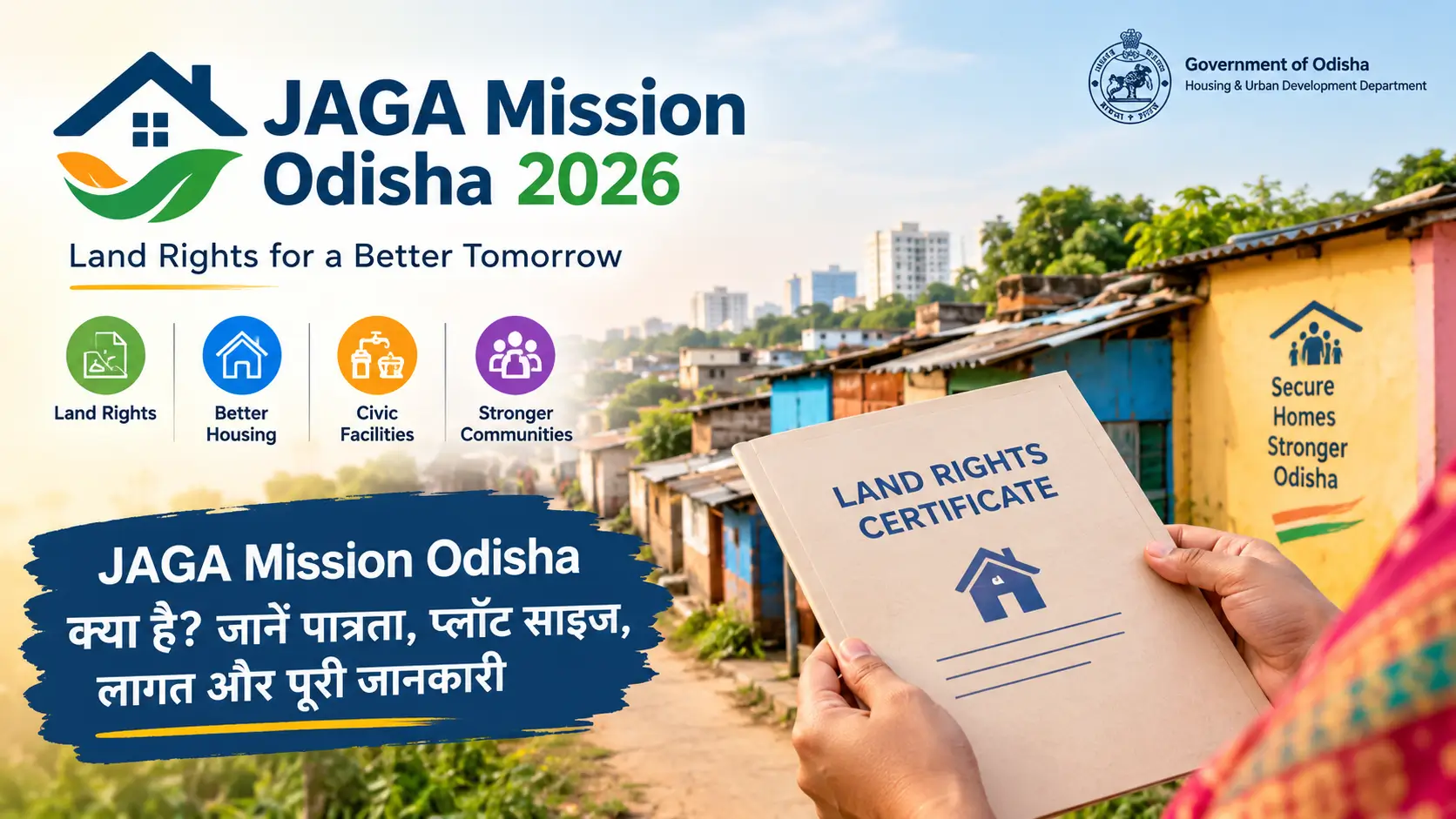
JAGA Mission Odisha is a state government initiative that helps eligible families living in urban slums secure legal rights over the land where they live. Instead of simply removing slum settlements, the programme focuses on improving existing neighbourhoods through land rights, better housing conditions and essential civic facilities.
The mission operates under the Housing and Urban Development (H&UD) Department of the Government of Odisha. Its legal framework includes the Odisha Land Rights to Slum Dwellers Act, 2017, along with amendments covering municipal corporation areas.
One important point: JAGA Mission does not mean that every slum resident automatically receives a free house or a cash payment. Eligible households may receive land rights or other forms of property rights after government verification. The size and cost of the land depend on the location, household category and applicable rules.
In this guide, you will find the eligibility conditions, plot size, land cost, certificate types, survey process and steps to take if your household has not been included.
JAGA Mission Odisha: Key Details at a Glance
| Particular | Details |
|---|---|
| Full name | Odisha Liveable Habitat Mission |
| Popular name | JAGA Mission |
| State | Odisha |
| Implementing department | Housing and Urban Development Department |
| Main objective | Land rights and slum upgrading |
| Legal framework | Odisha Land Rights to Slum Dwellers Act, 2017 |
| Mission launch | 7 May 2018 |
| Launch location | Chatrapur, Ganjam |
| Target beneficiaries | Eligible urban slum households |
| Maximum plot size | Depends on the applicable urban area rules |
| Free land provision | Generally up to 30 sq. metres for eligible EWS households, subject to applicable conditions |
| Online individual application | No general public application portal verified |
| Official website | https://jagamission.in/ |
What Is JAGA Mission in Odisha?
JAGA stands for the Odisha Liveable Habitat Mission. The Odia word “Jaga” means land or place.
The Odisha government introduced the programme to address a major problem faced by urban slum residents: living in a home without secure legal rights over the land beneath it.
The mission follows a different approach from traditional slum clearance programmes. It aims to improve existing settlements wherever possible rather than automatically relocating their residents.
Its work has two closely connected components:
1. Land rights: Eligible households receive legal recognition of their rights over the land they occupy.
2. Slum improvement: Existing settlements are upgraded with essential infrastructure and public facilities under the Biju Adarsh Colony programme.
The mission also encourages residents to participate in local planning through Slum Development Associations (SDAs).
Who Is Eligible for JAGA Mission Odisha?
Eligibility depends on the applicable legal provisions and the government’s verification process. Simply living in an urban slum does not automatically guarantee a land rights certificate.
Under the Odisha Land Rights to Slum Dwellers Act, 2017, the main eligibility conditions include:
- The applicant must be an Indian citizen.
- The applicant must qualify as a landless person under the Act.
- The household must occupy a qualifying urban slum settlement.
- The occupation must satisfy the applicable government-notified cut-off date.
- The household must meet the other conditions prescribed under the relevant legal framework.
- The land must be suitable for settlement, or an approved rehabilitation arrangement must be available.
What Does Landless Mean?
The Act defines a landless person as an Indian citizen who does not own a house or land in the relevant urban area, either personally or in the name of a family member.
For this purpose, family includes:
- Husband and wife
- Unmarried son
- Unmarried daughter
- Other blood relatives who are wholly dependent on the slum dweller
The law also takes existing land rights granted or inherited under the Act into account.
What Is the Cut-off Date?
The Act itself says that the government will notify the date by which a person must be occupying land in a slum to qualify.
Research on the implementation of the programme identifies 10 August 2017 as the relevant occupation date for the original land-rights framework.
However, applicants should not assume that this date automatically applies to every subsequent municipal corporation arrangement. The applicable notification and rules should be checked with the concerned Urban Local Body.
JAGA Mission Plot Size: How Much Land Can a Family Get?
The plot size is one of the most important parts of the programme. It is not the same for every household or every urban area.
Under Section 3 of the original 2017 Act, the maximum in-situ settlement limits are:
| Urban area | Maximum plot size |
|---|---|
| Municipal Council | 45 sq. metres |
| Notified Area Council (NAC) | 60 sq. metres |
| Relocation site | 30 sq. metres |
These are maximum limits, not guaranteed allotments.
The actual settlement depends on the area occupied, the applicable amendments and the availability of land.
Special Rule for Families Occupying Less Than 30 Sq. Metres
The Odisha Land Rights to Slum Dwellers (Amendment) Act, 2021 introduced an important provision.
Where a household occupies less than the applicable plot area, the land actually occupied or 30 square metres, whichever is higher, may be settled, subject to the availability of adjacent land.
This provision matters because some families occupy very small plots and may otherwise struggle to meet the minimum space requirements for housing.
What About Municipal Corporation Areas?
The five major municipal corporations covered by the separate framework are:
- Bhubaneswar
- Cuttack
- Berhampur
- Sambalpur
- Rourkela
The Odisha Municipal Corporation (Amendment) Act, 2022 extended the property-rights framework for slum households in these areas.
Where property rights can be granted, the corporation framework provides for them. Where that is not feasible, land rights may be granted in situ, subject to the prescribed conditions and a maximum of 45 square metres.
The framework also provides for allotment of a dwelling space in certain circumstances.
Therefore, families living in municipal corporation areas should not rely only on the original Municipal Council and NAC provisions.
Is JAGA Mission Land Free? Plot Cost Explained
Not every beneficiary receives the entire plot free of cost.
The amount payable depends on whether the household qualifies under the Economically Weaker Section (EWS) category and on the applicable government rules.
For EWS Families
Under the original Act, eligible EWS households receive land free of cost.
However, if the settlement exceeds 30 square metres while remaining within the permitted maximum, the additional area is chargeable according to a percentage of the benchmark land value determined by the government.
For Non-EWS Families
Households outside the EWS category may have to pay an amount calculated as a prescribed percentage of the land’s benchmark value.
Is There a Fixed EWS Income Limit?
The Act defines EWS according to the household income limit notified by the state government from time to time.
I could not confirm a current, universally applicable JAGA-specific income limit from the official material reviewed. It is therefore better to verify the applicable income criteria with the concerned municipality or NAC instead of relying on an outdated figure.
Important: The Act does not establish one universal land price for every city. Ask the concerned Urban Local Body for the applicable benchmark value, percentage and payment conditions before making any payment.
What Are the Rules of a JAGA Land Rights Certificate?
A JAGA land rights certificate provides important security to eligible families, but it does not provide unrestricted ownership.
The main conditions under the original Act include:
1. The Land Can Be Inherited
The land right is heritable. After the beneficiary’s death, the right can pass to the legal heirs according to applicable rules.
2. The Land Cannot Be Sold
The original Act prohibits the sale, gift, sub-lease or other unauthorised transfer of the settled land.
A transfer made in violation of the Act is void.
3. Mortgage Is Allowed for a Housing Loan
The original Act permits the land to be mortgaged to a financial institution for raising finance in the form of a housing loan.
However, this does not mean that every bank must approve a loan. Lending remains subject to the institution’s requirements.
4. Residential Use Is Compulsory
The land is intended for residential purposes. Using it for an unauthorised non-residential purpose can lead to cancellation of the certificate and other legal consequences.
5. Married Couples Can Receive Joint Rights
For married households, the certificate is issued jointly in the names of both spouses. A household headed by a single person receives the certificate in that person’s name.
6. Duplicate Certificates Are Not Permitted
A beneficiary cannot retain land rights certificates in multiple urban areas of Odisha. The Act also provides for action where multiple certificates are obtained through misrepresentation.
7. The Certificate Can Be Used as Address Proof
Section 3(9) of the original Act recognises the land rights certificate as acceptable evidence of residential address.
8. Existing Eviction Proceedings May End
Under Section 5, eviction proceedings relating to unauthorised occupation pending before an authority or court under state law abate when the land rights certificate is issued.
What Happens If Someone Breaks the Rules?
Under Section 9 of the original Act, contravention of the relevant provisions can result in imprisonment of up to one year, a fine of up to ₹20,000, or both.
The law also provides for cancellation of the certificate, invalidation of an unlawful transfer and removal of the person occupying the land in violation of the provisions.
For municipal corporation beneficiaries, the relevant corporation law and notified rules must also be considered.
Difference Between LRC, LEC and Property Right Certificate
These terms are important when checking government announcements or beneficiary statistics.
Land Right Certificate (LRC)
A Land Right Certificate recognises the land rights granted to an eligible slum household under the applicable legal provisions.
The rights are heritable but restricted from ordinary sale or transfer.
Land Entitlement Certificate (LEC)
A Land Entitlement Certificate is another term used in JAGA Mission implementation and government reporting.
The Centre for Policy Research has described it as an interim document associated with the assurance of land rights, subject to completion of the necessary conditions.
It should not automatically be treated as identical to a final Land Right Certificate.
Property Right Certificate
Municipal corporation areas have a separate legal framework that includes property rights as well as land rights.
The Odisha Municipal Corporation (Amendment) Act, 2022 introduced provisions for settling land rights or allotting dwelling space, depending on the applicable conditions.
This is why a beneficiary’s certificate type should be checked before assuming that all JAGA documents provide exactly the same rights.
How Are JAGA Mission Beneficiaries Selected?
There is no general individual online application process verified for this programme.
Beneficiaries are identified through a government-led survey, mapping, verification and approval process.
The process broadly includes the following stages:
Step 1: Identification of Slums
Authorities identify eligible slum settlements within the relevant urban local body.
Step 2: Drone Survey and Mapping
Drone imagery and spatial mapping help establish settlement boundaries, plot locations and the physical layout of the slum.
Step 3: Household Survey
The Urban Slum Household Area (USHA) survey collects information about individual households, family details, land occupation and existing facilities.
Step 4: Preparation of the Settlement Proposal
Survey information is combined with land records and maps to prepare a draft settlement proposal.
Step 5: Public Verification and Objections
The proposed household list and settlement details are checked. Objections and disputes can be considered during the verification process.
Step 6: Committee Approval
The Urban Area Slum Redevelopment and Rehabilitation Committee reviews the eligible household list and approves the settlement according to the applicable law.
Step 7: Certificate Distribution
After approval and completion of the required formalities, eligible households receive their respective certificates.
How to Check Your JAGA Mission Beneficiary Status
If you live in an urban slum and want to know whether your household has been included, follow these practical steps:
- Visit your concerned Municipality, NAC or Municipal Corporation office.
- Ask whether your slum has been surveyed under JAGA Mission.
- Request information about the draft or approved beneficiary list.
- Confirm whether your household details were correctly recorded.
- Ask whether your land-rights settlement has been approved or is still under verification.
- If your name is missing, ask about the objection or appeal procedure applicable to your case.
You can also contact your local Slum Development Association, if one is active in your settlement.
Important: Do not pay an agent who promises to add your name to the beneficiary list or guarantee a certificate. The approval process is governed by the relevant authorities and legal provisions.
What If Your Name Is Missing From the JAGA Mission List?
A household may be missing from a list for several reasons:
- The household was not included in the initial survey.
- Family or identity details were recorded incorrectly.
- Land occupation requires further verification.
- The settlement boundary is disputed.
- The land is not suitable for in-situ settlement.
- The household’s eligibility is under examination.
If your name is missing, submit a written representation to the concerned Urban Local Body and request an acknowledgement.
The original Act also provides an appeal mechanism under Section 8. An appeal against a decision or order can be made to the officer appointed by the state government, following the prescribed procedure.
Ask the authority which appellate officer and time limit apply to your case.
What Happens If a Slum Is on Unsafe or Reserved Land?
Not all slum settlements can be upgraded at their existing location.
The Act distinguishes between tenable and untenable settlements.
Tenable settlements: These are areas where residents can continue living without unacceptable risks to their safety, health or life, and where the land is not required for an incompatible public or development purpose.
Untenable settlements: These include locations where continued habitation creates serious safety or health risks, or where settlement is considered contrary to public interest.
Where in-situ settlement is not possible, eligible residents may be rehabilitated elsewhere under the applicable government arrangements.
For relocation under the original Act, the maximum land area is 30 square metres.
The law also provides for transit accommodation or space during redevelopment for the period required under the applicable housing scheme.
What Is Biju Adarsh Colony Under JAGA Mission?
JAGA Mission is not limited to issuing land certificates.
Its second major focus is transforming existing slums into better living environments through the Biju Adarsh Colony programme.
The programme focuses on facilities such as:
- Paver-block roads
- Stormwater drainage
- Street lighting
- Individual household water connections
- Electricity connections
- Individual household toilets
- Open spaces and children’s play areas
- Community facilities and Parichay Centres
Slum Development Associations also help residents participate in planning, implementation and maintenance of local infrastructure.
This approach is intended to make settlements safer, cleaner and more liveable.
How Many Families Have Benefited from JAGA Mission?
Published figures differ because government reports and news announcements cover different dates and implementation stages.
Some important historical figures are:
| Reporting period | Reported achievement |
|---|---|
| 2023 H&UD Department material | Approximately 173,000 families with land rights or entitlement certificates |
| August 2023 | More than 2.4 lakh families reported in an ANI report |
| July 2024 | 2,54,672 land rights grants or approvals, including LRCs and LECs, reported in the Odisha Assembly |
The July 2024 figure was reported by OMMCOM News from a written Assembly reply by the Housing and Urban Development Minister.
These numbers should not be presented as the confirmed current beneficiary total for November 2026.
The H&UD Department’s JAGA Mission fact sheet also reported that the programme covered 114 Urban Local Bodies and approximately 1.7 million people.
For updated programme information, visit the official JAGA Mission website and H&UD Department portal.
Why Are Some Families Still Waiting for Land Rights?
Although the programme has made progress, some households may still be waiting for approval or certificates.
Common reasons include:
- Land ownership disputes: Land belonging to railways, private owners or other government bodies may require additional decisions.
- Survey verification: Household details, plot boundaries and land occupation need to be checked.
- Relocation requirements: Some settlements cannot remain at their existing locations.
- Disputed beneficiary lists: Objections and household-level disputes can delay approval.
- Administrative processing: Committee review and completion of land records take time.
Therefore, a delay does not automatically mean that a household has been rejected.
Residents should ask the local authority for the specific reason and the next step in their case.
JAGA Mission Odisha vs PMAY: What Is the Difference?
People sometimes confuse JAGA Mission with the Pradhan Mantri Awas Yojana.
However, both programmes serve different purposes.
| Feature | JAGA Mission | PMAY |
|---|---|---|
| Main objective | Land rights and slum upgrading | Housing assistance |
| Primary focus | Security of tenure and better settlements | Construction or improvement of houses |
| Land certificate | Available to eligible beneficiaries under applicable rules | Not its primary purpose |
| Infrastructure | Slum-level civic improvements | Depends on the applicable housing component |
| Eligibility | JAGA-specific legal conditions | Separate PMAY eligibility conditions |
A household with JAGA land rights may explore housing assistance under an applicable housing scheme. However, receiving a JAGA certificate does not automatically guarantee PMAY assistance.
You can also read our guides on PMAY Odisha, the Odisha PM Awas Yojana Beneficiary List and Antyodaya Gruha Yojana.
Odisha Aahaar Kendra Guide – ₹5 Meal, Timings, Locations and Eligibility
Official Websites and Documents
For accurate information, always prioritise government documents over third-party scheme summaries.
- JAGA Mission Official Website – Mission information and updates.
- Odisha Housing and Urban Development Department (https://urban.odisha.gov.in/) – Department notifications, Acts and rules.
- Odisha Land Rights to Slum Dwellers Act, 2017 (https://www.indiacode.nic.in/bitstream/123456789/5976/1/1652-Act%20no.10-2017.pdf) – Eligibility, land limits, rights and legal provisions.
- Odisha Land Rights to Slum Dwellers Amendment Act, 2021 (https://urban.odisha.gov.in/sites/default/files/2023-10/Gazette%20%285%29.pdf) – Amendment to plot settlement provisions.
- Odisha Municipal Corporation (Amendment) Act, 2022 (https://urban.odisha.gov.in/sites/default/files/2023-10/1632-Law%20Dept.pdf) – Corporation-area property and land rights provisions.
- H&UD Department JAGA Mission Fact Sheet (https://urban.odisha.gov.in/sites/default/files/2023-09/JAGA%20MISSION.pdf) – Mission overview and historical implementation information.
Frequently Asked Questions
1. What is JAGA Mission Odisha?
JAGA Mission is the Odisha Liveable Habitat Mission. It aims to provide land rights to eligible urban slum households and improve their living conditions through basic infrastructure and community development.
2. Who can get land under JAGA Mission?
Eligible landless Indian citizens living in qualifying urban slum settlements may receive land rights, subject to the applicable occupation date, eligibility conditions, government verification and committee approval.
3. How much land is given under JAGA Mission?
Under the original Act, the maximum in-situ plot size is 45 square metres in Municipal Council areas and 60 square metres in NAC areas. Relocation plots are limited to 30 square metres. Municipal corporation areas have a separate framework with a maximum land-rights provision of 45 square metres.
4. Is JAGA Mission land completely free?
Eligible EWS families can receive land free of cost under the applicable provisions, generally up to 30 square metres. Charges may apply to additional land or to non-EWS beneficiaries.
5. Can I sell my JAGA Mission land?
No. Under the original Act, land rights are heritable but cannot ordinarily be sold, gifted or leased. Mortgage is permitted for a housing loan subject to the law.
6. Can I apply for JAGA Mission online?
No general individual online application portal has been verified. Beneficiaries are identified through government surveys and the prescribed approval process. Contact your local Municipality, NAC or Municipal Corporation.
7. What is the difference between LRC and LEC?
LRC means Land Right Certificate, while LEC means Land Entitlement Certificate. The two terms appear in JAGA Mission reporting, but they should not automatically be treated as identical documents or as proof of the same stage of approval.
8. Does JAGA Mission provide a free house?
Not automatically. The programme primarily focuses on land rights and improving slum infrastructure. Housing assistance may be available through separate schemes if the household meets their eligibility conditions.
9. Can a woman receive a JAGA Mission land certificate?
Yes. Under the original Act, married couples receive joint certificates, while a single-headed household receives the certificate in the single head’s name.
10. What should I do if my name is missing from the beneficiary list?
Contact your local Urban Local Body, request details of the survey and beneficiary list, and submit a written representation if your household was missed. You may also ask about the appeal procedure under the applicable law.
11. Can JAGA Mission beneficiaries get PMAY housing assistance?
They may apply for an applicable housing scheme if they satisfy its separate eligibility and documentation requirements. A JAGA certificate alone does not guarantee PMAY approval.
12. Where can I find official JAGA Mission updates?
Visit jagamission.in and the Odisha H&UD Department website (https://urban.odisha.gov.in/).
Disclaimer: This website is not affiliated with any government department. The information is provided for general guidance. Eligibility, land settlement and certificate issuance are subject to the latest government notifications, applicable legislation and verification by the concerned authority.