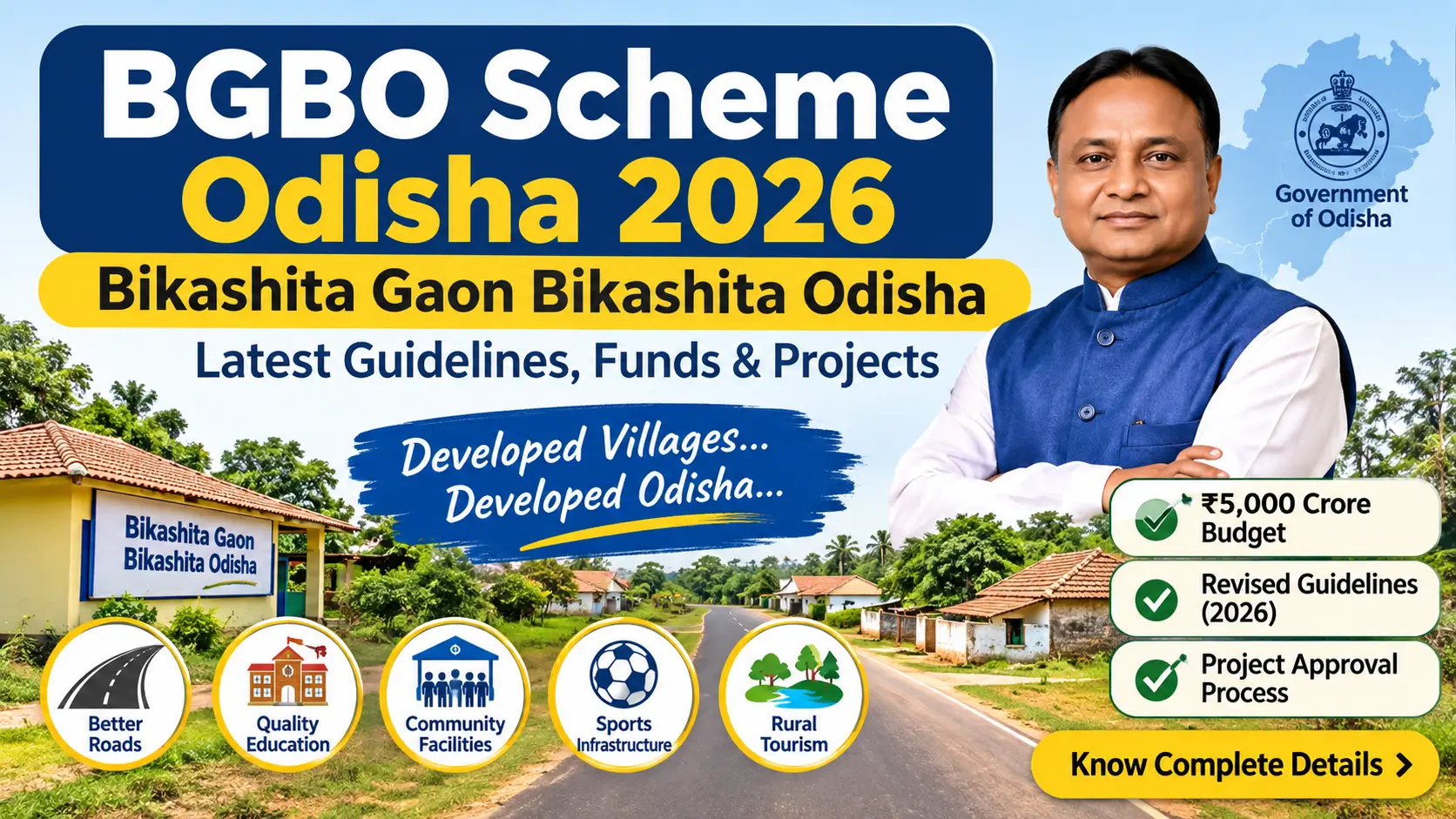
BGBO Scheme Odisha 2026: Latest Guidelines, Project Approval and Village Development
Read in another language:
The Bikashita Gaon Bikashita Odisha (BGBO) Scheme is a rural infrastructure development programme of the Government of Odisha. It aims to improve village infrastructure through projects such as roads, bridges, school facilities, community centres, playgrounds and other public assets.
The scheme replaced the earlier Ama Odisha Nabin Odisha (AONO) programme. Its implementation framework has also been revised to encourage community participation, improve project selection and strengthen accountability.
One important point for residents: BGBO is not an individual cash-benefit scheme. It does not provide a fixed amount of money directly to every villager. Instead, funds are used for approved infrastructure projects that benefit rural communities.
This guide explains the BGBO scheme’s objectives, funding, eligible works, revised guidelines, project approval process and how residents can check development work in their villages.
BGBO Scheme Odisha 2026: Overview
| Scheme Detail | Information |
|---|---|
| Full Name | Bikashita Gaon Bikashita Odisha |
| Short Name | BGBO |
| State | Odisha |
| Scheme Type | Rural Infrastructure Development |
| Launched By | Government of Odisha |
| Chief Minister at Launch | Mohan Charan Majhi |
| Launch Date | 5 February 2025 |
| Implementing Department | Panchayati Raj & Drinking Water Department |
| Total Planned Outlay | ₹5,000 crore over five years |
| Initial Budget Provision | ₹1,000 crore for FY 2024-25 |
| Previous Scheme | Ama Odisha Nabin Odisha (AONO) |
| Official Website | https://bikashitagaon-bikashitaodisha.odisha.gov.in/ |
| Project Management Portal | https://ppms.odisha.gov.in/ |
The scheme was launched to address infrastructure gaps in rural Odisha and support inclusive development. The state government announced a planned investment of ₹5,000 crore over five years, with an initial provision of ₹1,000 crore for 2024-25.
The annual budget provision should not be confused with the total five-year outlay. Actual allocations and expenditure may vary by financial year.
What Is the Bikashita Gaon Bikashita Odisha Scheme?
Bikashita Gaon Bikashita Odisha is an umbrella scheme designed to improve essential infrastructure in rural areas.
The programme focuses on creating durable public assets that can improve the quality of life in villages. These may include better road connectivity, educational infrastructure, community facilities, sports infrastructure and need-based rural tourism projects.
The scheme recognises that rural development requires more than financial assistance to individual households. Villages also need public infrastructure that supports education, mobility, community activities and local development.
The official BGBO portal describes the scheme as a programme for bridging critical rural infrastructure gaps and promoting inclusive growth.
Why Was Ama Odisha Nabin Odisha Replaced by BGBO?
The earlier Ama Odisha Nabin Odisha (AONO) programme was introduced by the previous Odisha government to support village infrastructure and development.
In October 2024, the state government announced its intention to rename and revise the programme. The new BGBO framework was subsequently introduced in January 2025.
The government stated that the revised programme would place greater emphasis on rural infrastructure, community participation and the development of sustainable public assets.
The change also brought a new approach to project selection and implementation.
What Happened to Incomplete AONO Projects?
The original BGBO guidelines allowed eligible incomplete projects under AONO to be taken up for completion under the new scheme, subject to the specified conditions.
The original framework referred to a minimum expenditure condition of 20% for eligible incomplete projects.
However, residents should not assume that every unfinished AONO project automatically qualifies for BGBO funding. The project must be examined under the applicable government guidelines and approval process.
What Works Are Allowed Under the BGBO Scheme?
BGBO supports several types of rural infrastructure projects.
1. Rural Roads and Connectivity
Road connectivity is one of the major priorities of the programme.
Permitted works include:
- Construction of inter-village roads
- Development of roads within villages
- Construction of bridges and culverts
- Standalone cross-drainage works with necessary approach roads
- Blacktop and cement concrete roads
- Upgradation of roads in forest and remote areas, where permitted
Special attention is given to unconnected habitations in Particularly Vulnerable Tribal Group (PVTG) areas, Naxal-affected regions and remote hilly locations.
2. Civic Assets and Community Facilities
The scheme can support the construction of public facilities used by village communities.
Examples include:
- Community centres
- Kalyana Mandaps
- Bhoga Mandapas
- Bhagabata Tungis
- Cultural centres
Certain facilities, such as toilets and water supply near places of worship, may be developed through convergence with programmes such as Swachh Bharat Mission and Jal Jeevan Mission, wherever applicable.
3. Education Infrastructure
BGBO can support the improvement of rural educational infrastructure.
Eligible works include:
- Additional classrooms
- Modernisation of existing school buildings
- Expansion of school infrastructure
- School library buildings
These projects are intended to improve the learning environment and provide better facilities to students in rural areas.
4. Sports Infrastructure
The scheme also provides for community-oriented sports facilities.
Examples include:
- Village playgrounds
- Volleyball courts
- Basketball courts
Sports facilities within high schools and colleges may also serve as community assets outside regular school hours.
5. Micro-Tourism Development
Need-based development of small tourism destinations in villages may be taken up under the scheme.
The objective is to improve local infrastructure and support community-oriented tourism opportunities.
6. Innovative Community Projects
The guidelines also provide scope for innovative projects that address local community needs.
Projects must comply with the applicable financial and administrative rules. Similar projects undertaken by other departments may be coordinated to avoid duplication and improve the use of public funds.
Important: Not every infrastructure project is automatically eligible under BGBO. The proposal must fall within the scheme’s permitted categories and receive approval from the competent authority.
BGBO Scheme Budget and Fund Allocation
The Government of Odisha announced a planned outlay of ₹5,000 crore over five years for the BGBO programme.
The initial provision for FY 2024-25 was ₹1,000 crore.
The original guidelines also included specific financial conditions for project selection and fund utilisation.
Important Fund-Utilisation Rules
The original BGBO guidelines included the following provisions:
| Rule | Details |
|---|---|
| Road Projects | Maximum 35% of the allotted funds |
| ITDA Blocks | 40% allocation earmarked for blocks under an Integrated Tribal Development Agency |
| Incomplete AONO Projects | Eligible projects subject to the applicable expenditure condition |
| Innovative Projects | Up to 5% of the sanctioned amount, as specified in the guidelines |
These figures relate to the original framework. Readers should refer to the latest amended guideline before relying on a specific percentage for a current project.
The scheme’s total outlay should also not be interpreted as the amount already spent or the amount available to an individual village.
Latest BGBO Scheme Guidelines 2026
The Odisha Panchayati Raj and Drinking Water Department issued Resolution No. 799 dated 7 January 2026, modifying the BGBO project-selection framework.
The revised approach aims to encourage active citizen participation, simplify project selection and promote the creation of durable community assets.
The revised guidelines are particularly important because they change how project proposals are considered.
What Changed Under the Revised Guidelines?
The revised framework places greater emphasis on:
- Need-based proposals prepared through Gram Sabha participation
- Proposals from Panchayati Raj Institution members
- Participation of elected representatives
- Participation of civil society members
- District-level scrutiny of proposals
- Final approval by the District Collector
- Processing and approval through the BGBO web portal
- Execution and monitoring through the Panchayati Raj Project Management System (PPMS)
The detailed process and applicable conditions should be checked in the official Resolution No. 799 and the subsequent departmental instructions.
How Are BGBO Projects Selected and Approved?
The project-selection process is designed to identify local infrastructure needs and examine proposals before approval.
Under the revised framework, the process can be understood through the following stages.
Step 1: Identification of Village Needs
The Gram Sabha identifies infrastructure requirements according to local needs and the financial allocation available for the relevant financial year.
The proposed works should address genuine community requirements rather than being selected without local consultation.
Step 2: Preparation of Project Proposals
Need-based project proposals may be submitted through the prescribed process.
The revised framework also provides for proposals from Panchayati Raj Institution members, elected representatives and civil society members.
Step 3: District-Level Scrutiny
A District-Level Committee examines project proposals for eligibility, feasibility and local priority.
The committee considers whether the proposed work is appropriate under the scheme and whether it can be implemented within the available financial allocation.
Step 4: Approval by the District Collector
The final list of projects is placed for approval by the District Collector.
A proposal should not be treated as an approved project merely because it has been suggested during a Gram Sabha meeting or submitted to a local authority.
Step 5: Project Processing Through the Official Portal
The government has directed that BGBO projects be processed and approved through the BGBO web portal.
After approval, project execution and monitoring follow the established Panchayati Raj Project Management System (PPMS) protocol.
How to Check BGBO Project Status in Odisha
Residents who want to know whether a development project has been approved or is under construction should use the official government portals.
Official BGBO Website
Visit: https://bikashitagaon-bikashitaodisha.odisha.gov.in
The BGBO portal provides scheme information and official announcements. It is the primary government website for the programme.
Panchayati Raj Project Management System (PPMS)
Visit: https://ppms.odisha.gov.in
PPMS is the government project management system used for project creation, approval, execution and monitoring.
The portal provides scheme-wise project information, including sanctioned, ongoing and completed project details.
For a specific village project, residents may need to identify the relevant district, block, Gram Panchayat or project record.
If the required information is not available online, contact the Gram Panchayat office or Block Development Office.
Note: Project data can change as approvals and construction progress are updated. A project status displayed on a portal should be checked against the latest available record.
Can an Individual Apply for the BGBO Scheme?
No. BGBO is not an individual beneficiary scheme.
There is no general personal application form through which a resident can claim a fixed cash benefit under the programme.
The scheme funds infrastructure projects that benefit rural communities.
However, residents can participate in the process of identifying local needs and raising proposals through the prescribed channels.
What Can Residents Do?
If your village needs a road, school classroom, playground or community facility, you can:
- Attend Gram Sabha meetings.
- Discuss the infrastructure requirement with your Sarpanch or ward member.
- Ask whether the proposed work is included in the village development plan.
- Check whether the proposal has been forwarded for consideration.
- Contact the Block Development Office if you need clarification.
- Check the BGBO portal and PPMS for available project information.
A proposal does not guarantee approval. Projects must meet the applicable guidelines and receive the required administrative approval.
Beware of Fake BGBO Registration Websites
BGBO is an infrastructure development programme, not a direct cash-transfer scheme.
Be cautious if a website, agent or social media account claims that you can receive a personal payment by registering under BGBO.
Do not pay an application fee to an unauthorised person. Use the official government website for scheme information.
How BGBO Is Different From Subhadra Yojana
People sometimes confuse BGBO with individual welfare schemes.
The main difference is the type of benefit.
| Feature | BGBO Scheme | Subhadra Yojana |
|---|---|---|
| Main Objective | Rural infrastructure development | Financial assistance to eligible women |
| Beneficiary | Village community | Eligible individual women |
| Type of Support | Public infrastructure projects | Direct financial assistance |
| Personal Application | No general individual benefit application | Individual beneficiary application |
| Main Focus | Roads, schools, community facilities | Women’s financial empowerment |
If you are looking for information about individual financial assistance in Odisha, you can read our Subhadra Yojana guide.
Gopabandhu Sambadika Swasthya Bima Yojana 2026: Apply Online, Eligibility and Last Date
MMJJM 2.0 Odisha 2026: ₹30,000 Livelihood Support, Eligibility and Selection Process
Cyclone Arnab Odisha Relief Package 2026: ₹2,500 Cash, Compensation & Payment Details
OBDRS Odisha 2026: Birth & Death Certificate Apply, Status and Download
Official Websites and Documents for BGBO
Readers should use official government sources to verify the latest scheme details.
| Resource | Purpose |
|---|---|
| Official BGBO Portal (https://bikashitagaon-bikashitaodisha.odisha.gov.in/) | Scheme information and announcements |
| Panchayati Raj & DW Department (https://panchayat.odisha.gov.in/en/taxonomy/term/6267) | BGBO guidelines and departmental documents |
| Resolution No. 799 (https://panchayat.odisha.gov.in/en/notification/modification-guidelines-bgbo-scheme) | Revised project-selection guidelines |
| PPMS Portal (https://ppms.odisha.gov.in/) | Project management and monitoring |
| PPMS Scheme-Wise Project Status (https://ppms.odisha.gov.in/scheme-wise-project-status) | Scheme-wise project progress |
The guidelines may be amended through subsequent government notifications. Always check the latest available official document before relying on a particular rule.
Frequently Asked Questions (FAQs)
What is the full form of BGBO?
BGBO stands for Bikashita Gaon Bikashita Odisha, a rural infrastructure development scheme of the Government of Odisha.
What is the main objective of the BGBO scheme?
The main objective is to bridge rural infrastructure gaps by developing roads, bridges, educational facilities, community assets, sports infrastructure and other eligible projects.
Who launched the BGBO scheme?
The Government of Odisha launched the scheme under Chief Minister Mohan Charan Majhi on 5 February 2025.
What is the total budget of the BGBO scheme?
The government announced a planned outlay of ₹5,000 crore over five years, with an initial provision of ₹1,000 crore for FY 2024-25.
Is BGBO a direct benefit scheme?
No. BGBO is a rural infrastructure programme. It does not provide a fixed personal cash benefit to every resident.
Can I apply online for the BGBO scheme?
There is no general individual beneficiary application form. Residents can participate in village-level planning and raise infrastructure requirements through the prescribed process.
What happened to Ama Odisha Nabin Odisha?
BGBO replaced the earlier Ama Odisha Nabin Odisha programme. Eligible incomplete projects may be considered for completion under the applicable guidelines.
How can I check the BGBO project list?
Visit the official BGBO portal and PPMS website. You may also contact your Gram Panchayat or Block Development Office for project-specific information.
Which department implements the BGBO scheme?
The Panchayati Raj and Drinking Water Department of the Government of Odisha is responsible for the scheme.
Where can I find the latest BGBO guidelines?
The latest available guidelines and modifications are published on the official Panchayati Raj and Drinking Water Department website.
Conclusion
The Bikashita Gaon Bikashita Odisha scheme is an important initiative for improving rural infrastructure across Odisha.
Its focus on roads, education, community facilities, sports infrastructure and other public assets can help address development gaps in villages.
The revised guidelines also place greater importance on community participation, project scrutiny and accountability.
For residents, the most useful step is to identify local infrastructure needs, participate in Gram Sabha meetings and check approved project information through the official BGBO and PPMS portals.
Always verify scheme-related claims through government notifications rather than relying on unofficial registration websites or social media posts.
Official Information Disclaimer: This article is an independent informational guide. It is not affiliated with the Government of Odisha. Scheme rules, funding and project details may change through official notifications.
Sources: Government of Odisha BGBO Portal; Panchayati Raj & Drinking Water Department; PPMS; official BGBO guidelines and amendments.