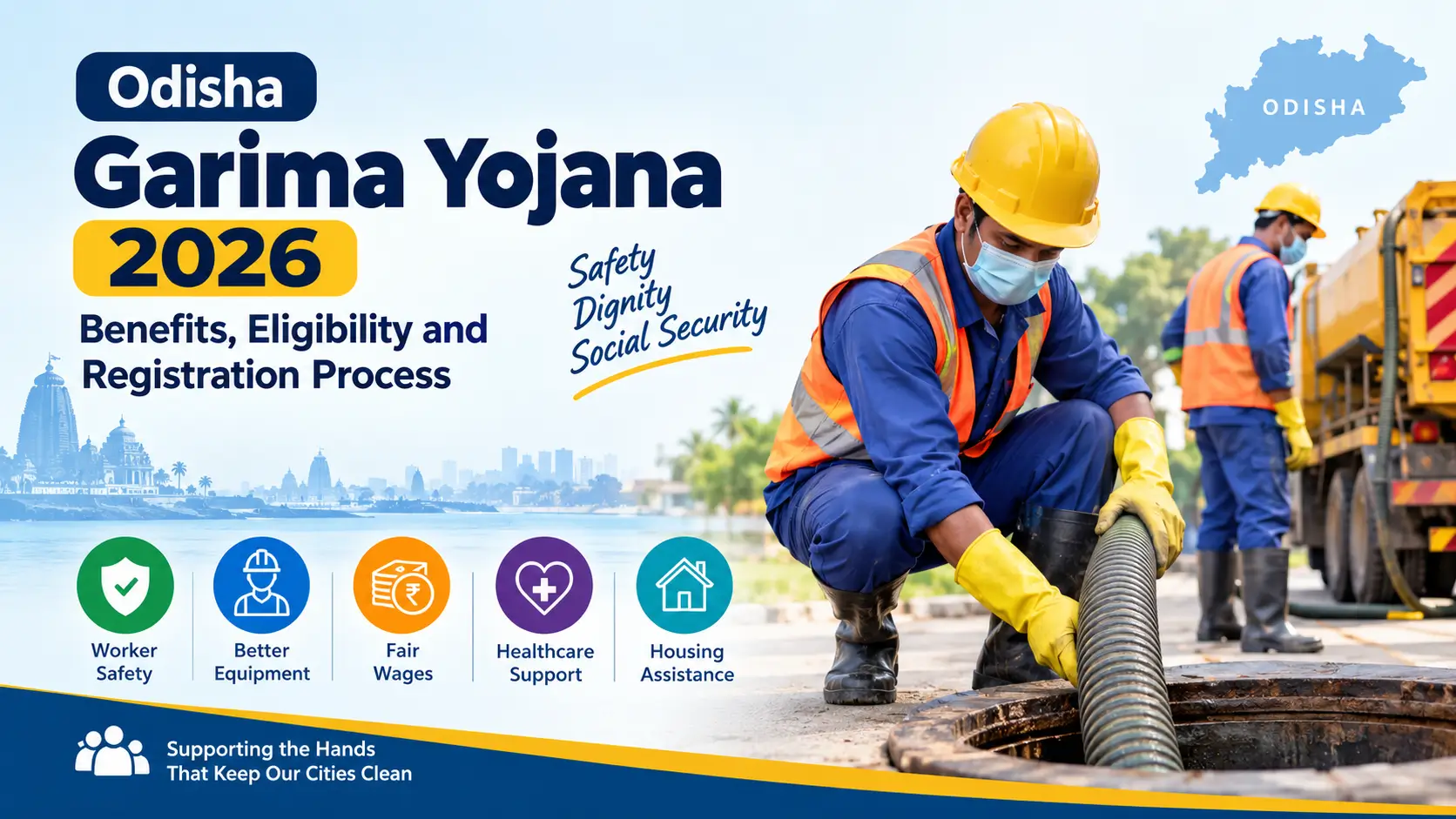
Garima Yojana Odisha 2026: Benefits, Eligibility and Registration Process
Read in another language:
Garima Yojana Odisha is a state government initiative designed to improve the safety, dignity and social security of sanitation workers involved in hazardous cleaning activities. The scheme covers core sanitation workers engaged in sewer maintenance, septic tank cleaning, drain cleaning, sewage treatment plants and public toilet maintenance across urban Odisha.
Launched on 11 September 2020, the scheme focuses on mechanised cleaning, worker identification, fair wages, safety equipment, insurance, healthcare and housing assistance. In 2026, Odisha also introduced a renewed focus on Mission Zero, which aims to prevent fatalities during sanitation work.
Workers and their families can contact their local Urban Local Body (ULB) to ask about Garima registration, ID cards and available benefits. The helpline 14420 can also be used to report unsafe sewer or septic tank cleaning and seek sanitation-related assistance.
Garima Yojana Odisha 2026: Key Details
| Particular | Details |
|---|---|
| Scheme name | GARIMA Scheme |
| State | Odisha |
| Launch date | 11 September 2020 |
| Implementing department | Housing and Urban Development Department, Government of Odisha |
| Target beneficiaries | Core sanitation workers |
| Coverage | All 115 urban local bodies, as reported in 2026 |
| Main objective | Safety, dignity and social security for sanitation workers |
| Identification process | Survey, verification and Garima ID registration |
| Helpline | 14420 |
| Major 2026 initiative | Mission Zero |
| Official website | Odisha H&UDD |
What Is Garima Yojana in Odisha?
GARIMA stands for Gaurav and Respect for Individuals Involved in Manual Activities. The scheme was launched by the Odisha government to recognise the contribution of sanitation workers and improve their working conditions.
Former Chief Minister Naveen Patnaik launched the programme on 11 September 2020. At the time, the government announced an initial corpus fund of ₹50 crore and a target of approximately 20,000 core sanitation workers and their families.
The scheme was designed to identify workers employed by municipal bodies, private contractors and sanitation service organisations, including people who work informally and may not appear on an official payroll.
Its broader objective is to reduce hazardous manual cleaning, improve access to protective equipment and machinery, provide social security and ensure that sanitation workers receive recognition and support.
Who Is Eligible for Garima Yojana?
Garima focuses on people engaged in core sanitation activities in urban Odisha. Eligibility depends on the nature of the work and verification under the scheme.
The recognised work categories include:
- Septic tank and desludging work: Emptying septic tanks and other onsite sanitation systems.
- Sewer maintenance: Cleaning and maintaining sewer networks and related infrastructure.
- Drain cleaning: Cleaning and maintaining urban drains.
- Treatment plant operations: Operating and maintaining sewage treatment plants and faecal sludge treatment plants.
- Public and community toilet maintenance: Cleaning and maintaining public sanitation facilities.
The scheme is not restricted to permanent municipal employees. Workers employed through contractors, private sanitation organisations and informal arrangements may also be identified through the official survey.
Odisha classifies core sanitation workers into Grade I and Grade II categories. Grade I generally includes workers involved in higher-risk activities, such as sewer and septic tank cleaning. The classification is important because certain benefits and safety provisions depend on the worker’s category.
Important: Being engaged in sanitation work does not automatically confirm eligibility for every benefit. The relevant ULB must verify the worker’s details and applicable entitlements.
Garima Yojana Benefits for Sanitation Workers
The scheme combines workplace safety measures with financial and social support. The benefits available to an individual depend on eligibility, the worker’s classification and the implementation status of the relevant provision.
1. Mechanised Cleaning and Safety Equipment
The government promotes the use of machines for sewer cleaning and septic tank desludging to reduce workers’ direct exposure to hazardous waste.
Safety measures include:
- Mechanised sewer and septic tank cleaning equipment.
- Personal Protective Equipment (PPE), including appropriate gloves, helmets, masks, protective eyewear and boots.
- Emergency Response Sanitation Units (ERSUs) for sanitation emergencies.
- Training and operating procedures for hazardous cleaning situations.
- Garima Griha facilities, which provide designated spaces for workers to rest, wash and change clothes.
The objective is to make mechanised and properly protected cleaning the standard practice rather than exposing workers to dangerous conditions.
More related Odisha schemes
Odisha Mo Seba Kendra List 2026: Find Your Nearest Centre & Download PDF
blog
Education scholarships
Central govt schemes
Subhadra yojana
Odisha Employment Exchange Online Registration 2026: Complete Verified Guide (Register, Validate, Renew)
Odisha Disability ID Card Apply Online 2026: Apply Online, Status, Documents & Benefits
2. Wages and Risk Allowance
Odisha recognised core sanitation work involving direct contact with faecal matter under its scheduled employment framework in 2021. The scheme also introduced special skilled and highly skilled classifications for relevant sanitation work.
The original Garima publications reported wage increases and a 15% risk and hardship allowance for specified highly hazardous work, including certain sewer and septic tank cleaning duties.
However, older wage figures should not be treated as the current minimum wage for October 2026. Odisha’s Labour Directorate lists a minimum-wage notification with variable dearness allowance (VDA) effective from 8 October 2026.
Workers should consult the latest notification and ask their ULB or employer which wage category and allowance apply to their duties.
Official reference: Odisha Labour Directorate — Notifications and Guidelines.
3. Life Insurance and Financial Protection
A notification issued by the Odisha Housing and Urban Development Department on 9 June 2025 provides for ₹10 lakh in life insurance support to eligible family members of a deceased Grade I core sanitation worker, subject to the applicable conditions.
The notification identifies the Urban Local Bodies as responsible for meeting the insurance premium from the Garima Corpus Fund.
There have also been reports of a ₹30 lakh compensation announcement relating to death during duty. However, the applicable order and claim procedure for that amount should be confirmed separately with the relevant ULB.
Do not assume that the ₹10 lakh insurance provision and the reported ₹30 lakh duty-death compensation are interchangeable or automatically payable in every case.
Official reference: Odisha Gazette notification dated 9 June 2025. (urban.odisha.gov.in/sites/default/files/2025-06/1646%20H%20%26%20UD%20%20Deptt.pdf)
4. Healthcare and Health Check-ups
Garima’s welfare framework includes healthcare support for identified sanitation workers.
Depending on the applicable arrangements, support can include:
- Health cards and linkage with nearby primary healthcare facilities.
- Periodic health check-ups.
- Screening for occupational health problems.
- Assistance following workplace accidents or injuries, where applicable.
Workers should contact their ULB or designated health facility to confirm the services currently available in their area.
5. Housing Assistance
Eligible sanitation workers may be linked to housing assistance under the applicable Pradhan Mantri Awas Yojana (Urban) arrangements.
Housing support is subject to the relevant scheme’s eligibility criteria, documentation, approval and availability. A Garima ID alone should not be interpreted as a guarantee of a housing sanction.
Ask the local municipality about the current application process and whether any housing work order or beneficiary approval has been issued.
6. Identity Documents and Other Social Security Support
Garima implementation has also included efforts to help workers access essential documents and welfare services.
Depending on individual circumstances, these efforts may include assistance with:
- Aadhaar details.
- Bank account access.
- Ration cards and food security.
- Health records.
- Relevant employment and social security entitlements.
Some additional provisions were announced when Garima was launched, including educational support for children, housing grants, two-wheeler assistance and post-service benefits. Their current availability and conditions should be verified locally rather than assumed to be universal entitlements.
Mission Zero and Garima Diwas 2026
On 22 August 2026, Odisha Chief Minister Mohan Charan Majhi inaugurated the national workshop titled Mission Zero: Ending the Casualties in Cleaning Work in Bhubaneswar during Garima Diwas 2026.
The initiative places particular emphasis on mechanised cleaning, robotics and modern technology to prevent deaths and serious injuries during hazardous sanitation operations.
The government also announced that Garima Diwas would be observed every year on the fourth Saturday of August. Under this schedule, the next observance falls on 28 August 2027.
At the 2026 event, insurance assistance and housing work orders were distributed, and modern sanitation safety equipment was showcased.
Official announcement: Chief Minister’s Office, Odisha — Garima Diwas 2026 (cm.odisha.gov.in/en/latest-news/focus-sanitation-workers-safety-fourth-saturday-august-be-observed-garima-diwas-every).
Garima Yojana Registration: How to Get a Garima ID Card
Garima registration is based on identifying and verifying eligible sanitation workers. I could not verify a public, general-purpose online application form for individual beneficiaries on the department’s website.
If you or a family member performs eligible sanitation work and has not been registered, follow these steps.
Step 1: Contact Your Local ULB
Visit your Municipal Corporation, Municipality or Notified Area Council (NAC). Explain that you work in a core sanitation role and want to check your registration under Garima.
Ask for the officer or team responsible for Garima implementation.
Step 2: Explain Your Work Details
Provide accurate information about your work, including:
- Whether you clean sewers, septic tanks or drains.
- Whether you operate sanitation machinery or maintain treatment plants.
- Whether you clean public or community toilets.
- Whether you work directly for a ULB, a contractor, a private organisation or independently.
These details help officials determine the appropriate classification and verification process.
Step 3: Keep Relevant Documents Ready
Carry available documents that may help establish your identity and employment details, such as:
- Aadhaar card or another accepted identity document.
- Bank passbook or bank account details.
- Mobile number.
- Ration card, if available.
- Employment, contractor or work-related records, if available.
This is a practical preparation list, not a claim that every document is mandatory in every case. Ask the local office for its current requirements.
Step 4: Complete the Official Survey and Verification
The designated team may record your work details through the survey process and verify your information. Informal workers can also approach the local ULB to ask how they can be included.
Step 5: Ask About Your Garima ID and Benefits
After verification, ask whether a Garima ID has been issued or whether further action is required. Also request information about the benefits applicable to your worker category.
If you face difficulties, contact the Garima helpline at 14420 or seek assistance from the relevant municipal office.
Note: Do not pay an unauthorised agent for registration. Confirm any official fee, if applicable, directly with the government office.
Garima Helpline 14420: Purpose and Uses
The short code 14420 was allotted for complaints and requests concerning unsafe sewer and septic tank cleaning. Odisha uses the helpline as part of its sanitation safety and Garima support arrangements.
You can use it to seek assistance with matters such as:
- Reporting unsafe sewer or septic tank cleaning practices.
- Requesting information about safe septic tank desludging services.
- Seeking guidance about sanitation-related complaints.
- Asking where to raise a concern involving sanitation worker safety.
When making a complaint, explain the location, nature of the problem and whether a worker is currently at risk.
If a worker is being exposed to immediate danger, report the situation promptly to the relevant local authorities. Do not enter a sewer or septic tank yourself to attempt a rescue.
Garima Yojana vs NAMASTE Scheme
Garima and NAMASTE share the goal of making sanitation work safer, but they are separate government initiatives.
| Feature | Garima Yojana | NAMASTE Scheme |
|---|---|---|
| Government | Odisha state government | Government of India |
| Implementing framework | Housing and Urban Development Department, Odisha | Ministry of Social Justice and Empowerment, in convergence with the Ministry of Housing and Urban Affairs |
| Main target | Core sanitation workers in Odisha’s urban areas | Sewer and septic tank workers, with waste pickers included as an additional target group |
| Key focus | Worker identification, safety, wages, insurance and welfare | Worker profiling, occupational safety, mechanisation, healthcare and livelihood support |
| Geographic scope | Odisha | National |
NAMASTE was launched in July 2023 to formalise and rehabilitate people engaged in hazardous sewer and septic tank cleaning, promote mechanised sanitation and improve worker safety. Its waste-picker component was added from 2024–25.
A worker in Odisha may be eligible for relevant provisions under both initiatives, depending on the applicable criteria. The local ULB can help explain which benefits are available and how the two programmes operate together.
Official reference: NAMASTE Scheme — Ministry of Social Justice and Empowerment (socialjustice.gov.in/index.php/schemes/37).
How Many Workers Are Covered Under Garima?
The original Garima scheme announcement set a target of approximately 20,000 core sanitation workers and their families.
A 2026 government report cited around 9,364 core sanitation workers identified and registered across 115 urban local bodies. This is a reported coverage figure, not the scheme’s original target.
The distinction matters because the number of workers identified or registered can change as surveys, verification and implementation continue.
For the latest official figures, consult the Odisha Housing and Urban Development Department (urban.odisha.gov.in/en/more/GARIMA) and relevant government publications.
Frequently Asked Questions
What is Garima Yojana Odisha?
Garima Yojana is an Odisha government scheme launched in September 2020 to improve the safety, dignity, wages, social security and welfare of core sanitation workers.
Who can benefit from Garima Yojana?
Eligible workers engaged in recognised core sanitation activities in urban Odisha may be covered. This includes qualifying workers employed by municipal bodies, contractors, private sanitation organisations and informal arrangements, subject to verification.
How can I apply for Garima Yojana online?
I could not verify a public online application form for individual beneficiaries. Contact your local ULB to ask about the survey, registration and Garima ID process.
How do I get a Garima ID card?
Approach your local Municipal Corporation, Municipality or NAC and request assistance with Garima worker identification. Officials can explain the verification process and documentation required.
What is the Garima Yojana helpline number?
The helpline is 14420. It is used for sanitation-related assistance, including complaints about unsafe sewer and septic tank cleaning.
How much insurance is available under Garima?
A June 2025 Odisha government notification provides ₹10 lakh in life insurance support to eligible family members of a deceased Grade I core sanitation worker, subject to the notification’s conditions. Any separate duty-death compensation should be confirmed through the relevant official order.
What are the current wages under Garima?
Wages depend on the applicable classification and the latest minimum-wage notification. Odisha lists a revised notification effective from 8 October 2026. Workers should check the latest official notification rather than relying on wage figures from older scheme publications.
What is Mission Zero under Garima?
Mission Zero is Odisha’s initiative to prevent fatalities in sanitation work by promoting mechanisation, modern technology, safety equipment and safer cleaning practices.
What is Garima Diwas?
Garima Diwas is an annual observance announced in August 2026. It will be held on the fourth Saturday of August each year to emphasise the safety and dignity of sanitation workers.
Are women sanitation workers eligible?
The scheme is not described as being restricted to men. Women engaged in eligible core sanitation work can approach their ULB to confirm registration and applicable benefits.
Does Garima guarantee housing assistance?
No. Eligible workers may be linked to applicable housing assistance, but approval depends on the relevant housing scheme’s criteria, documentation and sanction process.
Official Websites and Documents
For accurate information, use these government sources:
Government of India — NAMASTE Scheme (socialjustice.gov.in/index.php/schemes/37)
Final Words
Garima Yojana Odisha aims to make sanitation work safer while improving workers’ access to recognition, fair wages, insurance, healthcare and social security. Its success depends on identifying eligible workers, implementing safety measures and ensuring that approved benefits reach the intended beneficiaries.
If you or a family member works in sewer cleaning, septic tank desludging, drain maintenance or another recognised sanitation role, contact your local ULB to check Garima registration and the benefits available to you. You can also call 14420 for sanitation-related assistance.
Disclaimer: This article is for general information and is not an official government notification. Subhadra-yojanain.com is an independent website and is not affiliated with the Government of Odisha. Eligibility, benefit amounts, wages and procedures may change. Verify the latest details with the relevant government department or local ULB before making a decision.