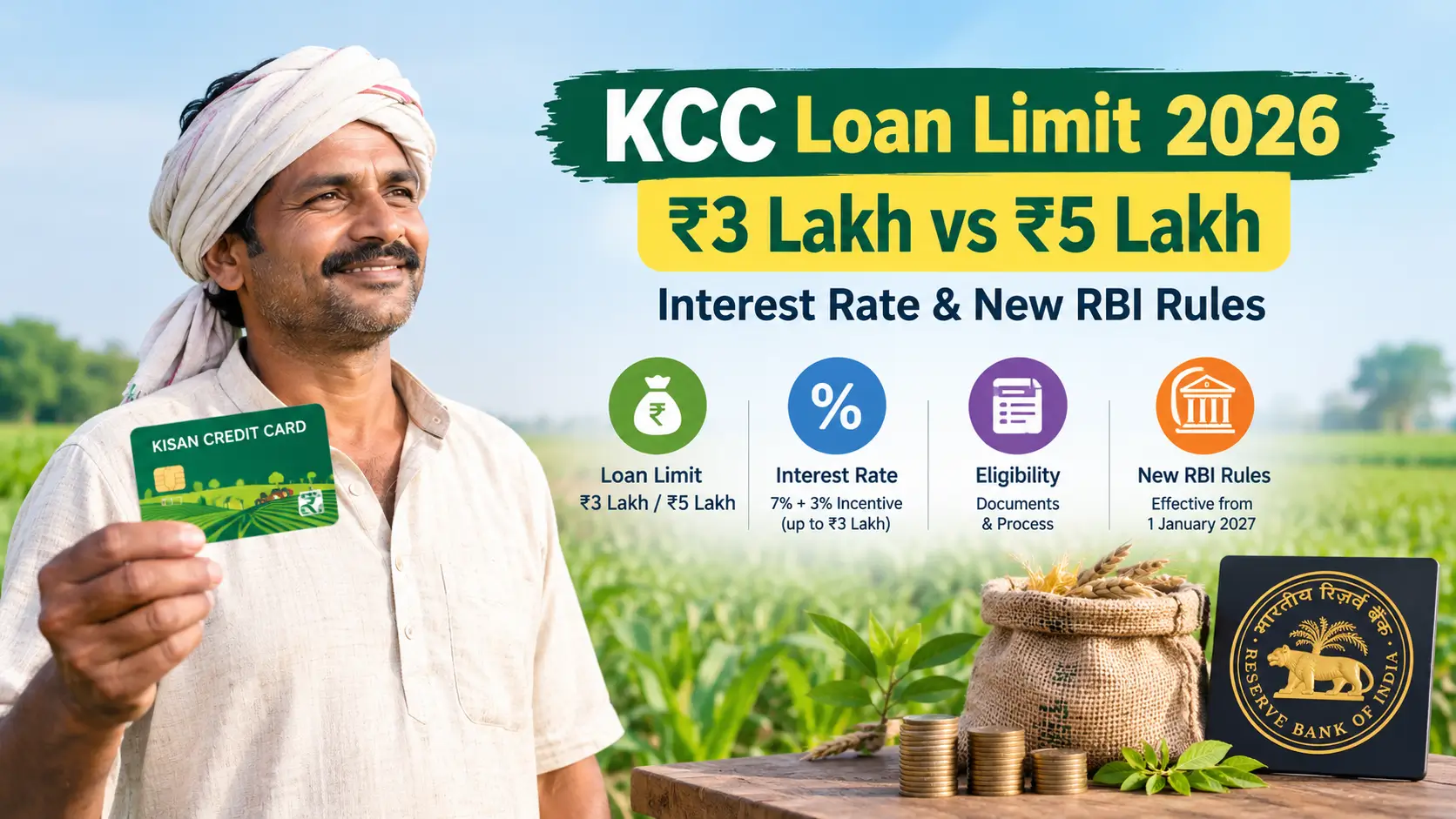
KCC Loan Limit 2026: ₹3 Lakh vs ₹5 Lakh, Interest Rate & New RBI Rules
Read in another language:
The Kisan Credit Card (KCC) loan limit has become confusing for farmers. Some websites mention ₹3 lakh, while others report that the government has increased the limit to ₹5 lakh. Both figures appear in official documents, but they refer to different aspects of agricultural lending and interest su
The important distinction: The Union Budget 2025–26 announced an increase in the KCC lending limit under the Modified Interest Subvention Scheme (MISS) from ₹3 lakh to ₹5 lakh. However, the RBI’s MISS circular for financial year 2025–26 specifies the concessional interest arrangement for short-term agricultural loans up to ₹3 lakh. The ₹5 lakh figure should not be interpreted as a guarantee that every farmer will receive the entire amount at an effective interest rate of 4
This guide explains the KCC loan limit, interest rate, eligibility, documents, application process and RBI’s new directions taking effect on 1 January 2027.
KCC Loan Limit 2026: Key Details at a Glance
| Particular | Details |
|---|---|
| Scheme name | Kisan Credit Card (KCC) |
| Introduced | 1998 |
| Interest support scheme | Modified Interest Subvention Scheme (MISS) |
| Budget 2025–26 announcement | Increase in the MISS lending limit from ₹3 lakh to ₹5 lakh |
| Concessional interest arrangement | 7% per annum on eligible short-term loans up to ₹3 lakh under the documented scheme terms |
| Prompt repayment incentive | Up to 3 percentage points, subject to applicable conditions |
| Effective interest rate | 4% on eligible credit when the full 3% incentive applies |
| Standard collateral-free threshold | Agricultural loans up to ₹2 lakh per borrower, subject to applicable rules |
| New RBI directions | Effective from 1 January 2027 |
| Application options | Participating bank, bank website or JanSamarth portal |
| Official information | RBI (https://www.rbi.org.in), PM-Kisan (pmkisan.gov.in) and Kisan Rin Portal (fasalrin.gov.in) |
Important: The latest MISS terms you can verify in the official documents cited below cover FY 2025–26. Confirm the applicable MISS terms for FY 2026–27 with your bank before calculating your borrowing costs.
What Is the Kisan Credit Card Scheme?
The Kisan Credit Card scheme helps farmers obtain short-term credit for agricultural activities without having to apply for a completely new loan every time they need money during the farming season.
After a bank approves the KCC facility, the borrower can withdraw money within the sanctioned limit for eligible expenses. These may include seeds, fertilisers, pesticides, labour, irrigation, harvesting and other approved farming requirements.
Once the borrower repays the amount used, the available credit can be replenished under the terms of the facility.
The scheme was introduced in 1998 to improve farmers’ access to institutional credit. Its coverage has since expanded beyond crop cultivation to include certain post-harvest expenses, produce marketing, farm maintenance and allied activities such as dairy, animal husbandry and fisheries.
The card may also support eligible investment-credit requirements. The precise facility and repayment terms depend on the bank’s sanction.
According to the Press Information Bureau’s KCC backgrounder published on 11 March 2026, India had more than 7.72 crore active KCCs and outstanding KCC credit of approximately ₹10.2 lakh crore.
Official reference: PIB — Kisan Credit Card: Fueling Growth in Agriculture (https://www.pib.gov.in/PressReleasePage.aspx?PRID=2238004)
Why Is the KCC Loan Limit ₹3 Lakh in Some Places and ₹5 Lakh in Others?
The confusion comes from the difference between the announced lending limit and the interest-benefit rules documented for a particular financial year.
1. What changed in Budget 2025–26?
The Union Budget 2025–26 announced that the lending limit under MISS would increase from ₹3 lakh to ₹5 lakh for loans taken through KCC.
The government also reported an increase in the credit limit for fisheries and allied activities from ₹2 lakh to ₹5 lakh.
These announcements are important, but a farmer should not assume that the entire sanctioned limit automatically qualifies for the same subsidised interest rate.
Official reference: PIB — Budget 2025–26 KCC announcement (https://www.pib.gov.in/PressReleasePage.aspx?PRID=2106230)
2. Why does the ₹3 lakh figure still matter?
The RBI’s circular dated 13 January 2026, concerning MISS for FY 2025–26, describes interest support for short-term agricultural and allied-activity loans through KCC up to an overall limit of ₹3 lakh.
The government’s KCC backgrounder published in March 2026 also explains the 7% interest arrangement and the additional 3% incentive for timely repayment in connection with loans up to ₹3 lakh.
This means the ₹5 lakh announcement and the documented concessional-interest arrangement should not be treated as interchangeable figures.
3. What should a farmer expect?
- Approved credit limit: The bank determines the amount based on eligible requirements and its assessment.
- Interest concession: The concessional rate and repayment incentive depend on the applicable scheme rules and eligible loan amount.
- Amount above the subsidised threshold: Do not assume it will automatically receive the same effective 4% rate. Ask the bank for the applicable rate and terms in writing.
- Final sanction: An announced ceiling does not mean every applicant is entitled to receive the maximum amount.
Before signing the loan documents, ask your bank to show the sanctioned limit, interest rate, repayment deadline and the portion eligible for interest benefits.
Official reference: RBI — MISS circular for FY 2025–26
KCC Interest Rate 2026: How Does the 4% Rate Work?
Under the documented concessional arrangement, eligible short-term agricultural loans carry an interest rate of 7% per annum. Farmers who repay on time may receive a Prompt Repayment Incentive (PRI) of up to 3 percentage points.
When the full incentive applies, the effective interest cost becomes 4% per annum.
The benefit is conditional. It should not be treated as an unconditional interest rate available on every KCC loan.
Example: Interest on a ₹2 lakh KCC loan
Suppose an eligible farmer uses ₹2 lakh for one year under the applicable concessional arrangement.
| Calculation | Amount |
|---|---|
| Principal used | ₹2,00,000 |
| Interest at 7% for one year | ₹14,000 |
| Illustrative 3% repayment incentive | ₹6,000 |
| Net interest cost after the full incentive | ₹8,000 |
| Effective annual rate | 4% |
This is a simplified illustration, not a loan quotation. Actual interest depends on the amount used, the period of use, repayments and the bank’s calculation method. The incentive is available only when the applicable conditions are met.
If repayment is delayed, the borrower may lose the incentive and may face additional interest or other charges under the loan terms.
Before borrowing: Ask your bank whether the relevant MISS and PRI provisions are in force for FY 2026–27 and how they apply to your proposed loan.
New RBI KCC Rules From 1 January 2027
The Reserve Bank of India issued the final Kisan Credit Card Directions, 2026, on 19 June 2026. The new directions are scheduled to apply to KCC loans sanctioned from 1 January 2027.
These are final directions, not merely the draft proposals released in February 2026.
The revised framework standardises important aspects of KCC lending, including the composite credit facility, crop-season calculations and credit-limit assessment.
Key changes under the new directions
| Feature | What the directions provide |
|---|---|
| Effective date | 1 January 2027 |
| Composite facility tenure | Six years |
| Short-duration crop season | Up to 12 months |
| Long-duration crop season | More than 12 months and up to 18 months |
| Marginal farmer | Landholding of up to one hectare |
| Credit-limit calculation | Based on prescribed components of the composite facility |
| Existing loans | Continue under existing guidelines until maturity or the next renewal |
The new framework combines eligible short-term credit requirements with investment-credit requirements into a composite facility. It also covers expenses such as post-harvest operations, household consumption needs, maintenance of agricultural assets, insurance and produce marketing, subject to the applicable provisions.
Will existing KCC borrowers be affected immediately?
No. The RBI directions state that loans sanctioned before 1 January 2027 will continue under the existing guidelines until maturity or the next renewal.
If you already have a KCC, contact your bank before renewal to understand how the revised directions will affect your facility.
Official source: RBI — Commercial Banks: KCC Scheme Directions, 2026 (https://www.rbi.org.in/scripts/BS_ViewMasDirections.aspx?id=13522)
Who Is Eligible for a Kisan Credit Card?
The KCC scheme covers eligible farmers involved in crop cultivation and certain agricultural or allied activities.
The main eligible categories include:
- Individual farmers who cultivate their own land.
- Joint borrowers who cultivate land.
- Tenant farmers and oral lessees.
- Sharecroppers.
- Self Help Groups (SHGs) and Joint Liability Groups (JLGs) of eligible farmers, including tenant farmers and sharecroppers.
- Eligible farmers engaged in dairy, animal husbandry, fisheries and other covered allied activities.
Can a tenant farmer apply without owning land?
Yes. Land ownership is not the only eligibility route. Tenant farmers, oral lessees and sharecroppers are included in the scheme’s eligibility framework.
However, the bank must be satisfied that the applicant meets its applicable requirements. The evidence accepted for cultivation, tenancy or group-based applications can vary according to the circumstances.
If you cultivate leased land, explain your situation to the bank before submitting the application. Ask which land or cultivation documents it will accept.
What Expenses Can a KCC Loan Cover?
KCC credit can support several stages of agricultural work, subject to the sanctioned facility and applicable scheme provisions.
Covered requirements may include:
- Seeds, fertilisers, pesticides and other crop inputs.
- Labour, irrigation and cultivation expenses.
- Harvesting, post-harvest handling and marketing.
- Eligible household consumption requirements.
- Maintenance of agricultural assets.
- Working capital for covered dairy, animal husbandry and fisheries activities.
- Eligible investment-credit requirements for agriculture and allied activities.
- Applicable insurance-related expenses and produce marketing loans.
Do not assume that every expense automatically qualifies. Check the purpose and terms recorded in your bank’s sanction letter.
Documents Required for KCC
Prepare your documents before visiting the bank. Missing information or inconsistent records can delay the application.
Commonly requested documents include:
- Completed KCC application form.
- Identity proof, such as Aadhaar or another document accepted by the bank.
- Address proof, where required.
- Landholding or cultivation records.
- Tenancy or lease-related evidence, where applicable.
- Details of the crops grown and the area under cultivation.
- Bank account details.
- Passport-size photographs, if requested.
- Additional documents required for the proposed credit limit or loan purpose.
The exact list depends on the bank, applicant category and type of credit requested. A bank may require additional security or supporting documents where applicable.
Check that the names and other details in your identity records, bank account and land documents are consistent.
How to Apply for a Kisan Credit Card Online
Farmers can explore online applications through participating banks or the government’s JanSamarth portal.
Option 1: Apply through JanSamarth
- Visit the official JanSamarth portal.
- Find the relevant Kisan Credit Card scheme.
- Review the eligibility requirements and application instructions.
- Enter the requested personal, agricultural and financial details.
- Upload documents where the portal requests them.
- Submit the application and save the reference number.
- Follow the instructions provided for bank verification and further processing.
The online journey may vary by scheme and lending institution. Some applicants may need to complete additional verification or visit a branch.
Option 2: Apply through your bank
- Visit your bank’s official website.
- Open the agriculture loan or Kisan Credit Card section.
- Check whether online KCC applications are available.
- Fill in the application and provide the required documents.
- Submit the form and save the acknowledgement.
- Respond to any request for verification or additional information.
If the online option is unavailable, visit the branch where you maintain your account or another participating bank that accepts your application.
PM-Kisan Beneficiaries: How to Use the One-Page KCC Form
A simplified one-page application form is available for PM-Kisan beneficiaries seeking KCC coverage. Basic applicant details can be pre-filled using bank records linked to PM-Kisan.
According to the government’s KCC backgrounder, applicants still need to provide land-record copies and details of the crops cultivated.
The process is as follows:
- Obtain the simplified KCC form from the PM-Kisan portal, the Department of Agriculture and Farmers Welfare website or a participating bank.
- Check the pre-filled details carefully.
- Add the required land and crop information.
- Attach the supporting documents.
- Submit the form to the relevant bank branch.
- Keep the acknowledgement for follow-up.
Common Service Centres (CSCs) can also assist eligible applicants in completing and digitally transmitting applications to the concerned bank branch.
Note: Being a PM-Kisan beneficiary does not automatically mean a KCC loan will be approved. The bank still assesses eligibility and the requested credit facility.
Official source: PM-Kisan (pmkisan.gov.in)
What Is the Kisan Rin Portal?
The Kisan Rin Portal (fasalrin.gov.in) was launched in September 2023 to support monitoring and administration of KCC-related lending and interest-benefit claims.
It integrates information such as farmer profiles, loan disbursements, interest-subvention claims and scheme performance.
Banks use the portal for relevant administrative and claim-processing activities. It is not the same as a general public loan application form.
If your interest benefit appears delayed or your bank says a claim is pending, ask the branch to check the relevant loan records and claim status.
What Should You Do if the Bank Delays or Rejects Your KCC Application?
A delayed application does not necessarily mean you are ineligible. First, identify the specific reason for the delay.
Step 1: Check the documents
Confirm that your identity details, bank account, cultivation information and land records are complete and consistent.
Step 2: Ask for the reason
Request clarification from the bank about any missing documents, eligibility issue or additional verification requirement. Keep your application acknowledgement.
Step 3: Contact the branch manager
If the application remains pending, meet the branch manager or agriculture-loan officer. Explain when you applied and ask what remains to be completed.
Step 4: Use the bank’s grievance process
If the matter is not resolved, submit a complaint through the bank’s official grievance channel. Keep a copy of the complaint and any response.
If the bank does not resolve the complaint satisfactorily, you can check whether the matter is eligible for escalation through the RBI Complaint Management System (cms.rbi.org.in). RBI’s complaint mechanism has eligibility conditions, so review them before filing.
Step 5: Seek local assistance
A CSC, eligible SHG/JLG or local agricultural office may help you understand the documentation process. They cannot guarantee that a bank will sanction the loan.
KCC for Dairy, Animal Husbandry and Fisheries
KCC coverage extends beyond crop cultivation to eligible working-capital requirements in allied activities.
Farmers involved in dairy, poultry, animal husbandry and fisheries can ask their bank about the relevant KCC facility and applicable credit limits.
The government has reported separate lending and application data for animal husbandry and fisheries under the scheme. However, the interest-benefit limits and conditions may differ from those applicable to crop loans.
Do not automatically apply the crop-loan interest rules to a loan used exclusively for an allied activity. Ask the bank to confirm the applicable rate, subsidy provisions and repayment terms for your specific activity.
Tips to Manage Your KCC Loan Safely
- Repay by the prescribed due date to remain eligible for applicable repayment incentives.
- Check the interest rate and repayment schedule before accepting the sanction.
- Use the credit for the purposes permitted under the loan.
- Keep copies of the application, acknowledgement and sanction letter.
- Check your account statement regularly.
- Never share an OTP, PIN or banking password with an unauthorised person.
- Avoid agents who promise guaranteed approval in exchange for an unofficial payment.
- Contact the bank directly if you notice an unexpected charge or a delay in an interest benefit.
Frequently Asked Questions
What is the KCC loan limit in 2026?
The Union Budget 2025–26 announced an increase in the lending limit under MISS from ₹3 lakh to ₹5 lakh. However, the documented interest-concession terms for FY 2025–26 specify short-term agricultural loans up to ₹3 lakh. Your approved limit and applicable interest benefits must be confirmed with your bank.
Is the KCC interest rate 4% or 7%?
The documented concessional arrangement provides a 7% rate on eligible short-term agricultural loans, with an additional incentive of up to 3 percentage points for timely repayment. When the full incentive applies, the effective rate is 4%. Confirm the rules applicable to your loan and financial year.
Can I get a ₹5 lakh KCC loan?
A ₹5 lakh lending limit was announced under the 2025–26 Budget measures. Actual sanction depends on the applicable scheme provisions, the bank’s assessment and the borrower’s eligible requirements. The maximum announced limit does not guarantee approval.
Is a KCC loan collateral-free?
The standard collateral-free threshold for agricultural loans was increased to ₹2 lakh per borrower from 1 January 2025. Applicable exceptions and security arrangements depend on the relevant rules and bank. Confirm the requirements for your proposed loan.
Can tenant farmers get a KCC?
Yes. Tenant farmers, oral lessees and sharecroppers are included in the eligibility framework. The bank will determine which evidence is required for your application.
Can I apply for a KCC online?
You can check the application facility on your bank’s official website or through JanSamarth. Availability and verification requirements may vary by lending institution.
Can PM-Kisan beneficiaries apply using a one-page form?
Yes. A simplified form is available, with basic details potentially pre-filled from bank-linked PM-Kisan records. Applicants still need to provide land records, crop information and other required documents.
How long is a KCC valid?
Under the existing framework, KCC validity is generally up to five years, subject to the applicable scheme and bank terms. RBI’s revised directions introduce a six-year composite facility for loans sanctioned from 1 January 2027.
What is the Kisan Rin Portal used for?
The Kisan Rin Portal supports KCC administration, loan data integration and processing of applicable interest-subvention and prompt-repayment claims. Contact your bank if you need help with an individual loan or claim.
What should I do if my KCC application is rejected?
Ask the bank for the specific reason, correct any documentation issue and use the bank’s grievance procedure if necessary. You may reapply if the underlying issue is resolved and you remain eligible.
For more government scheme explainers, visit our Central Government Schemes section. Farmers in Odisha can also consult our Odisha Mo Seba Kendra list for help with forms and online services.
Subhadra yojana
Odisha Higher Secondary Exam Date 2027: CHSE Time Table & Latest Update
blog Category
Odisha Employment Exchange Online Registration 2026: Complete Verified Guide (Register, Validate, Renew)
Odisha Disability ID Card Apply Online 2026: Apply Online, Status, Documents & Benefits
Disclaimer: Subhadra-yojanain.com is an independent information website and is not affiliated with the Government of India, the RBI or any bank. This article is for general information and does not constitute financial advice. Loan limits, interest benefits, eligibility and documentation requirements may change. Confirm the applicable rules with your bank before applying or borrowing.