PF Withdrawal Rules 2026: Eligibility, Limits, Tax and Online Claim
Read in another language:
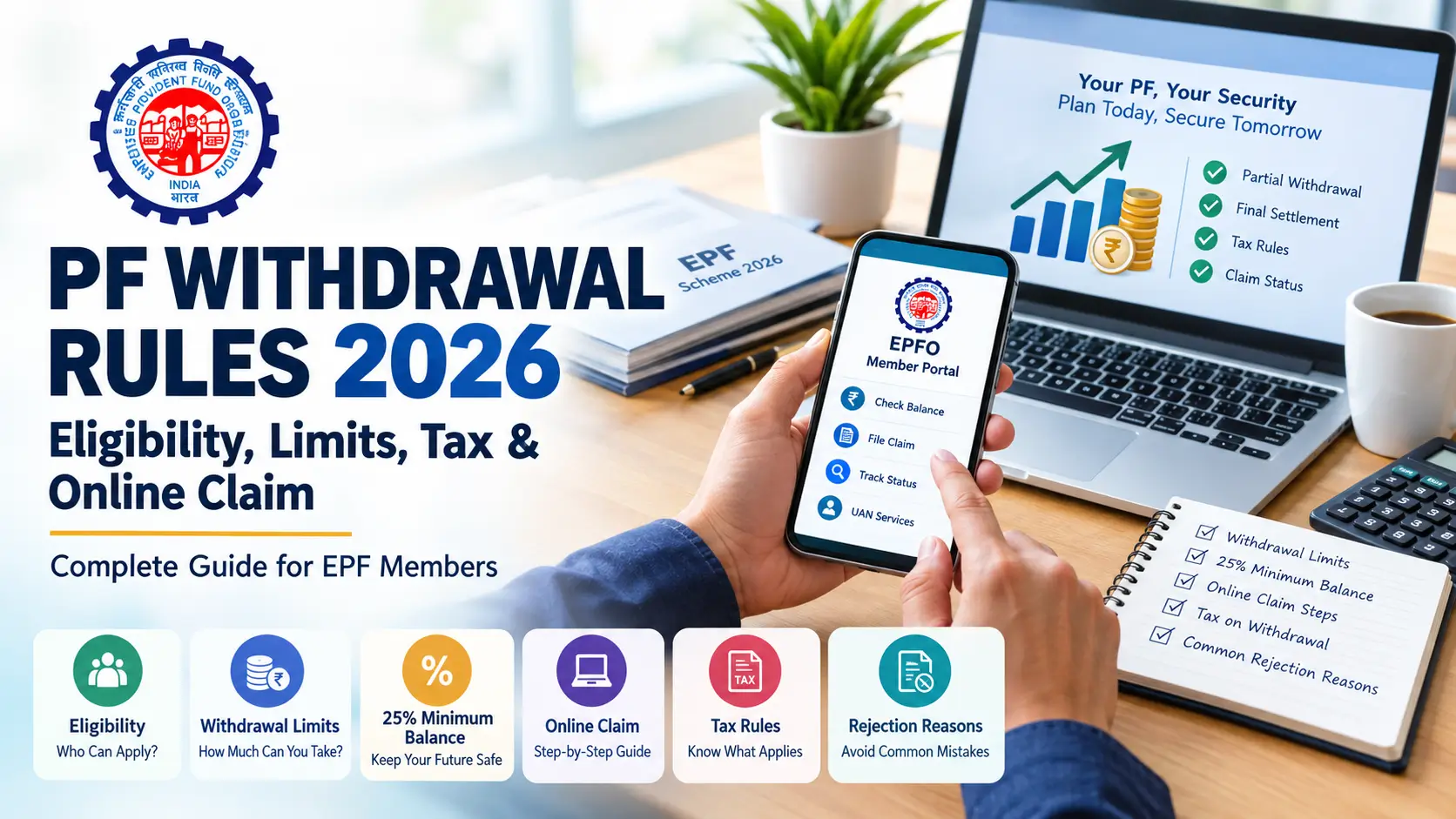
The Employees’ Provident Funds Scheme, 2026, notified through G.S.R. 525(E) dated 29 June 2026, introduced a revised framework for partial withdrawals. It groups withdrawal purposes into three broad categories, sets a 25% minimum balance requirement and generally requires 12 months of total membership for partial withdrawals.
However, partial withdrawal and final PF settlement are not the same. The amount you can claim depends on the reason for withdrawal, your membership history, the balance available and the conditions specified in the Scheme.
This guide explains the PF withdrawal rules for 2026, including the withdrawal limits, online claim process, tax treatment and common reasons for rejection.
PF Withdrawal Rules 2026: At a Glance
- Minimum membership: Generally 12 months of total EPF membership for partial withdrawals. Members who leave covered employment before completing 12 months may also qualify for a partial withdrawal under the Scheme.
- Minimum balance: 25% of the applicable aggregate contributions and interest must remain in the account after a partial withdrawal.
- Eligible withdrawal amount: Up to 100% of the Eligible Member Balance, after deducting the required minimum balance.
- Minimum partial claim: ₹1,000.
- Education withdrawals: Up to 10 times during membership.
- Marriage withdrawals: Up to 5 times during membership.
- Housing withdrawals: Up to 5 times during membership, subject to the applicable conditions.
- Special circumstances: Up to 2 withdrawals in a financial year, subject to eligibility.
- Online claim: Members can submit eligible claims through the EPFO Member Portal.
- UPI and ATM withdrawals: Treat these facilities as unavailable until EPFO confirms their operational launch through official channels.
What Changed Under the EPF Scheme, 2026?
The revised framework follows the withdrawal reforms approved by the Central Board of Trustees in October 2025. The new Scheme was subsequently notified in June 2026.
The main changes are:
| Feature | Revised position |
|---|---|
| Partial withdrawal categories | Three broad categories |
| Minimum membership | Generally 12 months |
| Minimum balance | 25% must remain after partial withdrawal |
| Education withdrawals | Up to 10 times |
| Marriage withdrawals | Up to 5 times |
| Housing withdrawals | Up to 5 times, subject to conditions |
| Special-circumstances withdrawals | Up to 2 times per financial year |
| Minimum partial withdrawal | ₹1,000 |
The three broad categories are essential needs, housing needs and special circumstances. Specific purposes, membership conditions and withdrawal frequencies still matter.
The official EPFO press brief on the 238th CBT meeting (https://www.epfindia.gov.in/site_docs/PDFs/EPFO_PRESS_RELEASES/PressBrief_MOL%26EChairs238thMeetingCBT_EPF_13102025.pdf) explains the reforms. For the binding provisions, refer to the Employees’ Provident Funds Scheme, 2026, published in the Gazette of India as G.S.R. 525(E).
How Much PF Can You Withdraw in 2026?
For a partial withdrawal, the amount you can claim is based on your Eligible Member Balance, not simply the total figure displayed in your passbook.
Under paragraph 46 of the 2026 Scheme, the Eligible Member Balance is the amount standing to your credit after deducting the minimum balance that must remain in the account.
Example: Understanding the 25% minimum balance
Suppose your account has ₹4,00,000 in applicable accumulated credits, including the relevant contributions and interest, before a partial withdrawal.
- Illustrative minimum balance: ₹1,00,000
- Illustrative Eligible Member Balance: ₹3,00,000
- Maximum potential partial withdrawal: ₹3,00,000, subject to the applicable conditions
The amount available for a real claim may differ depending on your account history and the Scheme’s calculation requirements. The example is intended to explain the basic calculation, not to replace the eligibility calculation made for your account.
Does the 25% minimum balance mean your money is lost?
No. The minimum balance remains in your EPF account. It is not a fee or penalty deducted by EPFO.
The requirement is designed to preserve part of your retirement savings. Interest is governed by the applicable EPF provisions and the rate declared by the government for the relevant period.
For the 2025–26 financial year, an interest rate of 8.25% was recommended by the Central Board of Trustees. Check EPFO announcements for the applicable rate and credit status for your account.
PF Partial Withdrawal Limits by Purpose
Paragraph 46 of the EPF Scheme, 2026, sets out the purposes, eligibility requirements and withdrawal frequencies.
1. Medical or illness expenses
A member may claim a partial withdrawal for the illness of the member or eligible family members.
- Membership requirement: 12 months of total EPF membership.
- Amount: Up to 100% of the Eligible Member Balance.
- Frequency: The provision does not specify a numerical maximum for this category.
The absence of a numerical frequency cap does not mean every application is automatically approved. The claim remains subject to the Scheme and EPFO’s processing checks.
2. Education expenses
Members may claim for education expenses relating to themselves or eligible family members.
- Membership requirement: 12 months.
- Amount: Up to 100% of the Eligible Member Balance.
- Frequency: Up to 10 times during membership.
3. Marriage expenses
The Scheme permits partial withdrawals for marriage involving the member or eligible family members.
- Membership requirement: 12 months.
- Amount: Up to 100% of the Eligible Member Balance.
- Frequency: Up to 5 times during membership.
4. Housing-related expenses
Eligible purposes include:
- Purchasing a house or flat.
- Acquiring a site for constructing a house.
- Constructing a house.
- Repaying an eligible home loan.
- Making additions, alterations, renovations or improvements to an existing house or flat.
The Scheme permits withdrawal up to 100% of the Eligible Member Balance after 12 months of total membership, subject to the applicable conditions. The frequency limit is five times during membership.
5. Special circumstances
The revised framework also permits partial withdrawal in special circumstances without requiring the member to specify a particular reason under this category.
- Membership requirement: 12 months.
- Amount: Up to 100% of the Eligible Member Balance.
- Frequency: Up to twice in a financial year.
This category may be relevant when you need money but your circumstances do not fit neatly into another purpose. Eligibility and claim validation still apply.
Do earlier withdrawals count towards the new limits?
Paragraph 46 provides that the permitted withdrawal frequencies are calculated afresh for each member from the commencement of the new Scheme. This means the new frequency counts are reset under the provision; it does not mean that every earlier withdrawal is refunded or that every claim is automatically eligible.
Can You Withdraw PF Before Completing 12 Months?
The answer depends on whether you are still employed and which withdrawal route applies.
For the partial-withdrawal provisions, 12 months of total membership is generally required. However, paragraph 46 also specifically addresses members who exit employment before completing 12 months of membership. Such members may qualify for a partial withdrawal, subject to the Eligible Member Balance limit.
This is different from final settlement of the entire PF balance. Leaving a job does not automatically make the full balance payable immediately.
If you have recently changed jobs, check whether transferring your PF account is more appropriate than withdrawing the money.
PF Partial Withdrawal vs Final Settlement
These are two different processes.
Partial withdrawal: You withdraw an eligible portion of the balance while retaining the minimum balance required by the Scheme.
Final settlement: You claim the full amount when the conditions for final withdrawal are met.
The 2026 Scheme provides specific circumstances in which the full PF balance may be withdrawn, including retirement after attaining age 55, permanent disability, permanent migration abroad, retrenchment and voluntary retirement, subject to the relevant provisions.
For other cases, the Scheme provides a waiting period linked to the member’s exit from covered employment. Check paragraph 49 of the notified Scheme for the applicable conditions before filing.
Do not assume that the 12-month rule for final settlement is interchangeable with the 12-month membership requirement for partial withdrawals.
EPS pension and withdrawal benefits are governed by separate provisions. The age of 58 is relevant to pension under the Employees’ Pension Scheme, while PF final settlement has its own rules. Before withdrawing pension benefits, check your eligible service and the applicable EPS provisions.
Documents and Details to Check Before Applying
A claim can be delayed when the member’s details do not match EPFO records. Before applying, check the following:
- Your Universal Account Number (UAN) is active.
- Aadhaar details are linked and verified where required.
- The mobile number needed for Aadhaar authentication is accessible.
- Your bank account number and IFSC are correct.
- Your PAN details are linked where applicable for tax purposes.
- Your date of exit has been recorded correctly if you have left your previous job.
- Your personal details match across EPFO and Aadhaar records.
- Your previous service and UAN records do not contain unresolved discrepancies.
EPFO’s current Member Portal states that UAN activation and new UAN generation through the portal have been discontinued and directs members to Aadhaar-based face authentication through the UMANG app.
Use the official EPFO Member Portal (unifiedportal-mem.epfindia.gov.in/memberinterface) and UMANG services (web.umang.gov.in) rather than unofficial links.
How to Withdraw PF Online: Step-by-Step Guide
You can submit an eligible claim online through the EPFO Member Portal.
Step 1: Open the EPFO Member Portal
Visit the official Unified Member Portal (unifiedportal-mem.epfindia.gov.in/memberinterface) and sign in using your UAN and password.
Step 2: Check your KYC details
Review your Aadhaar, bank account and other required details. Resolve any pending verification before proceeding.
Step 3: Open the online claim service
Go to Online Services and select the claim option. The portal may display different options depending on your account and eligibility.
Step 4: Verify your bank account
Enter or confirm the requested bank account details and proceed only when the information is correct.
Step 5: Select the appropriate claim
Choose the claim type available to you. Form 31 is commonly used for a partial withdrawal, while Form 19 has traditionally been used for final PF settlement. Pension-related benefits use separate forms and provisions.
The portal’s available options and forms may change with system updates, so follow the instructions shown for your specific claim.
Step 6: Enter the requested details
For a partial withdrawal, choose the relevant purpose, enter the amount and confirm the required information. The amount must comply with the applicable minimum and maximum limits.
Step 7: Complete authentication
Follow the portal’s instructions for OTP authentication or any other required verification. Upload supporting documents only if requested.
Step 8: Submit and track the claim
Save the claim reference number. Check the claim status through EPFO’s official services and respond if the portal requests corrections or further information.
You can also view your account details through the EPFO Passbook Portal (passbook.epfindia.gov.in) .
How Long Does PF Withdrawal Take?
The EPF framework provides a statutory settlement timeline of 20 days for covered claims. EPFO’s Citizens’ Charter also sets shorter service targets for certain claim types, but these are service standards rather than a guarantee that every claim will be settled within that period.
Eligible advance claims may be processed automatically. EPFO announced in June 2025 that the auto-settlement limit for advance claims had been increased to ₹5 lakh, with qualifying claims targeted for processing within three days.
Remember that ₹5 lakh is an auto-settlement processing limit, not a universal PF withdrawal limit. Your actual entitlement depends on the Scheme, the purpose of the claim and your available eligible balance.
If a claim remains pending beyond the applicable period, check the portal for an update or rejection reason. You can raise a grievance through the EPFO grievance portal.
Is PF Withdrawal Through UPI or ATM Available?
As of 29 October 2026, media reports indicate that EPFO is testing UPI-based withdrawal facilities and that an end-of-year launch has been anticipated. However, an anticipated launch date is not the same as an operational facility available to all members.
Until EPFO publishes an official rollout announcement and makes the service available, use the existing official online claim process.
Be cautious of messages or applications claiming to activate instant PF withdrawal. Never share your UAN password, Aadhaar OTP or bank credentials with an unofficial service.
More related Odisha schemes
Subhadra yojana
Odisha e-Challan 2026: Check Status, Traffic Fine List and Pending Challan Settlement
Post Office RD Rules 2026: Interest Rate, Maturity Chart & New Aadhaar Rule
KCC Loan Limit 2026: ₹3 Lakh vs ₹5 Lakh, Interest Rate & New RBI Rules
Category blog
PM Kisan 24th Installment Odisha: Date, ₹2,000 Payment Status and CM-KISAN Benefits
PF Withdrawal Tax Rules in 2026
Tax treatment depends on the type of payment, your period of continuous service, the amount withdrawn and the applicable tax provisions.
For a typical final PF settlement, the following general principles are useful:
- Five years or more of continuous service: Qualifying withdrawals are generally exempt from tax, subject to the applicable rules.
- Less than five years of continuous service: A taxable withdrawal may arise, and TDS may apply when the relevant threshold and conditions are met.
- Payment below ₹50,000: The usual TDS threshold for qualifying EPF payments may mean that no TDS is deducted, but this does not automatically make every payment tax-free.
- PAN and TDS: Where TDS applies, the rate and documentation depend on the applicable tax rules and the member’s circumstances.
Continuous service can include eligible previous service when the PF balance is transferred between employers. Do not assume that changing employers resets the five-year tax period if your service and PF balance have been properly carried forward.
What about Form 121?
From 1 April 2026, Form 121 replaced Forms 15G and 15H for eligible declarations under the Income-tax Act, 2025 framework. A valid declaration may prevent TDS on specified payments when the legal conditions are met.
Form 121 does not automatically exempt a taxable withdrawal from income tax. Eligibility depends on the declaration requirements and your tax position.
For the latest official guidance, consult the Income Tax Department’s Form 121 information (https://www.incometax.gov.in/iec/foportal/newformpage/forms/from121) and seek professional advice if your case involves multiple employers, transferred service or a taxable final settlement.
Why PF Claims Get Rejected
A rejection or return may result from incorrect details, incomplete KYC or choosing a claim type that does not match your eligibility.
Name or date-of-birth mismatch: Check your EPFO and Aadhaar records and use the authorised correction process.
Unverified bank account: Confirm the account number and IFSC, then complete any pending verification.
Missing date of exit: Check your service history and ask your previous employer to correct the record where necessary.
Incorrect claim type: Review the difference between partial withdrawal, final settlement and pension benefits before submitting a new claim.
Duplicate or overlapping UAN records: Contact EPFO for help resolving the service-history issue rather than submitting repeated claims.
Authentication failure: Make sure the registered mobile number is accessible and follow the official authentication instructions.
If the portal gives a specific rejection reason, address that reason before filing again. Repeatedly submitting the same incorrect application is unlikely to solve the underlying problem.
Should You Withdraw PF or Transfer It to a New Employer?
If you have changed jobs and are joining another EPF-covered establishment, transferring your PF balance may be worth considering.
Keeping your PF savings in the retirement system can help preserve your service history and avoid unnecessary withdrawals. A final settlement may have tax implications and may affect the continuity of records relevant to pension eligibility.
A partial withdrawal can make sense when you have an eligible expense and genuinely need access to your savings. But withdrawing simply because you have changed jobs may not be the most suitable choice.
Review your immediate financial needs, tax position and long-term retirement goals before deciding.
OPSC Scientific Officer Recruitment 2026: 89 Vacancies, Eligibility, Exam Date and Apply Online
PF Withdrawal Rules 2026: Frequently Asked Questions
Can I withdraw 100% of my PF in 2026?
For partial withdrawals, the Scheme allows up to 100% of the Eligible Member Balance, after deducting the required minimum balance. The full account balance is available only when the conditions for final settlement are met.
What is the 25% minimum balance rule?
It requires the prescribed minimum balance, calculated under the Scheme, to remain in your account after a partial withdrawal. It is not a fee or a permanent loss of money.
How many times can I withdraw PF for marriage?
The Scheme permits up to five marriage-related partial withdrawals during membership, subject to the eligibility requirements.
How many times can I withdraw PF for education?
Up to ten education-related partial withdrawals are permitted during membership, subject to the applicable conditions.
Can I withdraw PF if I have worked for less than 12 months?
A member who exits covered employment before completing 12 months may qualify for a partial withdrawal under paragraph 46. The amount remains subject to the Eligible Member Balance and other conditions. Full settlement is a separate matter.
Is the ₹5 lakh auto-settlement limit the maximum PF withdrawal?
No. It is the processing limit announced for eligible advance claims that qualify for automatic settlement. It does not override the withdrawal limits under the Scheme.
Is PF withdrawal through UPI available now?
Do not assume it is available until EPFO confirms the rollout through official channels. Continue to use the official claim portal in the meantime.
Is PF withdrawal tax-free after five years?
Qualifying withdrawals are generally exempt after five years of continuous service. The treatment can depend on the circumstances and applicable tax rules.
What should I do if my claim is pending for more than 20 days?
Check the status and any messages on the portal, verify whether additional information is required and raise a grievance through the official EPFO grievance portal if necessary.
Which website should I use to withdraw PF online?
Use the EPFO Unified Member Portal (unifiedportal-mem.epfindia.gov.in/memberinterface) for online claims and the EPFO Passbook Portal (passbook.epfindia.gov.in) to check your account details.
Official Sources
- (unifiedportal-mem.epfindia.gov.in/memberinterface) — member login and claim services.
- (https://www.epfindia.gov.in/site_docs/PDFs/EPFO_PRESS_RELEASES/PressBrief_MOL%26EChairs238thMeetingCBT_EPF_13102025.pdf) — background on the withdrawal reforms.
- (egazette.gov.in) — Employees’ Provident Funds Scheme, 2026, G.S.R. 525(E), dated 29 June 2026.
- (passbook.epfindia.gov.in) — member account details.
- (epfigms.gov.in) — complaints and claim-related issues.
- (https://www.incometax.gov.in) — tax provisions and Form 121 guidance.
Disclaimer: This article is for general information and is not an official EPFO publication. Withdrawal eligibility, tax treatment and processing times depend on the applicable rules and individual circumstances. Verify your claim details on official government websites before applying.