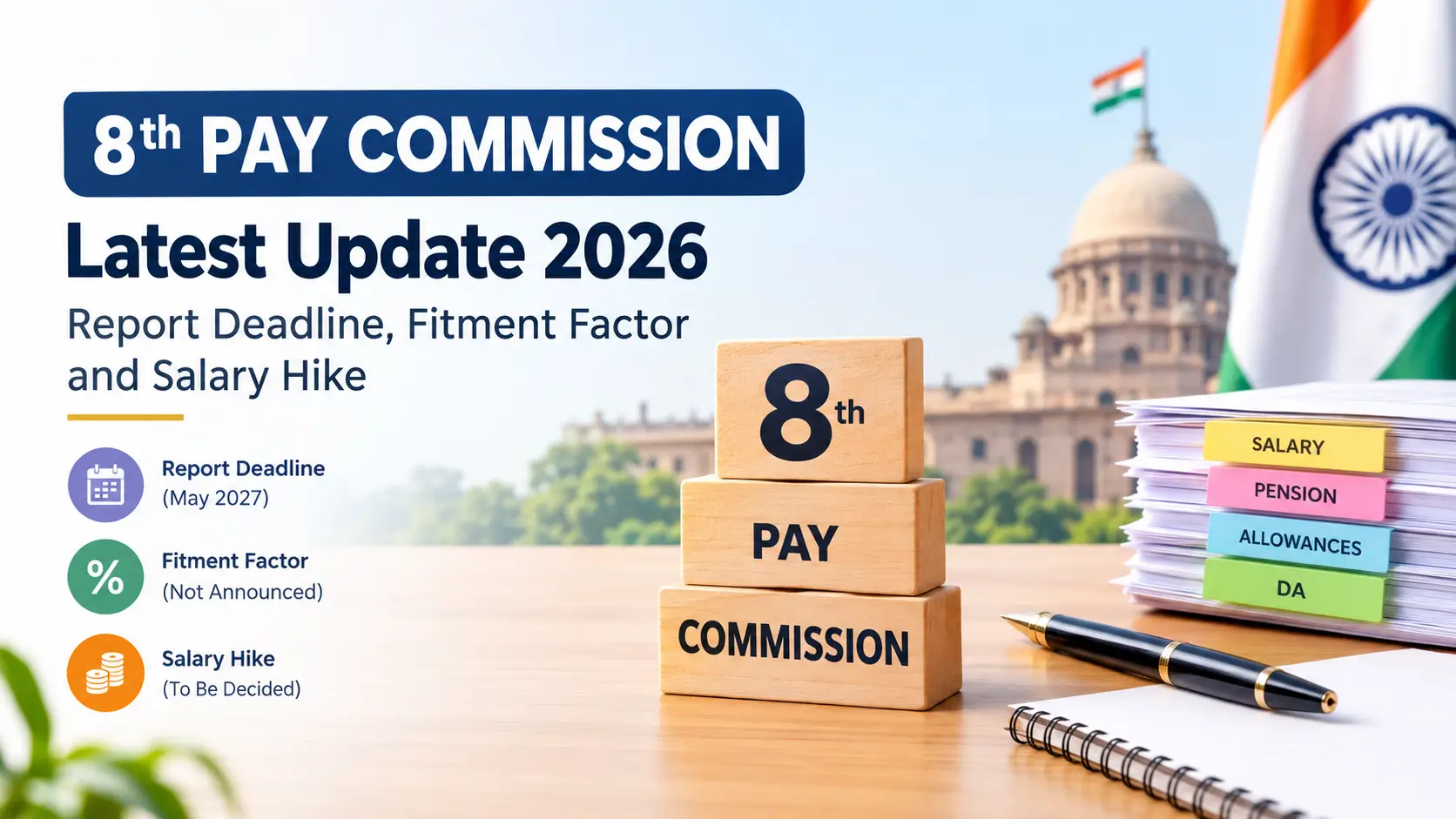
8th Pay Commission Latest Update 2026: Report Deadline, Fitment Factor and Salary Hike
Read in another language:
The 8th Central Pay Commission has completed several rounds of consultations with employee associations, unions and pensioner organisations. Its latest scheduled regional visit was to Mumbai on 22 and 23 October 2026. However, employees and pensioners are still waiting for the most important details: the proposed fitment factor, revised pay matrix, minimum basic pay and implementation date.
As of 28 October 2026, the government has not officially announced the 8th Pay Commission fitment factor or a revised salary structure. The Commission has 18 months from its constitution on 3 November 2025 to submit its recommendations, putting the expected deadline at approximately 3 May 2027.
This update explains the Commission’s progress, the demands made by employee organisations, illustrative salary calculations, the current DA position and what employees can realistically expect next.
8th Pay Commission Latest Update: Status at a Glance
| Key detail | Latest position |
|---|---|
| Commission constituted | 3 November 2025 |
| Chairperson | Justice Ranjana Prakash Desai |
| Part-time member | Prof. Pulak Ghosh |
| Member-Secretary | Pankaj Jain |
| Latest scheduled regional consultation | Mumbai, 22–23 October 2026 |
| Report submission deadline | Approximately 3 May 2027 |
| Official fitment factor | Not announced |
| Revised minimum basic pay | Not announced |
| New pay matrix | Not announced |
| Salary revision implementation date | Not confirmed |
| Arrears from January 2026 | Not confirmed |
| Interim report | No interim report identified in the official updates checked |
The Commission’s official website publishes its notices, consultation schedules and other announcements at 8cpc.gov.in.
The important distinction is that consultations are part of the recommendation process. They do not mean that a salary increase has already been approved.
Latest 8th Pay Commission News: What Happened in October 2026?
The Commission’s recent activity has focused on consultations with stakeholders.
Mumbai consultations on 22 and 23 October
The Commission announced its Mumbai visit through an official notice dated 21 September 2026. The notice invited eligible organisations, institutions, associations and unions to request appointments by 10 October, using the unique memo ID generated after submitting their memorandum.
The scheduled visit took place on 22 and 23 October. No official fitment factor or revised salary structure was announced through the consultation notice.
Official notice: 8th CPC Mumbai visit. (8cpc.gov.in/event/notice-regarding-8cpc-visit-to-mumbai-on-22nd-and-23rd-october-2026
Bengaluru consultations on 7 and 8 October
Before Mumbai, the Commission scheduled stakeholder consultations in Bengaluru on 7 and 8 October 2026.
These meetings form part of the wider consultation process through which the Commission gathers representations from employee bodies and other stakeholders.
What do these meetings mean for employees?
The meetings indicate that the Commission is collecting views and working through its consultation process. They do not establish when revised salaries will be paid.
Employees should wait for an official recommendation, followed by the government’s decision on the proposed changes.
When Will the 8th Pay Commission Submit Its Report?
The 8th Central Pay Commission was formally constituted on 3 November 2025. Its terms provide 18 months for submitting recommendations.
Based on that period, the expected deadline is around 3 May 2027.
This is the calculated deadline, not a guarantee that the report will be published on that exact date. The Commission may submit its recommendations earlier, and its terms also allow interim reports on specific matters where appropriate.
The report will need to address pay structures, allowances, pensions and other matters covered by its terms of reference. The government will then consider the recommendations before deciding what to implement.
For official documents, see the 8th Pay Commission website (8cpc.gov.in) and the PIB release on the Commission’s Terms of Reference. (https://www.pib.gov.in/PressReleasePage.aspx?PRID=2183289®=48&lang=2
8th Pay Commission Fitment Factor: Has It Been Announced?
No official fitment factor for the 8th Pay Commission has been announced as of 28 October 2026.
The fitment factor is a multiplier used in working out revised basic pay. The 7th Pay Commission used a fitment factor of 2.57, which is why many employees use it as a reference when discussing the next revision.
Employee organisations have submitted their own proposals. One widely discussed demand from the National Council–Joint Consultative Machinery (NC-JCM) staff side is a fitment factor of 3.833, alongside a proposed minimum basic pay of ₹69,000.
These are demands, not approved government figures. The Commission may consider them along with other representations, economic conditions and the government’s financial capacity.
Possible fitment factors and basic pay calculations
The following table shows what happens mathematically when an existing basic pay of ₹18,000 is multiplied by different factors.
| Illustrative fitment factor | Calculated basic pay |
|---|---|
| 1.90 | ₹34,200 |
| 2.28 | ₹41,040 |
| 2.57 | ₹46,260 |
| 2.80 | ₹50,400 |
| 3.833 | ₹68,994 |
Important: These figures are examples, not salary predictions. None of these multipliers has been confirmed for the 8th Pay Commission.
The actual revised pay could differ depending on the Commission’s recommendations and the government’s final decision.
8th Pay Commission Salary Hike: How Much Could Employees Get?
The amount of any future salary revision will depend on the approved pay structure, the applicable pay level and changes to allowances.
For example, a Level 1 employee currently drawing ₹18,000 in basic pay would have a calculated basic pay of ₹46,260 if a factor of 2.57 were applied directly.
That does not mean the employee’s total monthly salary would automatically become ₹46,260 plus the existing allowances.
Dearness Allowance, House Rent Allowance and other components may be recalculated or restructured when a new pay system is introduced. The final pay matrix may also determine how the revised figure is fixed.
For this reason, online salary calculators should be treated as illustrative tools until an official pay matrix is available.
Basic pay versus in-hand salary
These are different amounts:
- Basic pay: The fixed pay attached to an employee’s pay level, before applicable allowances and deductions.
- Gross salary: Basic pay plus applicable allowances and other salary components.
- In-hand salary: The amount received after applicable deductions.
A higher calculated basic pay does not automatically tell you the final increase in take-home salary.
When Will the 8th Pay Commission Salary Hike Be Implemented?
The implementation date has not been officially confirmed.
The government previously indicated that, following the usual ten-year revision pattern, the effect of the next Pay Commission would normally be expected from 1 January 2026. However, that expectation should not be treated as a confirmed payment date.
In a Lok Sabha reply dated 10 August 2026, the Ministry of Finance stated that the 8th Pay Commission had not yet submitted its recommendations.
The practical sequence is therefore:
- The Commission completes its consultations and prepares recommendations.
- It submits its report to the government.
- The government considers the recommendations and decides which proposals to accept.
- Official orders establish the applicable revised pay arrangements and dates.
- Departments implement the approved changes for eligible employees.
The report deadline of May 2027 is not the same as the date on which revised salaries will appear in bank accounts. Employees should avoid making financial commitments based on an assumed salary-hike date.
More Odisha related schemes
Subhadra yojana
Odisha Higher Secondary Exam Date 2027: CHSE Time Table & Latest Update
Odisha Employment Exchange Online Registration 2026: Complete Verified Guide (Register, Validate, Renew)
KCC Loan Limit 2026: ₹3 Lakh vs ₹5 Lakh, Interest Rate & New RBI Rules
Odisha Nirman Shramik Kalyan Yojana 2026: Eligibility, Benefits, Documents & Apply Online
Odisha Nirman Shramik Kalyan Yojana 2026: Eligibility, Benefits, Documents & Apply Online
Odisha Disability ID Card Apply Online 2026: Apply Online, Status, Documents & Benefits
Will Employees Receive 8th Pay Commission Arrears From January 2026?
There is no confirmed arrears arrangement for the 8th Pay Commission as of 28 October 2026.
Employees are asking whether the revised pay will be calculated retrospectively from 1 January 2026 if implementation occurs later. That question remains open until the government announces the applicable effective date and payment rules.
Even if a future decision provides for retrospective benefits, the amount payable would depend on the approved pay revision, the effective date, eligibility and applicable deductions.
Be cautious of social media posts that promise a fixed arrears amount or a guaranteed payment month without an official order.
Dearness Allowance Update: Is DA Connected to the 8th Pay Commission?
Dearness Allowance (DA) is separate from the 8th Pay Commission’s work. Under the existing arrangement, DA is revised periodically using the applicable formula linked to the 7th Pay Commission.
The Union Cabinet approved a 2 percentage-point increase in DA and Dearness Relief in April 2026, taking the rate from 58% to 60% of basic pay or pension, effective from 1 January 2026.
As of 28 October 2026, I could not verify an official government order announcing a further DA revision effective from 1 July 2026 in the official sources checked. Therefore, the last officially verified rate in this article is 60%.
Reports predicting a further increase, including estimates of 63%, should not be described as confirmed until an official announcement or order is available.
Check the latest notices from the Department of Expenditure (doe.gov.in) and Press Information Bureau (https://www.pib.gov.in) before relying on a new DA figure.
8th Pay Commission Update for Pensioners
The Commission’s work is relevant to central government pensioners as well as serving employees.
Important matters include pension revision, retirement benefits, gratuity and the treatment of employees covered by different pension arrangements, including the National Pension System (NPS) and Unified Pension Scheme (UPS), within the Commission’s terms of reference.
However, pensioner associations’ demands should not be confused with approved pension changes.
The final impact on pension amounts will depend on the Commission’s recommendations and the government’s decisions. Until official orders are issued, pensioners should continue to refer to their existing pension rules and applicable government instructions.
Will State Government Employees Get the Same Salary Increase?
Not automatically.
The 8th Central Pay Commission concerns central government pay and related matters within its mandate. State governments decide separately whether and how to adopt central pay recommendations.
Some states have adopted central pay revisions with modifications in the past. The timing, financial arrangements and eligibility provisions may vary by state.
Odisha, for example, would need to make its own decision before any revised central pay structure could be treated as applicable to its state employees.
State employees should monitor their respective finance departments and official government notifications rather than relying on a central pay-hike estimate.
What Is the 8th Pay Commission Expected to Review?
The Commission’s terms of reference cover several areas, not just basic salary.
Pay structure and allowances: The Commission will review the existing pay structure and allowances, including the scope for rationalisation.
Bonus and performance incentives: It will examine existing bonus arrangements and principles for linking incentives to performance and productivity.
Pension and retirement benefits: Pension-related matters, gratuity and the treatment of different pension arrangements fall within the scope of the exercise.
Government finances: Recommendations must take account of economic conditions, fiscal prudence and the resources required for development spending.
State finances: The Commission must consider the financial implications for state governments.
Public and private sector comparisons: Pay and working conditions in public sector undertakings and the private sector are also relevant to the terms of reference.
These areas help explain why the final recommendations cannot be reduced to a single fitment factor.
How to Check Official 8th Pay Commission News
Use primary government sources whenever possible.
- Visit 8cpc.gov.in for Commission notices, consultation schedules and official updates.
- Search Sansad (sansad.in) for parliamentary questions and replies about the Commission.
- Visit the Department of Expenditure (doe.gov.in) for relevant pay and DA orders.
Before trusting a headline, check whether it links to an official notification, whether the publication date is current and whether the figure is an approved decision or merely a proposal.
The Commission’s website should be your first reference for its own notices. Avoid unofficial pages that request fees or unnecessary personal information in exchange for supposed access to pay commission benefits.
Frequently Asked Questions
1. What is the latest 8th Pay Commission update for October 2026?
The Commission’s latest scheduled regional consultation was in Mumbai on 22 and 23 October 2026. As of 28 October, no official fitment factor, revised pay matrix or implementation date had been announced.
2. What is the expected 8th Pay Commission report date?
The Commission has 18 months from its constitution on 3 November 2025. This puts the expected submission deadline at approximately 3 May 2027.
3. Has the 8th Pay Commission fitment factor been finalised?
No. Figures such as 2.28, 2.57 and 3.833 are discussed in estimates or proposals, but none should be treated as the officially approved 8th CPC fitment factor.
4. What will be the new minimum basic pay?
The revised minimum basic pay has not been announced. The existing ₹18,000 Level 1 basic pay under the 7th Pay Commission is commonly used for illustrative calculations, not as a confirmed starting point for the next pay matrix.
5. Will the salary hike be effective from 1 January 2026?
The ten-year revision pattern has been discussed as a possible reference point, but the effective date has not been confirmed. The government will need to make the relevant decision.
6. Will arrears be paid from January 2026?
No official arrears arrangement has been confirmed. The effective date and any retrospective payments will depend on the government’s eventual decision.
7. What is the current DA rate for central government employees?
The last officially verified rate used in this update is 60%, effective from 1 January 2026. Check the Department of Expenditure and PIB for any subsequent order.
8. Will pensioners also benefit from the 8th Pay Commission?
Pension and retirement-benefit matters are within the Commission’s scope. The actual revision, eligibility and payment arrangements remain subject to recommendations and government approval.
9. Will Odisha government employees receive the same increase?
Not automatically. Odisha’s state government would need to make its own decision about adopting or modifying the central recommendations.
10. Where can I check the official 8th Pay Commission notification?
Visit 8cpc.gov.in. You can also check PIB (https://www.pib.gov.in) and Sansad (sansad.in) for related government announcements and parliamentary replies.
Final Takeaway
The 8th Pay Commission has progressed through consultations, including its October 2026 meetings in Bengaluru and Mumbai. The next major milestone is the preparation and submission of its recommendations, with the expected deadline around 3 May 2027.
For now, there is no officially confirmed fitment factor, revised minimum basic pay, implementation date or arrears arrangement. Employee-union demands and salary calculations can help readers understand the debate, but they are not substitutes for a government decision.
This article will need to be updated when the Commission or the government publishes a material new development.
Disclaimer: This is an independent informational article and is not affiliated with the Government of India or the 8th Central Pay Commission. Proposals, estimates and calculations are provided for explanation only. Always verify current information through official government sources before making financial decisions.