Orissa High Court District Judge Recruitment 2026: 38 Posts vs 46 LDCE
Read in another language:
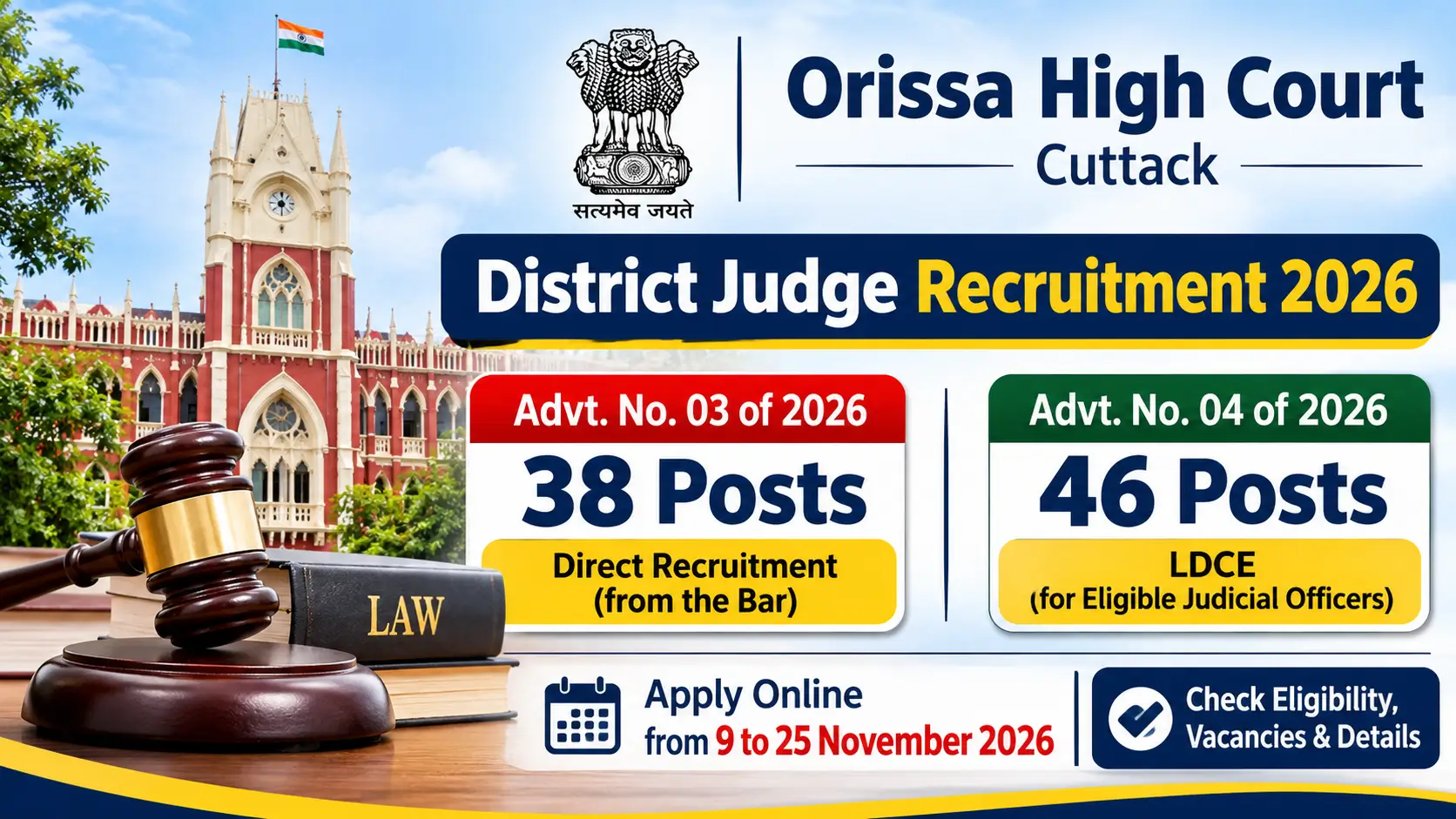
The High Court of Orissa, Cuttack, has issued two separate recruitment advertisements for the District Judge cadre in 2026. While both notices have the same application dates and pay scale, they are meant for different categories of candidates.
Advertisement No. 03 of 2026 is for 38 District Judge posts through direct recruitment from the Bar. Advertisement No. 04 of 2026 is for 46 District Judge posts through a Limited Departmental Competitive Examination (LDCE) for eligible serving judicial officers.
This distinction is important. Practising advocates and eligible candidates with the prescribed legal experience should check Advertisement No. 03. The 46-post LDCE is not open to the general public.
Online applications for both advertisements are scheduled to open on 9 November 2026 at 10:00 AM and close on 25 November 2026 at 11:59 PM.
This guide explains both recruitment notices separately, including eligibility, vacancies, age limits, selection process, salary, documents and application instructions.
Orissa High Court District Judge Recruitment 2026: Overview
| Particulars | Advt. No. 03 of 2026 | Advt. No. 04 of 2026 |
|---|---|---|
| Recruiting Authority | High Court of Orissa, Cuttack | High Court of Orissa, Cuttack |
| Post | District Judge | District Judge |
| Recruitment Type | Direct Recruitment | Limited Departmental Competitive Examination |
| Total Posts | 38 | 46 |
| Eligible Candidates | Advocates and specified judicial officer profiles | Eligible serving judicial officers |
| Pay Scale | ₹1,44,840–₹1,94,660 | ₹1,44,840–₹1,94,660 |
| Application Start | 9 November 2026, 10:00 AM | 9 November 2026, 10:00 AM |
| Last Date | 25 November 2026, 11:59 PM | 25 November 2026, 11:59 PM |
| Application Mode | Online | Online |
| Application Fee | ₹750, with specified exemptions | Refer to Advertisement No. 04 |
The High Court’s Recruitment Corner lists both District Judge advertisements dated 5 November 2026. The advertisements themselves carry the date 4 November 2026.
Important: The two advertisements represent different recruitment routes. Candidates should not treat the 46 LDCE posts as vacancies available to practising advocates.
Which District Judge Recruitment Notice Is Meant for You?
Before applying, identify the recruitment route that matches your professional background.
Advertisement No. 03 of 2026 — Direct Recruitment
This advertisement is for eligible advocates and candidates who meet the prescribed experience conditions involving advocacy and judicial service.
If you are a practising advocate or a former judicial officer who is now practising as an advocate, check Advertisement No. 03.
Advertisement No. 04 of 2026 — Departmental LDCE
This advertisement is intended for eligible serving judicial officers who meet the prescribed service conditions.
It is not an alternative application route for advocates who do not qualify under direct recruitment.
The High Court has also published a separate advertisement for Civil Judge (Senior Division) recruitment through LDCE. Candidates should carefully select the correct advertisement before proceeding.
Advertisement No. 03 of 2026: 38 District Judge Vacancies
The High Court of Orissa is filling 38 District Judge posts through direct recruitment from the Bar.
Category-Wise Vacancy Details
| Category | Posts | Women |
|---|---|---|
| Unreserved | 19 | 7 |
| SEBC | 4 | 1 |
| Scheduled Caste (SC) | 6 | 2 |
| Scheduled Tribe (ST) | 9 | 3 |
| Total | 38 | 13 |
Three posts are horizontally reserved for Persons with Benchmark Disabilities (PwBD), subject to the conditions stated in the advertisement.
The category-wise reservation, vacancy adjustments and eligibility provisions are governed by the official notification. The High Court also reserves the right to modify the number of vacancies or cancel the recruitment process.
Eligibility Criteria for Direct Recruitment
Candidates applying under Advertisement No. 03 of 2026 must possess a law degree from a recognised university and satisfy one of the experience conditions specified in the advertisement.
The eligible experience profiles include:
- An advocate with at least seven years of continuous practice.
- An advocate who previously served in the judicial service and has the required combined experience as an advocate and judicial officer.
- A judicial officer who completed the required seven years of continuous practice as an advocate before entering judicial service.
- A judicial officer with at least seven years of combined experience as an advocate and judicial officer.
The experience calculation must follow the advertisement’s prescribed rules. Practice is counted from the date of provisional enrolment with the State Bar Council.
Public Prosecutors may also apply if they meet the eligibility conditions. They must inform the head of their office in writing and obtain the required No Objection Certificate.
Candidates should verify their individual eligibility directly from the official PDF before submitting an application.
Odia Language Requirement
The Odia language requirement is an important part of direct recruitment.
Candidates must be able to speak, read and write Odia. They must also have passed an Odia examination equivalent to the Middle English School standard, as prescribed in the advertisement.
The examination includes translation and re-translation questions involving Odia and English. Candidates who meet the professional experience requirements but do not satisfy the language condition may not be eligible.
Age Limit
The prescribed age limit is 35 to 45 years, calculated as on the date of application, subject to applicable relaxations.
| Category | Upper Age Relaxation |
|---|---|
| All candidates for recruitment year 2026 | 1 year |
| SC, ST, SEBC (Non-Creamy Layer) and Women | 5 years |
| Persons with Benchmark Disabilities | 10 years |
| PwBD candidates belonging to SC, ST or SEBC (NCL) | Cumulative relaxation, as applicable |
Where a candidate qualifies for more than one relaxation, the applicable benefit must be determined according to the official advertisement.
Candidates whose date of birth is close to the prescribed limit should carefully check the age calculation before applying.
Who Is Not Eligible?
The advertisement specifies disqualification conditions. These include circumstances involving:
- A person who is not an Indian citizen.
- Dismissal from service by a High Court, Government or statutory authority.
- Conviction for an offence involving moral turpitude.
- Permanent debarment by a High Court, UPSC or State Public Service Commission.
- Attempts to influence the recruiting authority.
- Failure to satisfy the prescribed Odia language requirement.
- A married candidate having more than one living spouse, unless an applicable exemption has been granted.
The exact disqualification provisions in the official advertisement take precedence.
Application Fee for Advertisement No. 03
The application fee for direct recruitment is ₹750.
Payment can be made through the online payment methods specified in the application portal, including net banking, debit card, credit card or UPI.
The fee is non-refundable and cannot be adjusted against another application.
SC, ST and PwBD candidates may opt for the fee exemption provided in the advertisement.
Candidates should use the official High Court website for the application process and avoid payment links shared by unofficial websites or intermediaries.
District Judge Selection Process: Direct Recruitment
The direct recruitment process consists of a written examination followed by an interview.
Written Examination Pattern
| Paper | Subjects | Marks | Duration |
|---|---|---|---|
| Paper 1 | Civil Laws | 100 | 2 Hours |
| Paper 2 | Criminal Laws | 100 | 2 Hours |
| Paper 3 | General English | 100 | 2 Hours |
| Interview | Viva-Voce | 30 | — |
Paper 3 is qualifying in nature. Candidates must obtain the prescribed minimum qualifying marks in the English paper.
The final merit list is prepared using Paper 1, Paper 2 and the interview, subject to the qualifying conditions.
Paper 1: Civil Laws
Paper 1 carries 100 marks.
The examination includes:
- Code of Civil Procedure (CPC) — 30 marks
- Personal Laws — 30 marks
- Land, property, contract and related laws — 40 marks
The 40-mark section includes important legislation such as:
- Transfer of Property Act
- Specific Relief Act
- Limitation Act
- Law of Contract
- Odisha Consolidation of Holdings and Prevention of Fragmentation of Land Act
- Odisha Estate Abolition Act
- Odisha Land Reforms Act
- Motor accident claims law
- Arbitration and Conciliation Act, 1996
- Commercial Courts Act, 2015
Candidates should refer to the official syllabus for the complete list of prescribed legislation.
Paper 2: Criminal Laws
Paper 2 carries 100 marks.
| Subject | Marks |
|---|---|
| CrPC and BNSS | 30 |
| IPC and BNS | 30 |
| Evidence Act and BSA | 30 |
| Special Criminal Laws | 10 |
The special criminal laws section includes legislation relating to NDPS, food safety, prevention of corruption, essential commodities, environmental protection, water pollution, SC/ST atrocities, domestic violence, POCSO and juvenile justice.
Both the older criminal statutes and the newer codes appear in the syllabus. Candidates should prepare according to the specific provisions of the advertisement rather than assuming that one set of laws has completely replaced the other for examination purposes.
Paper 3: General English
Paper 3 is qualifying in nature and carries 100 marks.
| Component | Marks |
|---|---|
| Odia to English Translation | 10 |
| English to Odia Re-translation | 10 |
| Short Essay of Approximately 150 Words | 30 |
| Précis of a 300-Word Passage | 30 |
| Comprehension Passage and Questions | 20 |
| Total | 100 |
Candidates must obtain at least 45% in Paper 3, according to the details provided in the advertisement.
Interview and Final Merit
The interview carries 30 marks.
The prescribed qualifying conditions include:
- At least 45% in each of Paper 1 and Paper 2.
- At least 50% overall in the written examination.
- Relaxed qualifying conditions for eligible PwBD candidates, as specified in the advertisement.
- At least 40% in the interview.
Candidates are called for the interview according to the prescribed ratio and merit conditions.
The final merit calculation is based on Paper 1, Paper 2 and the interview, making a total of 230 marks. Paper 3 is qualifying and does not contribute to the final merit total.
Advertisement No. 04 of 2026: 46 District Judge LDCE Vacancies
Advertisement No. 04 of 2026 is for recruitment to the District Judge cadre through a Limited Departmental Competitive Examination.
This route is meant for serving judicial officers who meet the required service conditions.
Eligibility for the 46-Post LDCE
According to the information in the advertisement, eligible officers must have completed the following service requirements as on 1 April 2026:
- At least three years of qualifying service as Civil Judge (Senior Division).
- At least seven years of combined service as Civil Judge (Junior Division) and Civil Judge (Senior Division).
Senior Division service is counted from the date of the promotion notification. Junior Division service is counted from the date of joining the judicial service.
Candidates must confirm their service eligibility and application procedure from Advertisement No. 04 of 2026.
LDCE Examination and Assessment Pattern
The selection process includes written papers, viva-voce and assessment of the officer’s service record and judicial work.
| Assessment Component | Marks |
|---|---|
| Paper 1: Civil Laws | 75 |
| Paper 2: Criminal Laws | 75 |
| Viva-Voce | 30 |
| CCRs, PARs and ACRs of the Last Five Years | 20 |
| Disposal Rate of the Last Five Years | 10 |
| Quality of Judgments | 20 |
| Total | 230 |
The written examination carries 150 marks in total.
The prescribed qualifying conditions include at least 45% in each written paper, 50% in the aggregate and at least 40% in the viva-voce.
The judgment assessment includes five judgments. Candidates submit two judgments of their choice along with a list of ten contested judgments delivered as Civil Judge (Senior Division). The Court selects three additional judgments from the submitted list for evaluation.
Candidates must also apply under intimation to their controlling authority.
The LDCE route is different from direct recruitment. Advocates should not apply for these 46 posts unless they are serving judicial officers who meet the specified conditions.
How to Apply for Orissa High Court District Judge Recruitment 2026
The application process for both advertisements is online.
Applications are scheduled to open on 9 November 2026 at 10:00 AM and close on 25 November 2026 at 11:59 PM.
Steps to Apply Online
- Visit the official website of the High Court of Orissa.
- Open the Recruitment Corner.
- Select the Examination Portal.
- Choose the correct recruitment advertisement.
- Read the application instructions carefully.
- Fill in the online application form with the required details.
- Enter your name exactly as mentioned in your High School Certificate.
- Upload the required photograph, signature and supporting documents.
- Pay the application fee, if applicable.
- Review the form and submit it before the closing date.
- Save or print the submitted application and acknowledgement details.
Candidates should select the correct examination: Direct Recruitment to District Judge 2026 or District Judge LDCE 2026.
The application link may not be visible before the scheduled opening time. Candidates should check the official portal on 9 November rather than relying on third-party application buttons.
If more than one application is submitted, the latest application with the higher acknowledgement number is considered, according to the instructions in the advertisement.
Documents Required for Direct Recruitment
Candidates applying under Advertisement No. 03 should prepare the required documents in advance.
The documents may include:
- Aadhaar card
- High School or equivalent certificate showing name and date of birth
- Odia language qualification certificate
- Law degree certificate
- Legal practice certificate, where applicable
- Judicial service certificate, where applicable
- Recent colour photograph
- Full signature
- SC, ST or SEBC Non-Creamy Layer certificate, where applicable
- Disability certificate, where applicable
- Gazette notification for a change of name
- No Objection Certificate for applicable government employees
Certificate Requirements to Check Carefully
The practice certificate must follow the format and endorsement requirements in the official advertisement.
The prescribed certificate may need to be issued by the Principal Judicial Officer of a court or by an advocate meeting the required standing, with the necessary endorsement.
Judicial officers must obtain the experience certificate from the competent authority specified in the advertisement.
Candidates applying under SEBC Non-Creamy Layer should verify the validity period and certificate requirements. An OBC certificate should not automatically be treated as a substitute for the required SEBC certificate.
Women belonging to SC, ST or SEBC categories must follow the certificate rules specified for the relevant category.
Candidates who changed their name after school should check whether newspaper publication and Odisha Gazette notification are required.
Since some certificates require endorsements from judicial authorities, candidates should begin collecting them early.
What Happens After the Application?
After submitting the form, candidates should continue checking the official High Court website.
The recruitment process may include the following stages:
- Publication of eligible and ineligible candidate lists.
- Examination date announcement.
- Release of e-Admit Cards.
- Written examination.
- Document verification.
- Interview or viva-voce.
- Publication of the final merit list.
- Medical examination, training and probation, as applicable.
Admission at each stage is provisional. If a candidate is found ineligible during verification, the candidature may be rejected.
The Court does not necessarily send admission letters by post. Candidates should check the official website for examination notices and e-Admit Cards.
Candidates called for document verification or interview should carry the original documents and the required self-attested copies.
No travelling or daily allowance is paid for appearing in the recruitment process, according to the notice.
District Judge Salary in Odisha
The pay scale for both recruitment routes is:
₹1,44,840 to ₹1,94,660
The selected candidates are also entitled to dearness allowance and other admissible allowances according to the applicable rules.
The actual monthly in-hand salary may vary depending on allowances, deductions and applicable service rules.
The advertisement does not provide a guaranteed in-hand salary figure. Candidates should therefore avoid relying on exact take-home salary estimates published by unofficial websites.
Preparation Tips for District Judge Recruitment 2026
The examination covers a wide range of civil and criminal laws. A structured preparation plan can help candidates use their time effectively.
1. Confirm Your Eligibility First
Check your enrolment date, qualifying practice, judicial service experience, age and language qualification before starting the application process.
2. Divide Civil and Criminal Law Preparation
Prepare civil laws and criminal laws in separate study sessions. Maintain a clear list of the legislation included in the official syllabus.
3. Practise English Writing
Translation, précis writing, comprehension and essay writing are important parts of Paper 3.
Candidates should practise writing within the prescribed word limits and time restrictions.
4. Study Old and New Criminal Codes Together
Prepare IPC and BNS, CrPC and BNSS, and the Evidence Act and BSA according to the syllabus.
A comparison chart can help identify the corresponding provisions.
5. Give Attention to Odisha-Specific Laws
Odisha land laws and other state-specific legislation form part of the prescribed syllabus. Candidates should not focus only on central laws.
6. Practise Timed Answer Writing
Regular practice helps candidates improve accuracy, structure and time management.
Common Mistakes Candidates Should Avoid
Before submitting the application, check these points:
- Applying under Advertisement No. 03 when the candidate is eligible only for the departmental LDCE.
- Treating the 46 LDCE posts as open vacancies for advocates.
- Calculating practice experience from the LLB completion date instead of the prescribed enrolment date.
- Ignoring the Odia language qualification.
- Uploading an incorrect or expired category certificate.
- Entering a name that does not match the required educational certificate.
- Waiting until the last day to obtain endorsed experience certificates.
- Paying an intermediary to submit the application.
- Relying on unofficial websites instead of the original High Court advertisement.
Related Odisha Recruitment Updates
Candidates following judicial and government recruitment in Odisha may also find these guides useful:
- Subhadra Yojana
- Balangir District Court Group D Recruitment 2026
- Odisha Sarkari Naukri — Latest Government Jobs
- Odisha Police Recruitment Guide
- MMJJM 2.0 Odisha 2026
Please note that the Balangir District Court recruitment is a separate recruitment process and is not related to the Orissa High Court District Judge advertisements.
Official Links
Candidates should use the official website for the latest notices, application instructions and examination updates.
- High Court of Orissa — Official Website
- Recruitment Corner (https://www.orissahighcourt.nic.in/recruitment-corner/)
- Notification Section (https://www.orissahighcourt.nic.in/notification/)
- Orissa Superior Judicial Service and Orissa Judicial Service Rules, 2007 (https://www.orissahighcourt.nic.in/OSJS-OJS-Rules2007.pdf)
The original advertisements should be treated as the final authority for eligibility, reservation, experience, examination rules and other recruitment conditions.
Frequently Asked Questions
How many District Judge posts are announced by the Orissa High Court in 2026?
The two advertisements cover 84 posts in total: 38 through direct recruitment under Advertisement No. 03 and 46 through LDCE under Advertisement No. 04.
These are separate recruitment routes with different eligibility conditions.
Can a practising advocate apply for the 46 LDCE posts?
No. Advertisement No. 04 is intended for eligible serving judicial officers who meet the prescribed Civil Judge service requirements.
Who can apply for the 38 District Judge direct recruitment posts?
Eligible law graduates who meet the required experience conditions, age limit and Odia language qualification may apply under Advertisement No. 03.
What is the last date to apply for Orissa High Court District Judge Recruitment 2026?
The scheduled last date is 25 November 2026 at 11:59 PM. Applications are scheduled to open on 9 November 2026 at 10:00 AM.
What is the age limit for direct recruitment?
The prescribed age range is 35 to 45 years, subject to the applicable relaxations and the age calculation rules in the official advertisement.
Is Odia compulsory for direct recruitment?
Yes. Candidates must satisfy the prescribed Odia language requirement, including the ability to speak, read and write Odia and the required examination qualification.
What is the application fee for Advertisement No. 03?
The application fee is ₹750. SC, ST and PwBD candidates may opt for the exemption provided in the advertisement.
How many papers are included in the direct recruitment examination?
The direct recruitment examination includes three written papers: Civil Laws, Criminal Laws and General English. The English paper is qualifying in nature.
What is the selection process for the 46-post LDCE?
The LDCE includes two written papers, viva-voce and assessment of service records, disposal rate and judgment quality.
What is the salary of a District Judge in Odisha?
The pay scale is ₹1,44,840–₹1,94,660, along with dearness allowance and other admissible allowances.
Where can candidates apply?
Candidates should visit the official High Court of Orissa website and select the relevant recruitment through Recruitment Corner and the Examination Portal.
Disclaimer: Subhadra-Yojanain.com is an independent information website and is not affiliated with the High Court of Orissa or the Government of Odisha. The information in this article is based on the recruitment details available as of 6 November 2026. Candidates should read the original official advertisements carefully and verify all eligibility conditions before applying.